 Rated 5 star on


Dynamic Pricing Optimization: Prices That Respond to Demand
Quick answer
Dynamic pricing changes prices automatically in response to demand, stock, time and market signals, within limits you set. Start with clear rules and add demand models once there is enough data. Every system needs floors, ceilings, speed limits and a stop switch. Florida's price-gouging law limits increases on essential goods during declared emergencies.
Most businesses set prices once and revisit them a few times a year. Meanwhile, demand changes by the hour: a heat wave, a big game, a competitor out of stock. Dynamic pricing lets prices respond automatically, within limits you set. Done well, it lifts margin and moves stock. Done carelessly, it can anger customers and break the law.
Key Takeaways
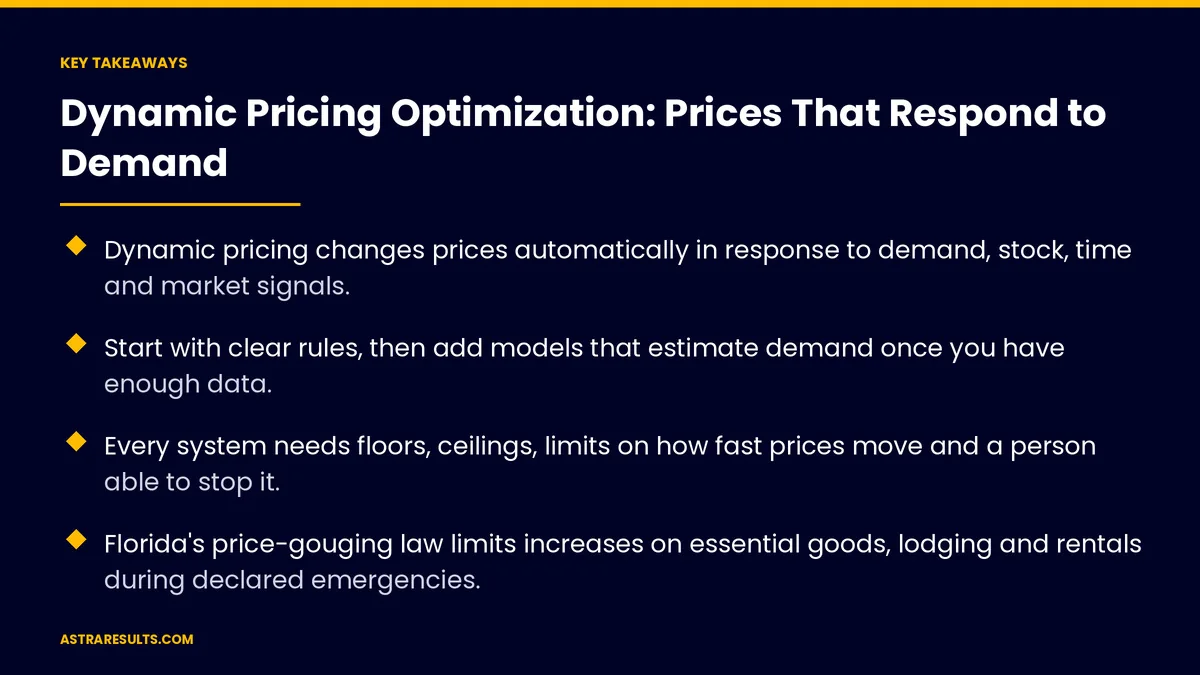
- Dynamic pricing changes prices automatically in response to demand, stock, time and market signals.
- Start with clear rules, then add models that estimate demand once you have enough data.
- Every system needs floors, ceilings, limits on how fast prices move and a person able to stop it.
- Florida's price-gouging law limits increases on essential goods, lodging and rentals during declared emergencies.
- Set prices from your own data and public prices; shared tools that pool competitors' private data draw antitrust action.
- Test on one category with a comparison group, and judge it on profit, not just revenue.
Published: October 6, 2026 | Reading Time: ~11 minutes | Category: Dynamic Pricing Optimization
This guide explains how dynamic pricing works, which signals and methods to use, the guardrails every system needs, the legal limits on emergency pricing and shared pricing tools, and how to test before you roll it out. Put plainly: let prices follow demand, inside rules you write, using only your own data.
This is general information, not legal advice. Pricing is regulated by price-gouging, antitrust, consumer protection and disclosure laws that vary by state. Confirm your system and rules with counsel before launch.
In This Playbook
- What dynamic pricing is
- Where does dynamic pricing fit best?
- The signals it uses
- Rules first, models later
- Guardrails every system needs
- Florida's price-gouging law
- Antitrust: use only your own data
- Pricing customers accept
- Test before you roll out
- Pricing numbers to watch
- The first three months
What dynamic pricing is
Prices that change with conditions. Up when demand is strong or stock is low, down when demand is weak or stock needs to move.
Automatic, within limits. Software adjusts prices on a schedule or in response to signals, inside rules you set.
Different from personalized pricing. Dynamic pricing changes the price for everyone based on market conditions. Charging different people different prices based on their personal data is a separate practice with extra legal risk, and some states now require disclosure when it's used.
Related to revenue and yield management. Those focus on capacity that expires, like rooms and slots, as covered in revenue management and yield management. Dynamic pricing also covers products, fees and services.
Where does dynamic pricing fit best?
E-commerce and retail. Prices that respond to stock levels, sales speed, season and public competitor prices.
Events and entertainment. Ticket prices that move with demand before the date.
Service fees. Delivery fees, rush fees and after-hours fees that reflect busy periods.
Restaurants and venues. Off-peak offers that move demand to quieter times.
Where to be careful. Rentals, essential goods and anything people need urgently, especially during emergencies.
The signals it uses
Sales speed. How quickly a product or service is selling compared with normal.
Stock and capacity. How much is left, and how long until it expires or needs to move.
Time. Day of week, season, hours to an event, days until a product goes out of season.
Public competitor prices. What others publicly charge, collected responsibly.
Costs. Your own costs, so prices never drop below what makes sense.
Clean data first. Signals are only useful if sales, stock and price data are accurate and current, as explained in data pipelines explained.
Rules first, models later
Start with rules. For example: if stock falls below 20 units and sales are above normal, raise the price 5%, never above the ceiling.
Rules are easy to explain. Your team, and regulators if they ask, can see exactly why a price changed.
Add models when you have data. Machine learning can estimate how demand changes with price for each product, as explained in machine learning for operators.
Optimize for profit. Revenue can rise while margin falls. Set the goal as profit, within your limits.
Keep a person involved. Large changes and new rules should be approved before they go live.
Guardrails every system needs
Floors and ceilings. A lowest and highest price for every product or service.
Speed limits. A maximum change per day or per week, so prices don't swing wildly.
Protected items. Staples and essentials whose prices stay stable.
Supplier rules. Minimum advertised prices or other agreements you've signed.
An emergency freeze. A switch that holds or caps prices for covered goods and services when a state of emergency is declared.
A stop switch. A named person can pause all automatic pricing at once, with every change logged, following the controls in agent security.
Florida's price-gouging law
When it applies. During a declared state of emergency, in the areas covered by the declaration.
What it covers. Essential commodities, dwelling units, public lodging and self-storage.
What it bans. Prices that grossly exceed the average price during the 30 days before the declaration, unless higher costs or market trends justify them (Fla. Stat. § 501.160).
The penalties. Up to $1,000 per violation, and up to $25,000 for violations within 24 hours.
What it means for automatic pricing. A hurricane can trigger exactly the demand spike a dynamic pricing system is built to chase. Freeze or cap covered prices automatically when an emergency is declared.
Antitrust: use only your own data
The concern. Competitors who feed private pricing data into the same tool can end up coordinating prices without ever speaking.
Federal action. In November 2025, the Department of Justice settled its case against RealPage, a rent-pricing software company, with limits on using competitors' nonpublic data to recommend prices.
State laws. Since January 2026, California makes it unlawful to use a common pricing algorithm as part of an agreement to restrain trade. New York bans rent-setting software that draws on multiple landlords' data.
The safe practice. Set prices from your own sales, costs and stock, plus publicly available competitor prices. Avoid tools that pool competitors' private data, and check any vendor's data sources.
Pricing customers accept
Explain the logic. Peak-time and off-peak pricing is widely accepted when it's clear.
Show the full price. Hotels, short-term rentals and live-event tickets must show total prices, including mandatory fees, upfront.
Avoid surprises mid-purchase. Hold the price once a customer is checking out.
Treat people fairly. Never use protected traits, or stand-ins for them, to set prices.
Watch complaints. Rising complaints or reviews about pricing are a signal to slow down.
Test before you roll out
Pick one category. Somewhere with enough sales to learn from and limited risk.
Keep a comparison group. Similar products or locations with fixed prices, so you can see the real effect, the same holdout idea used in AI outbound scoring.
Run long enough. Several weeks, covering normal and busy periods.
Judge on profit. Gross margin, sell-through and customer reaction, not revenue alone.
Then expand carefully. Add categories one at a time with the same guardrails. Platform details for online stores are in Shopify or custom.
Pricing numbers to watch
Gross margin. In dollars, compared with the fixed-price comparison group.
Sell-through and waste. Stock sold before it expires or goes out of season.
Conversion rate. Whether price changes are scaring customers away.
Price changes. How often prices move and how far.
Guardrail hits. How often floors, ceilings and speed limits stop a change.
Complaints. Customer complaints and reviews mentioning price.
The first three months
Days 1–30: data and rules
Clean sales, stock, cost and price data. Choose one category to test. Set floors, ceilings, speed limits and protected items. Build the emergency freeze and stop switch. Review the rules and data sources with counsel.
Days 31–60: run the test
Turn on rule-based pricing for the test category, with a fixed-price comparison group. Review price changes weekly and approve any new rules. Watch conversion and complaints closely.
Days 61–90: measure and decide
Compare gross margin, sell-through and conversion with the comparison group. Refine the rules, consider a demand model if data allows, and expand to the next category only if results hold.
How Astra builds dynamic pricing
Astra Results Marketing builds dynamic pricing that follows demand inside rules you control. We start with clear, explainable rules using your own sales, stock and cost data and public market prices, then add demand models when the data supports them.
Every system has floors, ceilings, speed limits, protected items, an emergency freeze and a stop switch, reviewed with your counsel. We test against a comparison group and judge results on profit. Engagements begin with a pricing data review through our dynamic pricing optimization team.
Related reading
Frequently asked questions
What is dynamic pricing?
Changing prices automatically in response to demand, stock, time and public market signals, within limits you set. Prices change for everyone based on conditions, which is different from personalized pricing based on an individual's data.
Is dynamic pricing legal?
Generally yes, within the law. Price-gouging laws limit increases on essential goods and lodging during declared emergencies, antitrust laws restrict shared tools that pool competitors' private data, and some states require disclosures for certain pricing practices. Confirm your setup with counsel.
What does Florida's price-gouging law cover?
During a declared state of emergency, it bans prices for essential commodities, dwelling units, public lodging and self-storage that grossly exceed the average of the 30 days before the declaration, unless justified by higher costs or market trends. Penalties reach $1,000 per violation.
Can we use competitors' prices to set ours?
Publicly available competitor prices are commonly used. Avoid tools that pool competitors' nonpublic data, which have drawn federal antitrust action and new state laws in California and New York.
What guardrails does a dynamic pricing system need?
Price floors and ceilings, limits on how fast prices change, protected items, supplier rules, an emergency freeze for covered goods and a stop switch, with every change logged.
How do we know dynamic pricing is working?
Test it on one category against a fixed-price comparison group, and compare gross margin, sell-through, conversion and complaints over several weeks before expanding.
Ready for prices that follow demand without the risk? Astra Results Marketing builds dynamic pricing on your own data with clear rules, floors, ceilings, speed limits, an emergency freeze and a stop switch, tested against a comparison group and reviewed with your counsel. ▸ CALL (786) 321-2866 · ▸ REQUEST YOUR CONSULTATION





