Rated 5 star on

Wholesaler Engagement: Account Questions Answered
Quick answer
A wholesaler answers account questions by connecting its engagement layer to the ERP it already runs. Order status, contract pricing, stock and invoices become fast lookups. The system confirms which account is asking before it shares any price. Credit decisions and disputes are handed to a person. Reps get their selling hours back.
A wholesaler's sales rep spends most of the day not selling. The phone rings with "where is my order," "what is my price" and "do you have it in stock." Each call takes four minutes, comes from a good account and cannot be ignored. By 3 pm the rep has answered forty and opened no new business.
Key Takeaways
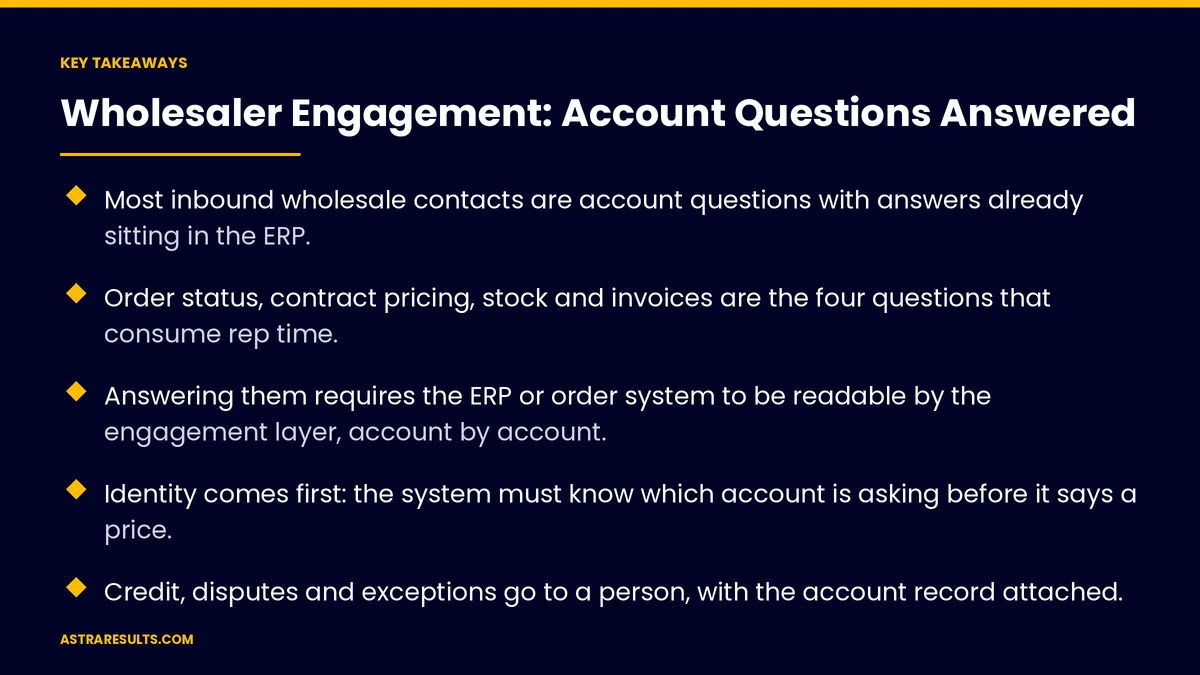
- Most inbound wholesale contacts are account questions with answers already sitting in the ERP.
- Order status, contract pricing, stock and invoices are the four questions that consume rep time.
- Answering them requires the ERP or order system to be readable by the engagement layer, account by account.
- Identity comes first: the system must know which account is asking before it says a price.
- Credit, disputes and exceptions go to a person, with the account record attached.
- Measure by rep hours returned to selling and by orders placed after a question was answered.
Published: October 29, 2026 | Reading Time: ~12 minutes | Category: Customer Engagement
This is the engagement problem in wholesale and distribution, and it looks nothing like retail. The customers are known accounts with contracts, credit terms and order histories. The questions are repetitive, answerable from systems the business already runs, and almost never the reason a rep was hired. This piece covers how to answer them in seconds.
Put plainly: account questions should be answered by the account's own data, not by a rep's afternoon.
Guidance for owners and operators of wholesale, distribution and B2B supply businesses. Nothing here is legal advice. Contract pricing disclosure, credit decisions and recorded communication are governed by the agreements and rules that apply to each business and should be confirmed with counsel.
In This Playbook
- What wholesale engagement is not
- The four questions that eat the day
- Identity first, then answers
- Connecting the engagement layer to the ERP
- Channels wholesale customers use
- What goes to a person
- The numbers that move
- The first three months
What wholesale engagement is not
Not retail chat. A retail assistant answers a stranger about a product. A wholesale assistant answers a known account about that account's own orders, prices and balance. Every answer is specific to who is asking, which changes the structure entirely.
Not a help desk. The questions are not about how to use something. They are about the state of a business relationship: what shipped, what it cost, what is owed, what is available. The answers live in the order system, not in a knowledge base.
Not a replacement for reps. Reps exist to grow accounts, introduce lines and win back the ones that went quiet. The goal is to remove the forty calls that stop them doing it, which is the same principle applied across the stack in the engagement stack explained.
The four questions that eat the day
Where is my order. The most frequent contact in almost every distributor. The answer is in the order management system with a status and often a carrier tracking number. The rep looks it up and reads it out.
What is my price. Contract pricing means the same SKU costs different accounts different amounts. Reps keep price lists in their heads and in spreadsheets. Getting it wrong costs margin or trust.
Do you have it. Stock questions, often urgent, often at 7 am before a job starts or a kitchen opens. The answer changes hourly and lives in inventory.
Send me the invoice. Or the statement, or the proof of delivery, or the credit memo. Documents that already exist and need to be found and forwarded.
The common factor. Every one of these is a lookup against data the business already holds, filtered by account. None requires judgment. All of them are currently done by the most expensive people in the building.
Identity first, then answers
The rule that governs everything. The system must know which account is asking before it answers anything. A price given to the wrong account is a contract breach. An order status given to a competitor is a leak. Identity is not a feature. It is the precondition.
How identity is established. A known phone number or email matched to an account contact. A customer number confirmed. A login on the ordering portal. For anything sensitive, a second factor before pricing or balance is disclosed.
Who at the account. A buyer, a receiving clerk and an accounts payable contact at the same customer need different answers and different permissions. The account record has to hold contacts and roles, not just a company name, which is the identity-resolution work described in the foundation every AI project needs.
The fallback. When identity cannot be confirmed, the system answers only what is public and routes the rest to a person. It never guesses.
Connecting the engagement layer to the ERP
What has to be readable. Orders and their statuses. Contract or tier pricing by account. Inventory by location, refreshed often enough to be trusted. Invoices, statements and delivery documents. Credit status and holds.
Read before write. The first phase is read-only. The assistant looks things up and reports them. Placing orders, changing addresses or releasing holds come later, if at all. Each write requires its own rule and its own audit trail.
The integration reality. Most distribution ERPs are older than the people using them. Many expose data through nightly exports rather than live connections. That is workable for pricing and documents. It is not workable for stock, where a stale answer is worse than no answer.
Refresh frequency has to be set per data type, and the assistant has to say how current its answer is.
Automation kinship. The same connections that let the engagement layer answer questions are the ones that automate the back office. That is why distributors who have already done accounts payable automation get here faster.
Channels wholesale customers use
Phone, still. Contractors call from trucks. Kitchen managers call between deliveries. Voice remains the largest channel for most distributors and the one that most needs to be answered at 6:45 am.
Text and WhatsApp. Increasingly the default for reorders and "do you have it" questions, especially where the account's staff work in Spanish. In South Florida this is not a niche. It is a large share of the base. The point made in what changes when Spanish is a channel applies with full force to wholesale.
Email. Where documents move: purchase orders in, invoices and statements out. An engagement layer that reads inbound email and matches it to an account removes a surprising amount of manual forwarding.
The ordering portal. Where one exists, it should hold the same answers the assistant gives, so a customer who prefers self-service is never told something different.
One record across all of them. An account that texts at 7 am and calls at 9 am is one conversation. The channel comparison in voice, chat, SMS and WhatsApp covers what each one tolerates. The record layer is what makes them one.
What goes to a person
Credit. Holds, limit increases, payment arrangements. The system can state the status. Only a person decides what changes.
Disputes. Short shipments, damaged goods, pricing disagreements. The assistant collects the facts, attaches the order and the documents, and hands the case to someone with authority.
Anything the customer asks to escalate. A buyer who says "let me talk to Maria" reaches Maria, with the conversation attached, without repeating the account number.
The handoff standard. The person picks up with the account record, the order in question and the conversation so far already on screen. The distinction between answering and deflecting, drawn in customers answered, not deflected, is the standard the handoff is held to.
The numbers that move
Rep hours. Count the account-question calls per rep per day before the work starts. Forty calls at four minutes is more than two and a half hours. Returning most of it is the first and largest number.
Answered after hours. Stock and order-status questions at 6 am and 8 pm, currently voicemail, answered on the spot. For a distributor whose customers start early, this alone changes the relationship.
Orders after answers. The stock question that becomes an order. The price question that becomes a reorder. Measured as orders placed within a set window of an answered question, by channel.
Fewer errors. Prices quoted from the contract table rather than memory. Invoices sent to the accounts payable contact rather than the buyer. Small, cumulative and worth tracking.
Retention. Accounts that get answered stay. The quiet churn of a good account moving to a competitor who picks up the phone is rarely measured and always expensive. Reps freed from lookups have time for the outbound work in pipeline without a sales floor.
The first three months
Days 1–30: count and map
Inbound contacts logged for thirty days by type, channel, hour and account. Account-question share established. ERP data mapped to the four questions: where each answer lives, how fresh it is. Who is allowed to see it. Identity rules written with counsel where pricing and balances are involved.
Days 31–60: read-only answers live
Order status and documents answered first on the two largest channels, since neither involves disclosing price or credit. Identity confirmation in place. Contract pricing added once identity is proven reliable. Handoff rules tested with real reps.
Days 61–90: stock, Spanish, measurement
Inventory answers live where refresh frequency supports them, with currency stated. Spanish-language handling live where the account base requires it. Rep hours, after-hours answers and orders-after-answers compared to the Day 1 baseline.
How Astra handles it
Astra Results Marketing begins with the contact log, because most distributors estimate their account-question volume at half its real size. The ERP is mapped question by question, and identity rules are settled before any price or balance is disclosed.
The engagement layer is built read-only first, on the channels the accounts already use, in the languages they use, with handoff to a named person for credit, disputes and anything the customer wants escalated. Reporting runs on rep hours returned, after-hours contacts answered and orders placed after an answer, against a baseline taken before the work.
Engagements begin with a thirty-day contact log through our AI customer engagement team.
Related reading
Frequently asked questions
What counts as an account question?
Any inbound contact whose answer already exists in the order, pricing, inventory or billing system for that specific account: order status, contract price, stock availability, invoices, statements and delivery documents. They are lookups, not decisions.
Why does identity come before answers?
Because every answer is account-specific. Contract pricing disclosed to the wrong account breaches the contract. An order status disclosed to a competitor is a leak. The system must confirm who is asking, and their role at the account, before it says anything specific.
Does this require a new ERP?
No. It requires the existing ERP to be readable by the engagement layer, question by question, at a refresh rate suited to each data type. Documents and pricing tolerate nightly refresh. Stock does not, and the assistant should state how current its answer is.
Should the assistant place orders?
Not at first. The first phase is read-only. Order placement, address changes and hold releases are writes, each needing its own rule, permission model and audit trail. Each added only after read-only answers have proven reliable.
What goes to a person?
Credit decisions, disputes over short shipments or pricing, and any customer who asks to speak to someone. The person receives the account, the order and the conversation before picking up, so the customer never repeats the account number.
How is the return measured?
Rep hours returned from account-question calls, after-hours contacts answered instead of reaching voicemail, and orders placed within a set window after an answered question. All three against a baseline logged before the work starts.
Ready to give your reps their afternoons back? Astra Results Marketing logs your inbound contacts, maps the four account questions to your ERP, settles identity rules first, and measures the result in rep hours returned and orders placed after an answer. ▸ CALL (786) 321-2866 · ▸ REQUEST YOUR CONSULTATION