 Rated 5 star on

Restaurant Forecasting: Covers, Staff, Inventory
Quick answer
Restaurants should forecast covers by day and daypart first, then plan staff and food from that number. Sales history, reservations, weather, events and holidays drive demand. Build schedules within labor targets and overtime rules. Turn the forecast into prep lists and orders. Let managers adjust it, record why and check accuracy weekly.
Every restaurant decision starts with one guess: how busy will we be? Guess high, and labor and food go to waste. Guess low, and guests wait and dishes run out. Forecasting covers by day and daypart, using sales history, reservations, weather and local events, turns that guess into a number managers can plan around.
Key Takeaways
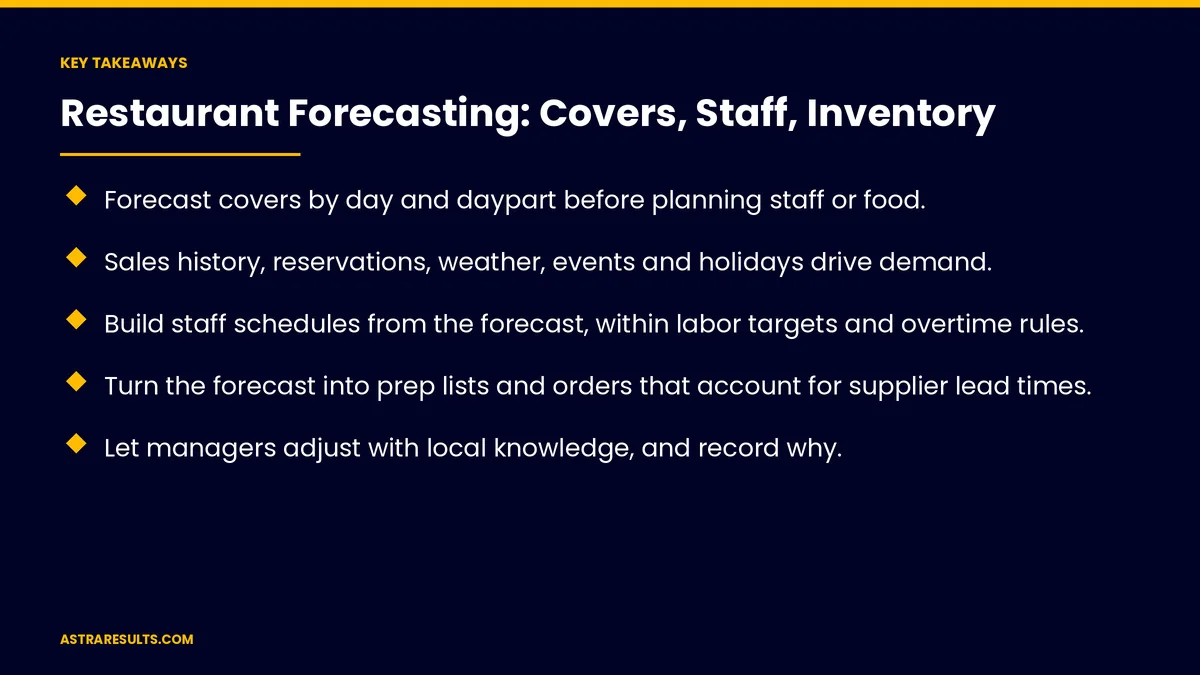
- Forecast covers by day and daypart before planning staff or food.
- Sales history, reservations, weather, events and holidays drive demand.
- Build staff schedules from the forecast, within labor targets and overtime rules.
- Turn the forecast into prep lists and orders that account for supplier lead times.
- Let managers adjust with local knowledge, and record why.
- Check accuracy weekly against last year and adjust.
Published: October 25, 2026 | Reading Time: ~8 minutes | Category: Machine Learning & Analytics
This guide covers restaurant forecasting: forecasting covers, what drives demand, staffing from the forecast, prep and ordering, reducing waste, manager input, checking accuracy, starting with built-in tools, multiple locations and what to measure. Put plainly: forecast covers first, then build staff schedules and prep lists from that number.
For forecasting across a whole restaurant group, see restaurant group AI.
In This Playbook
- Forecasting covers
- Which data drives a restaurant cover forecast?
- Staffing from the forecast
- Prep and ordering
- Reducing waste
- Manager input
- How should forecast accuracy be checked?
- Start with built-in tools
- Multiple locations
- What to measure
- The first three months
Forecasting covers
By day. The week ahead.
By daypart. Breakfast, lunch, dinner and late night.
Dine-in and off-premise. Delivery and takeout forecast separately.
Which data drives a restaurant cover forecast?
Sales history. The same days last year and recent weeks.
Reservations. Bookings already on the books.
Weather. Rain, heat and storms change traffic.
Local events. Games, concerts and festivals.
Holidays and seasons. Including tourist seasons.
Promotions. Specials and marketing pushes, including ChatGPT ads.
Staffing from the forecast
Covers to shifts. How many people each daypart needs.
Labor targets. Labor cost as a share of sales.
Overtime rules. Built into schedules.
Real-time checks. Line and table data, as in restaurant vision.
Prep and ordering
Menu mix forecast. Which dishes guests will order.
Prep lists. Quantities for each station.
Par levels. Stock targets by item.
Supplier lead times. Orders placed early enough.
Reducing waste
Perishables first. Order closer to need.
Track waste. What's thrown out, and why.
Feed it back. Waste data improves the next forecast.
Manager input
Local knowledge. A nearby event or a road closure.
Overrides allowed. With a reason recorded.
Learn from overrides. Patterns become forecast inputs.
How should forecast accuracy be checked?
Compare with a baseline. The same day last year or a simple average.
Weekly reviews. Big misses explained.
Guest feedback. Wait complaints in reviews, as in restaurant review analysis.
Start with built-in tools
Point-of-sale forecasts. Many systems include them, as covered in predictive analytics for small businesses.
Test before trusting. Against a simple baseline.
Go custom when needed. As weighed in demand forecasting.
Multiple locations
Each location forecast separately. Different neighborhoods behave differently.
Shared lessons. Events and weather effects across locations.
One view for the group. Reports before predictions, as weighed in ML vs business intelligence.
What to measure
Forecast accuracy. Against actual covers.
Labor as a share of sales. By daypart.
Food waste. Weight or cost per week.
Stockouts. Popular dishes running out.
Guest wait times. At peaks.
The first three months
Days 1–30: forecast covers
Pull sales history and reservations, add weather and events and forecast covers by day and daypart.
Days 31–60: plan from it
Build staff schedules and prep and order lists from the forecast, with manager overrides recorded.
Days 61–90: improve
Review accuracy weekly, track waste and stockouts and add what managers learn to the forecast.
How Astra builds restaurant forecasting
Astra Results Marketing builds restaurant forecasting that turns covers into staff schedules, prep lists and orders. We start with built-in tools, add weather, events and reservations, keep managers in control and check accuracy every week.
Engagements begin with a data review through our machine learning and advanced analytics team.
Related reading
Frequently asked questions
What should restaurants forecast first?
Covers by day and daypart. Staff schedules, prep and orders all follow from that number.
What affects restaurant demand?
Sales history, reservations, weather, local events, holidays, tourist seasons and promotions.
How does forecasting help staffing?
It turns expected covers into shifts that meet labor targets and overtime rules.
How does it reduce waste?
By forecasting which dishes guests will order, setting prep and par levels and ordering perishables closer to need.
Should managers override forecasts?
Yes, with local knowledge, and with the reason recorded so the forecast learns.
What should we measure?
Forecast accuracy, labor share of sales, food waste, stockouts and guest wait times.
Ready to know how busy you'll be? Astra Results Marketing builds restaurant forecasting that turns expected covers into staff schedules, prep lists and orders, with managers in control. ▸ CALL (786) 321-2866 · ▸ REQUEST YOUR CONSULTATION





