 Rated 5 star on

Predictive Analytics for Small Businesses
Quick answer
Small businesses can use predictive analytics to estimate reorders, busy days, cash flow and likely buyers from past data. With limited data, simple averages, trends and seasons often work best. Many CRMs and accounting tools already include predictions. Turn each prediction into an action, and check it against a baseline.
Predictive analytics sounds like a big-company tool, but the idea is simple: use what happened before to estimate what's likely next. Which customers will reorder this month? Which days will be busiest? Which leads are most likely to buy? Small businesses can answer these with data they have, often using tools they already pay for.
Key Takeaways
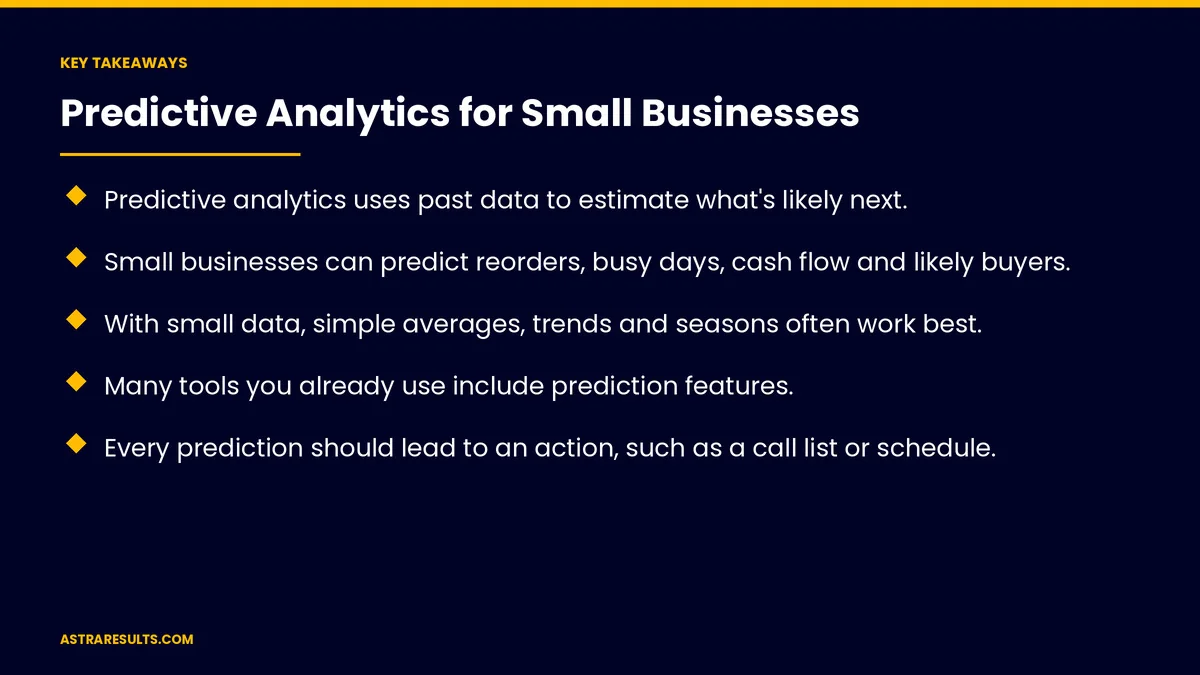
- Predictive analytics uses past data to estimate what's likely next.
- Small businesses can predict reorders, busy days, cash flow and likely buyers.
- With small data, simple averages, trends and seasons often work best.
- Many tools you already use include prediction features.
- Every prediction should lead to an action, such as a call list or schedule.
- Check predictions against a simple baseline before trusting them.
Published: October 19, 2026 | Reading Time: ~8 minutes | Category: Machine Learning & Analytics
This guide covers predictive analytics for small businesses: practical uses, working with small data, simple methods, built-in prediction tools, acting on predictions, checking accuracy, common pitfalls, when to go custom and what to measure. Put plainly: start with one question, use simple methods on the data you have and turn each prediction into an action.
In This Playbook
- Practical uses
- How much data does a small business need to predict?
- Simple methods
- Built-in prediction tools
- Act on predictions
- Check accuracy
- Common pitfalls
- When to go custom
- What to measure
- The first three months
Practical uses
Reorders. Which customers are due to buy again, as in wholesaler reorder prediction.
Customers at risk. Regulars who've gone quiet.
Busy days. Staffing and stock for peaks, as in demand forecasting.
Cash flow. Expected income and bills ahead.
Likely buyers. Leads most worth calling first.
How much data does a small business need to predict?
Months of history, not years. Often enough for simple patterns.
Clean data matters more. Duplicates and gaps hurt small datasets most.
Do you need more? As weighed in is data engineering right for your size.
Simple methods
Averages. Each customer's usual gap between orders.
Trends. Growing or shrinking over recent months.
Seasons. Holidays, summer and hurricane season.
Rules. "Flag customers 50 percent past their usual gap."
Often enough. Complex models need more data to beat these.
Built-in prediction tools
CRM lead scores. Many CRMs rank leads automatically.
Sales system forecasts. Expected sales by day or week.
Accounting cash flow projections. Upcoming income and bills.
Test before trusting. As covered in off-the-shelf first.
Act on predictions
Call lists. Customers due or at risk.
Staff schedules. Matched to expected demand.
Stock orders. Before the rush.
Reports first. As weighed in ML vs business intelligence.
Check accuracy
Compare with a baseline. Last year's same week, or a simple average.
Track misses. How far off, and why.
Adjust monthly. Small changes as patterns shift.
Common pitfalls
Too little data. A few weeks can mislead.
One-off events. Storms, closures and promotions skew patterns.
Changing conditions. New competitors or prices.
Overconfidence. Predictions are estimates, not promises.
When to go custom
Built-in tools fall short. On accuracy or fit.
Data in many systems. Combining it needs work.
High stakes. Inventory or staffing decisions worth real money, as in the business case for predictive analytics.
Choose a partner carefully. As covered in choosing an ML partner.
What to measure
Prediction accuracy. Against the baseline.
Actions taken. Calls made, schedules adjusted and orders placed.
Results. Reorders won, overtime saved and stockouts avoided.
Time spent. Building and checking predictions.
For operators, as covered in machine learning for operators.
The first three months
Days 1–30: one question
Pick one question, such as which customers are due to reorder, gather the data and clean it.
Days 31–60: simple predictions
Use averages, trends or a built-in tool, and turn predictions into a weekly call list or schedule.
Days 61–90: check and expand
Compare with a baseline, track results and add a second question if the first one pays off.
How Astra helps small businesses predict
Astra Results Marketing helps small businesses use predictive analytics. We start with one question, use simple methods and built-in tools first, turn predictions into weekly actions and check accuracy against a baseline before going further.
Engagements begin with a data and decision review through our machine learning and advanced analytics team.
Related reading
Frequently asked questions
What is predictive analytics?
Using past data to estimate what's likely next, such as reorders, busy days or cash flow.
Can small businesses use predictive analytics?
Yes. Months of clean data and simple methods are often enough for useful predictions.
Do we need complex models?
Usually not at first. Averages, trends and seasons often beat complex models when data is limited.
Do our existing tools predict anything?
Many CRMs, sales systems and accounting tools include lead scores, forecasts or cash flow projections. Test them before trusting.
How do we use predictions?
Turn them into actions: call lists, staff schedules and stock orders.
What are common mistakes?
Too little data, ignoring one-off events like storms, changing conditions and treating predictions as promises.
Ready to see what's coming in your business? Astra Results Marketing helps small businesses predict reorders, busy days and cash flow with simple methods, turning every prediction into a weekly action. ▸ CALL (786) 321-2866 · ▸ REQUEST YOUR CONSULTATION





