Rated 5 star on

Hotel Intake: Booking Questions Answered Instantly
Quick answer
An independent hotel should answer every pre-booking question in seconds, using live rates and availability from its property management system. Guests who message directly are usually trying to book direct. A slow reply sends them back to the booking site. Group inquiries are captured in one exchange and turned into a same-day draft proposal.
A traveller finds the hotel on a booking site, opens the hotel's own website to check the direct rate, and sends a question: two beds for the 14th? The message sits in a shared inbox until morning. By then the traveller has booked there. The hotel pays a commission on a guest who tried to book direct.
Key Takeaways
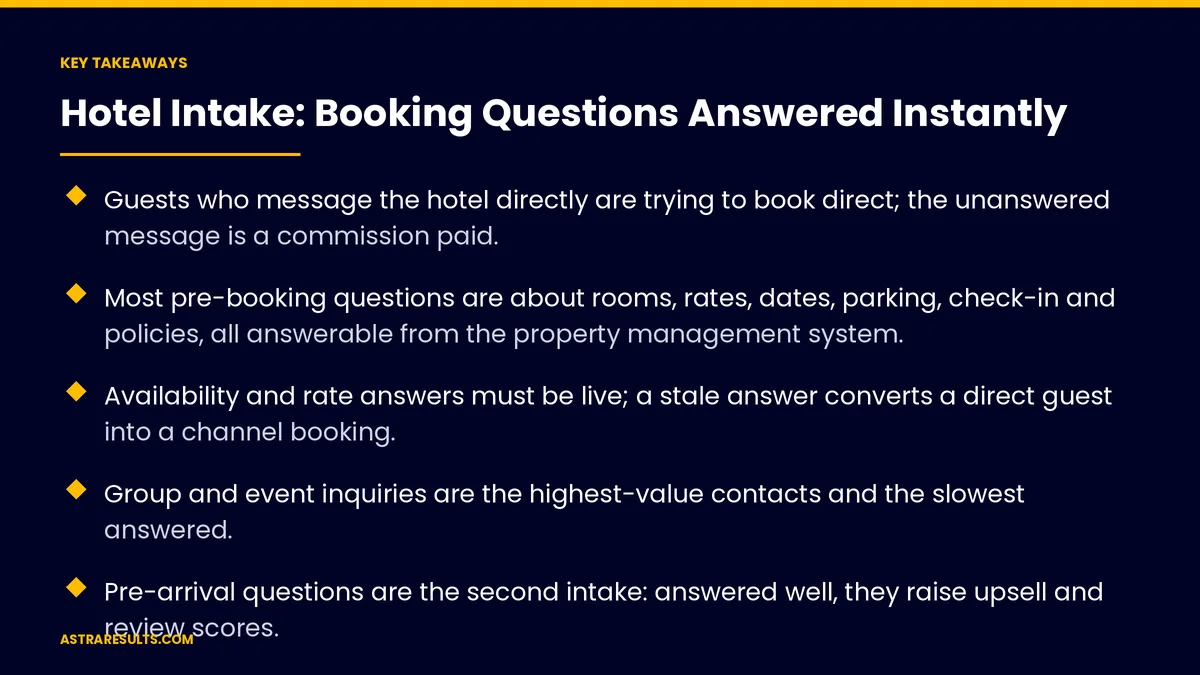
- Guests who message the hotel directly are trying to book direct; the unanswered message is a commission paid.
- Most pre-booking questions are about rooms, rates, dates, parking, check-in and policies, all answerable from the property management system.
- Availability and rate answers must be live; a stale answer converts a direct guest into a channel booking.
- Group and event inquiries are the highest-value contacts and the slowest answered.
- Pre-arrival questions are the second intake: answered well, they raise upsell and review scores.
- Measure by direct booking share, response time, quote-to-contract rate on groups and revenue per inquiry.
Published: October 15, 2026 | Reading Time: ~12 minutes | Category: Inbound Intake
Hotel intake is the set of questions a guest asks before committing. The speed of the answers decides whether the booking lands direct or through a channel that takes a share. This piece covers answering those questions in seconds from the property's systems, holding the booking direct, and handling the groups a small team cannot quote by hand.
Put plainly: the guest who asks the hotel a question wants to book with the hotel; answer before they give up.
Guidance for owners and general managers of independent hotels, inns and small groups. Nothing here is legal advice. Rate parity clauses, accessibility disclosures, guest data privacy and text consent are governed by contracts and law that vary by jurisdiction and should be confirmed with counsel.
In This Playbook
- Why the question is a direct booking
- The questions guests ask before booking
- Answering from the property's systems
- Groups and events
- Pre-arrival: the second intake
- Channels, languages and time zones
- Multi-property
- The numbers that move
- The first three months
Why the question is a direct booking
The behavior. Travellers compare on booking sites and then check the hotel's own site, expecting a better rate or a small perk. When they message the hotel, they have already chosen it. The only decision left is where to pay.
The cost of silence. A commission on every booking that came through a channel after the guest tried to book direct. For an independent property that is a large share of margin, paid for the privilege of not answering.
The window. Minutes. Travellers plan in sessions, with the booking site open in the next tab. The guest who does not hear back closes the hotel's tab and completes the booking they had already started. The intake principle in every lead answered in seconds applies with a competitor one tab away.
Who is free to answer. The front desk is checking guests in. The reservations line, if there is one, is staffed in office hours. The inquiry arrived at 10 pm from another time zone.
The questions guests ask before booking
Rooms and dates. Do you have a room with two beds for these dates. Is there a connecting room. Which rooms have a view. Answerable from live inventory.
Rates and what is included. What is the rate direct. Is breakfast included. Is there a resort fee. What are the taxes. The direct rate stated plainly, with what it includes, and the perk for booking direct if the hotel offers one.
Logistics. Parking and its cost. Airport distance and shuttle. Early check-in and late check-out. Pets. Accessibility. From the property record, maintained by the hotel.
Policies. Cancellation, deposit, minimum stay, children. Stated from the policy, never softened.
Local. Is it walkable to the beach, restaurants nearby, is there a pool. Facts the hotel controls; opinions about the area handled with care and directed to the hotel's own descriptions rather than invented.
Answering from the property's systems
Live or nothing. Availability and rates change by the hour. An answer that says a room is available when it is not, or quotes yesterday's rate, sends the guest to the channel that showed the truth. The system reads the property management system and the rate engine at the moment it answers.
Holding the room. Where the systems allow, the answer offers to hold the room for a short window while the guest decides, or takes the booking directly in the conversation with payment. A guest who has a room held stops comparing.
The direct perk. Free breakfast, a late check-out, a room upgrade when available, a small discount within what parity clauses permit. Stated in the answer so the guest sees the reason to book direct at the moment they are deciding.
The voice. The hotel's, not the software vendor's: the register a good front-desk agent uses, in the language the guest wrote in. The approach is the one described in replies in your voice, with warmth appropriate to hospitality and no invented amenities.
Handoff. A guest with a complaint, a special request the property record does not cover, or a request that needs a manager's approval reaches a person with the conversation attached. The system does not promise what it cannot confirm.
Groups and events
The highest-value inquiry. A wedding, a corporate retreat, a sports team, a family reunion. Ten to a hundred rooms and often food, beverage and space. The inquiry arrives by form or email, asks for a proposal, and waits days because the sales manager is a single person with a full calendar.
What the system does. Captures the complete request in one exchange: dates and flexibility, room count and mix, meeting or event space, food and beverage, budget range, decision date, decision maker. Confirms it back in a structured summary. Checks group availability and blocks against the property management system.
What it prepares. A draft proposal from the hotel's group rates and space charts, with the comparable recent contracts attached, handed to the sales manager to price and personalize. The manager sends a proposal the same day instead of the same week.
Follow-up. On the proposal, until signed or lost, with the reason recorded. Groups lost to a competitor for a reason the hotel could have addressed are the intelligence that improves the next proposal.
Rooming lists and cutoffs. After the contract, the administrative traffic of a group, handled by message with the organizer, freeing the sales manager for the next inquiry.
Pre-arrival: the second intake
The questions between booking and check-in. What time can I arrive. Can I add a night. Can you arrange a crib, a transfer, a dinner reservation. Is the pool heated. Often more many than pre-booking questions and just as often unanswered.
Why they matter. Every answered pre-arrival question is a smoother check-in and a better first hour. Many are upsell moments: the extra night, the transfer, the upgrade, the late check-out, offered when the guest is already thinking about the stay.
The sequence. Confirmation with the details that matter. A message a few days before arrival with what to expect and one relevant offer. A message the day before with arrival logistics. A check-in after arrival asking if everything is right, which catches problems while they can still be fixed, following the feedback logic in restaurant engagement.
Reviews. Asked for after departure, once, from guests whose in-stay check-in was positive. Problems reported in-stay are routed to a manager before they become public.
Channels, languages and time zones
Channels. Web chat, email, WhatsApp and messaging apps, the booking sites' own messaging where the site permits, and the phone. One guest record across all of them.
Booking-site messaging. Answered inside each site's rules, which restrict moving the guest off-platform before booking. The system knows the rules per site and stays within them.
Languages. Miami hotels answer guests from Latin America, Europe and the rest of the United States. Spanish and Portuguese natively, in the guest's tone, with other languages routed to a person or handled where the system can, following what changes when Spanish is a channel.
Time zones. The inquiry from Madrid arrives at 4 am local. It is answered at 4 am with live availability, and the booking is direct by breakfast.
Multi-property
One system, each property's facts. A small group runs the same intake for every property, with each property's inventory, rates, policies and voice variations in its own record, on the model described for franchise intake.
Cross-selling. A property that is full offers the sister property, with the guest's consent. The booking stays in the group instead of going to a channel.
Reporting. Direct share, response time and group conversion by property, so the general manager whose team is slowest sees it before the owner does.
The numbers that move
Direct booking share. The proportion of reservations that arrive through the hotel's own channels, before and after. The number that pays for the whole thing.
Response time. Median minutes to a useful answer with live availability, by channel and hour, measured as described in the metric nobody tracks.
Inquiries with no reply. Counted, falling to none.
Group quote-to-contract. Time to proposal and the share signed, with lost reasons.
Revenue per inquiry. Bookings and upsells traced to conversations, with the discipline in attribution across every channel.
Front-desk and sales hours. Returned from the inbox to guests in the lobby and groups on the phone, against a baseline.
The first three months
Days 1–30: the inquiry log and the connections
Thirty days of inquiries logged by channel, hour, language and response time, including those with no reply. Property management system and rate engine connected for live availability. Property record assembled: logistics, policies, amenities, the direct perk. Parity clauses reviewed with counsel so the direct offer stays within them. Group request fields agreed with sales.
Days 31–60: answer and hold
Pre-booking questions answered in seconds with live availability and the direct rate, in English, Spanish and Portuguese, on every channel within each channel's rules. Room holds and in-conversation booking live where systems allow. Group requests captured complete and draft proposals prepared for the sales manager. Complaints and special requests routed to a person.
Days 61–90: pre-arrival and review
Pre-arrival sequence live with one relevant offer per stay and an in-stay check-in. Group follow-up running to signature or loss with reasons. Direct share, response time, no-reply count, group conversion and revenue per inquiry compared to Day 1.
Where Astra fits in
Astra Results Marketing begins with the inquiry log, because most hotels have never counted the guests who asked a question, heard nothing and booked through a channel that night. The property management system and rate engine are connected first. So every answer carries live availability and the direct rate. The direct perk is set within what the hotel's contracts permit.
Pre-booking answers, room holds and group capture go live in the guest's language, with proposals reaching the sales manager complete the same day. The pre-arrival sequence follows, with upsell offers timed to when the guest is thinking about the stay. Reporting runs on direct booking share, response time, group conversion and revenue per inquiry.
Engagements begin with a thirty-day inquiry log through our AI inbound sales team.
Related reading
Frequently asked questions
Why do unanswered guest messages cost a hotel money?
Because a guest who messages the hotel has usually found it on a booking site and is checking whether to book direct. Unanswered, they finish the booking on the site. The hotel pays a commission on a guest who tried to avoid one.
Can the system quote rates and availability?
Yes, and only live: it reads the property management system and rate engine at the moment it answers, states the direct rate with what it includes, and offers the direct perk within what parity clauses allow. A stale answer would send the guest back to the channel that showed the truth.
How are group inquiries handled?
The complete request is captured in one exchange and confirmed back, group availability is checked. A draft proposal from the hotel's group rates and space charts is prepared for the sales manager to price and send the same day. Follow-up runs until signed or lost.
What happens to messages sent through booking sites?
They are answered within each site's rules, which usually restrict moving the guest off-platform before a booking is made. The system knows the rules per site and stays inside them.
What is pre-arrival intake?
The questions between booking and check-in: arrival time, extra nights, transfers, cribs, dinner reservations. Answered promptly, they smooth the first hour and create upsell moments, and an in-stay check-in catches problems before they reach a review.
How is the return measured?
Direct booking share, median response time with live availability by channel and hour, inquiries with no reply, group time-to-proposal and quote-to-contract rate, revenue per inquiry including upsells, and front-desk and sales hours returned, each against a thirty-day baseline.
Ready to keep the booking direct? Astra Results Marketing counts the guests who asked and heard nothing, connects your systems so every answer carries live availability and your direct rate, captures groups complete for your sales manager, and reports on direct share and revenue per inquiry. ▸ CALL (786) 321-2866 · ▸ REQUEST YOUR CONSULTATION