 Rated 5 star on


Website Development Timelines: Week by Week
Quick answer
A typical business website of 15 to 25 pages can often launch in about 12 weeks when content and decisions arrive on time. Content is the most common cause of delay, so start it in week one. One decision maker and fixed review rounds keep design moving. Give testing and fixes their own weeks.
"How long will the website take?" is usually the second question after "how much?" The real answer depends less on the developers than on how fast decisions, content and approvals arrive. A site that could launch in twelve weeks often takes six months because the words weren't ready or five people had to approve each page.
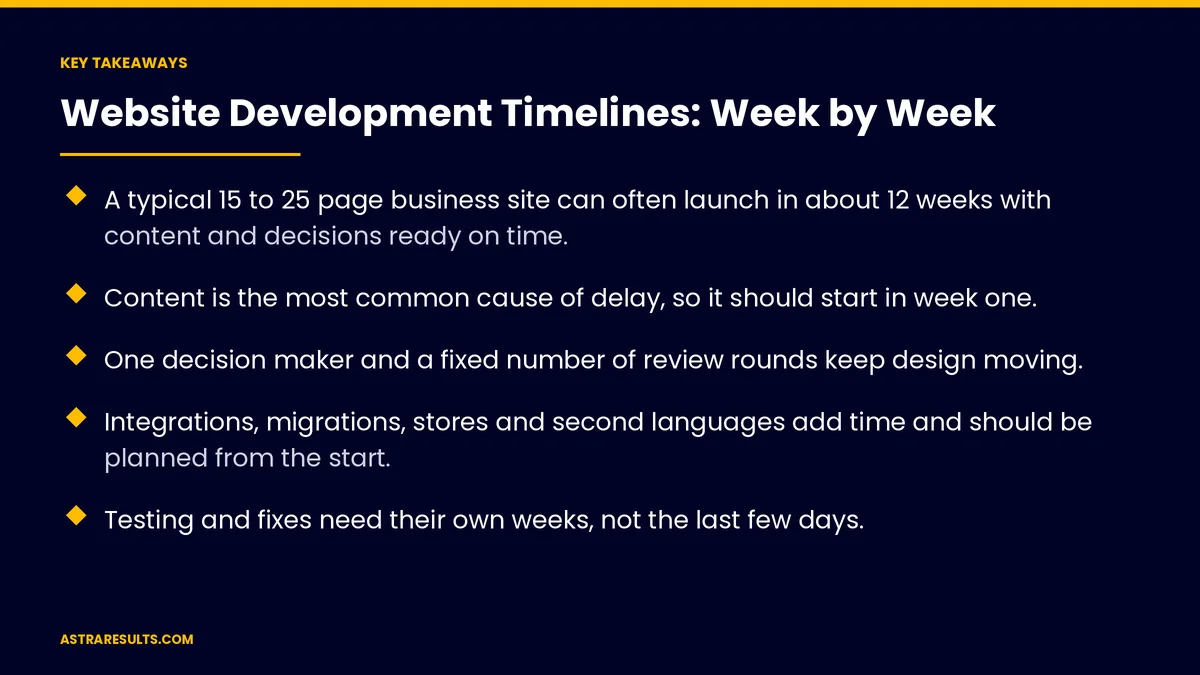
Key Takeaways
- A typical 15 to 25 page business site can often launch in about 12 weeks with content and decisions ready on time.
- Content is the most common cause of delay, so it should start in week one.
- One decision maker and a fixed number of review rounds keep design moving.
- Integrations, migrations, stores and second languages add time and should be planned from the start.
- Testing and fixes need their own weeks, not the last few days.
- The first weeks after launch are part of the project, not an afterthought.
Published: October 26, 2026 | Reading Time: ~9 minutes | Category: Website Development
This guide lays out a week-by-week example for a typical business website, explains what makes projects shorter or longer, and shows how to keep yours on schedule. Put plainly: the build is rarely the slow part; content and decisions are.
In This Playbook
- An example 12-week plan
- What makes a website project shorter or longer?
- What makes projects run late
- How to stay on schedule
- After launch
- Schedule numbers to track
- The first three months
An example 12-week plan
This is an example for a 15 to 25 page business website with a contact form, booking link and basic integrations. Your timeline will depend on the factors covered after it.
What happens in the first week of a website project?
Agree on goals, visitors and the main action for each type of visitor. Name one decision maker and one content owner. Collect logins for hosting, domain, analytics and any tools the site must connect to. The brief itself is covered in website development.
Week 2: sitemap and content plan
List every page and write one sentence on what each must do. If you're replacing a site, list every old page and where it will redirect. Assign who writes or supplies each page's content, with due dates.
Weeks 3 and 4: content and photos
Write or gather the words for each page, starting with the homepage and main service pages. Schedule photography of your team, work and location. This is where most projects slip, so hold to the due dates.
Weeks 4 and 5: design of key pages
Design the homepage, one service page and the contact page, phones first. Review them in two rounds with the decision maker and a few real customers.
Week 6: design approval
Approve the key designs. Apply the same design to the remaining page types.
Weeks 6 to 9: build
Set up the platform, build the page templates, enter the content, connect forms and booking, add tracking and search basics, and build Spanish pages if needed. Connections to other tools are covered in API integration.
What gets tested before a website launches?
Test every form, link and redirect on real phones and computers. Check speed, accessibility, spelling, phone numbers and hours.
Week 11: fixes and training
Fix what testing found. Train your team to update pages. The content owner signs off on every page.
Week 12: launch
Launch early in the week. Submit the sitemap, update your Google Business Profile and watch forms, traffic and errors daily.
Weeks 13 and 14: early monitoring
Check leads, conversion and errors against your baseline, using the numbers in website KPIs that matter to revenue. Fix broken links and missed redirects fast.
What makes a website project shorter or longer?
Size. A five to eight page site can often launch in four to six weeks. Fifty pages or more takes longer.
Content readiness. Content written before the project starts can save weeks.
Integrations. Booking, CRM, payments and custom tools each add design, build and testing time.
Online stores. Products, shipping, taxes and payments add significant time, as weighed in Shopify or custom.
Migration. Replacing a large site means redirect mapping and careful checks to protect search traffic.
Languages. Spanish pages written for that audience, not just translated, need their own writing and review time, as covered in what changes when Spanish is a channel.
Approvals. More approvers means more rounds and more waiting.
What makes projects run late
Content arrives late. The build can't finish without the words.
Too many reviewers. Each new opinion restarts the design discussion.
Scope grows. New pages and features added after design is approved.
Missing logins. Waiting days for access to hosting, the domain or another tool.
Surprise integrations. A tool nobody mentioned until week eight.
How to stay on schedule
One decision maker. One person approves each stage.
Content first. Start writing in week one, not after design.
Fixed review rounds. Two rounds of feedback per stage, agreed upfront.
A change list. New ideas go on a list for after launch, unless they're essential.
All access on day one. Every login and integration listed at kickoff.
Weekly check-ins. Fifteen minutes to review progress and decisions due.
After launch
The first weeks matter. Most small problems show up in the first fortnight.
Plan ongoing care. Updates, backups and security start right away, as covered in website security and maintenance.
Add what was parked. The change list becomes the plan for the next round of improvements.
Schedule numbers to track
Schedule. Planned versus actual dates for each stage.
Content on time. The share of pages delivered by their due date.
Review rounds. How many rounds each stage needed.
Launch issues. Problems found in the first two weeks after launch.
Results. Leads and conversion against the pre-launch baseline.
The first three months
Days 1–30: set up for speed
Name the decision maker and content owner, collect every login and list every integration. Finish the sitemap and content plan, and get the first pages of content written.
Days 31–60: hold the line
Approve key designs in two review rounds, finish content, and move into the build. Put new ideas on the change list instead of into the current scope.
Days 61–90: test, launch, watch
Test everything, fix issues, train the team, launch and monitor closely. Turn the change list into the plan for the next improvements.
How Astra runs website projects
Astra Results Marketing runs website projects on a clear weekly plan. We start content in week one, name one decision maker, fix the number of review rounds and collect every login and integration at kickoff.
Testing and fixes get their own weeks, and the first weeks after launch are part of the project. You get a realistic timeline for your site's size and needs before work begins. Engagements begin with a kickoff workshop through our website development team.
Related reading
Frequently asked questions
How long does it take to build a business website?
It depends on size, content and decisions. A typical 15 to 25 page site can often launch in about 12 weeks when content and approvals arrive on time. A small site may take four to six weeks; large sites, stores and complex integrations take longer.
What causes website projects to run late?
Late content, too many reviewers, scope added after design approval, missing logins and integrations nobody mentioned at the start.
When should we start writing content?
In week one. Content is the most common cause of delay, and design works best when the real words are available.
How many design review rounds should we plan?
Two rounds per stage is a good default, agreed at the start, with one decision maker approving each stage.
Does a Spanish version add time?
Yes. Spanish pages written for that audience need their own writing and review time. Plan them in the sitemap and schedule from the start.
What happens after launch?
Close monitoring for the first two weeks, fixes for any broken links or forms, ongoing updates and backups, and a plan for the improvements parked during the project.
Ready for a website project that launches on time? Astra Results Marketing runs website projects on a clear weekly plan, with content started in week one, one decision maker, fixed review rounds and testing that gets its own time. ▸ CALL (786) 321-2866 · ▸ REQUEST YOUR CONSULTATION





