 Rated 5 star on

Wholesaler ML: Reorder Prediction by Account
Quick answer
Reorder prediction uses each account's order history to flag who should order soon and who is late. Start simply with each account's average gap between orders. Then predict next-order dates and likely items. Send the results to rep call lists and suggested carts. Show the reasons behind each prediction and let reps decide.
Most wholesale revenue comes from accounts that order again and again. When a regular account goes quiet, reps often notice weeks later, after it buys elsewhere. Reorder prediction looks at each account's history and flags who should order soon, what they usually buy and who is running late. Reps call the right accounts at the right time.
Key Takeaways
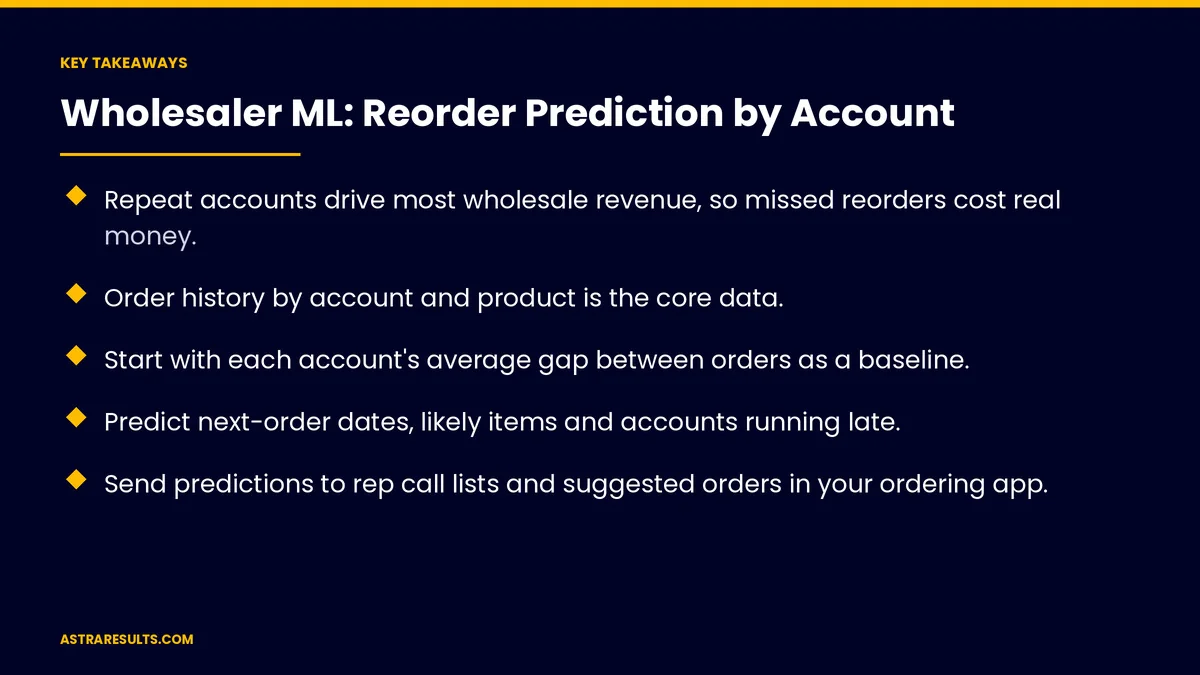
- Repeat accounts drive most wholesale revenue, so missed reorders cost real money.
- Order history by account and product is the core data.
- Start with each account's average gap between orders as a baseline.
- Predict next-order dates, likely items and accounts running late.
- Send predictions to rep call lists and suggested orders in your ordering app.
- Show the reasons behind each prediction, and let reps decide.
Published: October 30, 2026 | Reading Time: ~8 minutes | Category: Machine Learning & Analytics
This guide covers reorder prediction for wholesalers: the data it needs, starting with a simple baseline, what the model predicts, at-risk accounts, suggested orders, how reps and systems use predictions, inventory planning, explaining predictions and what to measure. Put plainly: predict each account's next order, act on the ones running late and let reps make the call.
In This Playbook
- The data it needs
- What is a simple baseline for reorder prediction?
- What the model predicts
- At-risk accounts
- Suggested orders
- How reps use predictions
- Inventory planning
- Explaining predictions
- What to measure
- The first three months
The data it needs
Order history. Every order by account, product, date and quantity.
Clean account records. One record per customer, without duplicates, as covered in data KPIs.
Seasons and promotions. Holidays, sales and price changes.
Account details. Size, type and location.
Sell-through, if available. What the account sold to its own customers.
What is a simple baseline for reorder prediction?
Average gap between orders. For each account.
Flag accounts past their usual gap. A simple rule that already helps.
Then add machine learning. When the baseline misses seasonal or product patterns, as weighed in ML vs business intelligence.
What the model predicts
Next order date. When each account is likely to order.
Likely items. What they usually buy.
Likely quantities. Based on history and season.
Confidence. How sure the prediction is.
At-risk accounts
Running late. Past the expected order date.
Shrinking orders. Smaller or less frequent orders over time.
Missing products. Items they stopped ordering.
Early warning. Reps reach out before the account is lost.
Suggested orders
In the ordering app. A ready-made cart based on history, as with wholesaler ordering apps.
Customers stay in control. They edit before ordering.
Orders by email too. Read automatically, as in purchase order reading.
How reps use predictions
Daily call lists. Accounts due soon and accounts running late.
Reasons shown. "Usually orders every 14 days; last order 21 days ago."
Reps decide. Predictions guide, people sell.
New accounts too. Won through wholesaler outbound, then tracked for reorders.
Fits the bigger process. As designed in the process layer.
Inventory planning
Expected orders add up. Account predictions inform stock levels.
Fewer stockouts. On items regulars depend on.
System-level forecasts. As covered in demand forecasting.
Explaining predictions
Simple reasons. Order gaps, seasons and recent changes.
Trust grows. When reps see why an account is flagged.
Feedback. Reps mark wrong predictions so the model improves.
For operators, as covered in machine learning for operators.
What to measure
Prediction accuracy. Days between predicted and actual orders.
Reorder rate. Accounts ordering on time.
At-risk accounts recovered. After outreach.
Order size. Average order value from suggested orders.
Stockouts. On items regular accounts buy.
The first three months
Days 1–30: clean and baseline
Clean account records, pull order history and flag accounts past their usual gap between orders.
Days 31–60: predict and show
Add next-order dates, likely items and confidence, and show predictions with reasons in rep call lists.
Days 61–90: suggest and measure
Add suggested orders to the ordering app, track accuracy and recovered accounts and use rep feedback to improve the model.
How Astra builds reorder prediction
Astra Results Marketing builds reorder prediction for wholesalers. We clean account data, start with a simple baseline, predict next orders and likely items, flag at-risk accounts and send predictions to reps and ordering apps with clear reasons.
Engagements begin with an order data review through our machine learning and advanced analytics team.
Related reading
Frequently asked questions
What is reorder prediction?
Using each account's order history to predict when it will order next, what it will buy and whether it's running late.
What data do we need?
Order history by account, product, date and quantity, clean account records and information on seasons and promotions.
Do we need machine learning right away?
No. Start with each account's average gap between orders. Add machine learning when you need seasonal and product patterns.
How do reps use predictions?
Through daily call lists of accounts due soon or running late, with simple reasons shown for each.
Can customers see suggested orders?
Yes, in an ordering app, as a ready-made cart they can edit before ordering.
How do we know it's working?
Track prediction accuracy, on-time reorders, recovered at-risk accounts, order size and stockouts.
Ready to know which accounts should order next? Astra Results Marketing builds reorder prediction that flags accounts due soon and running late, suggests orders and shows reps the reasons, so fewer regulars slip away. ▸ CALL (786) 321-2866 · ▸ REQUEST YOUR CONSULTATION





