Rated 5 star on

Conversational AI: Customers Answered, Not Deflected
Quick answer
Deflection measures how many customers were kept away from a person. Resolution measures how many had their problem solved. Only the second is worth optimising, and it requires the system to reach real records and take real actions rather than return a help article. When it cannot, it hands over cleanly, with the conversation attached.
The last decade of customer service automation was built around a metric called deflection: the share of customers kept away from a human. Companies celebrated it. Customers experienced it as a wall — a chatbot offering five buttons, none of which matched the problem, and a help centre link instead of an answer.
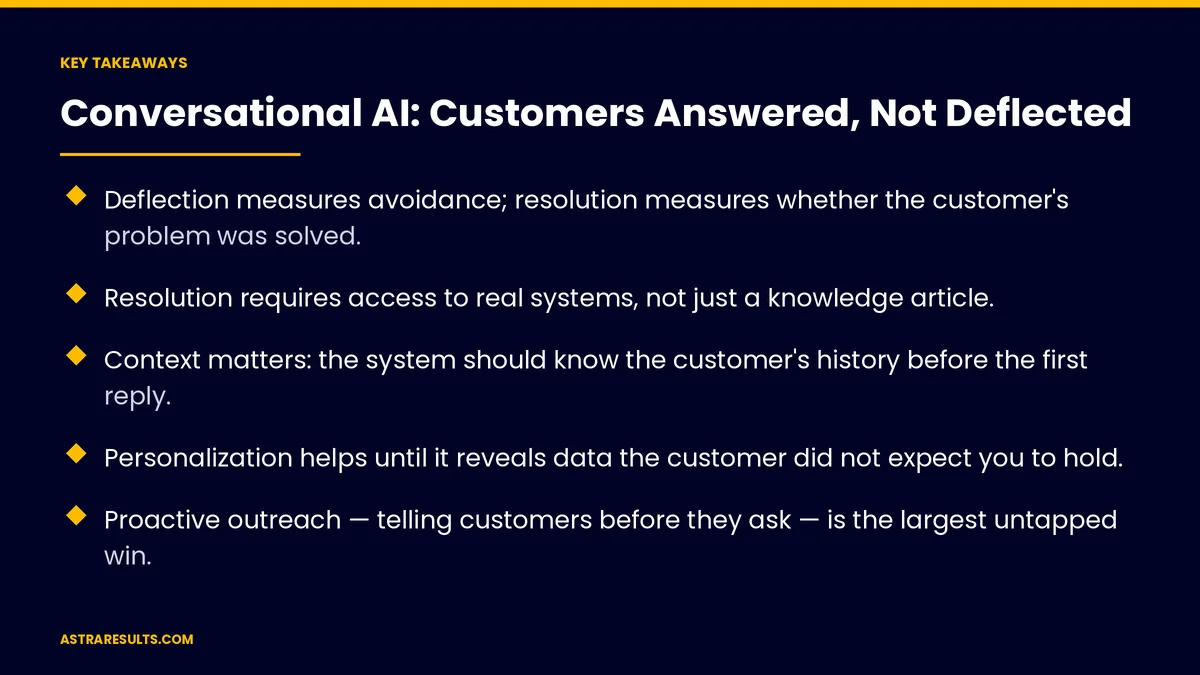
Key Takeaways
- Deflection measures avoidance; resolution measures whether the customer's problem was solved.
- Resolution requires access to real systems, not just a knowledge article.
- Context matters: the system should know the customer's history before the first reply.
- Personalization helps until it reveals data the customer did not expect you to hold.
- Proactive outreach — telling customers before they ask — is the largest untapped win.
- Measure resolution rate, customer effort and escalation quality, never deflection.
Published: September 10, 2026 | Reading Time: ~13 minutes | Category: Customer Engagement
The technology has changed enough that deflection is the wrong goal. A system can now understand what someone asked, find the answer in the company's own information, do something about it, and hand off cleanly when it cannot. This guide covers what that requires and how to measure it properly. Reduced to a sentence: resolution is the metric; deflection is what failure looks like on a dashboard.
Guidance for owners and operators. Nothing here is legal advice. Messaging consent, recording, data retention and sector rules on customer communications vary by jurisdiction and must be reviewed with counsel before deployment.
In This Playbook
- Why deflection failed
- What resolution requires
- Context: knowing who is asking
- Personalization without the creep
- Proactive: telling them before they ask
- The handoff, again
- Channels
- Measuring it properly
- Where it fails
- A three-month sequence
- What Astra does here
Why deflection failed
- What it measured. Conversations that did not reach a human. Nothing about whether the customer's problem was solved.
- What it produced. Systems designed to end conversations rather than resolve them. Button menus that cover the common cases and dead-end on everything else. "Was this helpful?" as the exit.
- What customers learned. To type "agent" immediately, skipping the system entirely, which made the deflection number worse and the experience longer.
- Why it persisted. Deflection is easy to measure and improves with a tighter menu. Resolution is harder to measure and requires the system to do things.
- The shift. A system that understands language and reaches real systems can resolve rather than deflect. That changes the metric from avoidance to outcomes, explored in outputs over inputs.
What resolution requires
Answering is not resolving. Resolution means the customer's situation changed.
- Reading the real question. In the customer's words, including context from earlier messages, typos, and mixed languages.
- Finding the real answer. From the company's own documents and policies, with the specific case in mind — not a generic article, the case for which sits in retrieval from your own documents.
- Doing the thing. Checking an order, rescheduling an appointment, updating an address, sending a copy of an invoice, starting a return. This requires connections to the systems that hold those records, and it is where most deployments stop short.
- Confirming it happened. Telling the customer specifically what was done, with the reference they need.
- Knowing when to stop. Handing off with everything gathered, the moment it is the right move.
Context: knowing who is asking
A system that asks a returning customer for their account number has already failed.
- What it should know before replying. Who the customer is, what they bought, what is open, what they contacted about last time, and what language they prefer.
- Where that comes from. The CRM, the order system, the ticket history — connected, the case for which sits in connected data.
- Identity, carefully. Recognizing a customer from a logged-in session or a verified phone number is fine. Guessing from a name is not. Anything sensitive requires proper verification, and the system should ask rather than assume.
- Across channels. The customer who chatted yesterday and calls today is the same person with the same issue. One conversation, many doors.
- The effect. Shorter conversations, fewer repeated questions, and a customer who does not have to explain themselves twice.
Personalization without the creep
There is a line, and crossing it costs more than the personalization gained.
- On the right side. Using what the customer told you or bought from you. "Your order shipped Tuesday." "Since you have the maintenance plan, this is covered."
- On the wrong side. Referencing data the customer did not knowingly give the business. Inferred characteristics. Anything that makes the person wonder how you know that.
- The check. Would the customer be comfortable if you explained how you knew? If explaining it is awkward, do not use it.
- Tone. Friendly, not familiar. The system represents a business, not a friend. Manufactured warmth reads as manipulation, especially when the customer is frustrated.
- Disclosure. The customer should be able to tell they are talking to an automated system, and asking "am I talking to a person?" should get a straight answer. Some jurisdictions require this; honesty recommends it regardless.
Proactive: telling them before they ask
The largest untapped opportunity, because it removes the contact instead of handling it.
- The pattern. The delivery is late, so the customer is told before they notice. The appointment is tomorrow, so a reminder goes out with the option to reschedule. The card on file expires next week. The service is due.
- Why it works. A customer told about a problem feels informed. The same customer discovering the problem themselves feels neglected, and the conversation starts from a worse place.
- The volume effect. Proactive messages remove entire categories of inbound contact, which is a bigger saving than handling those contacts efficiently.
- The discipline. Relevant, timed, and stoppable. Proactive becomes spam quickly, and the unsubscribe must be honored instantly and permanently.
- Consent. Messaging rules differ by channel and jurisdiction, and proactive outreach is where they bite hardest. Counsel maps them first.
The handoff, again
The single most important design decision, and the one most commonly botched.
- When to hand off. The customer asks for a person. Frustration is detected. The request falls outside authority. Confidence is low. The same issue has come back twice.
- What travels with the customer. The full conversation, what was tried, what the system knows about the account, and its best guess at the problem. The customer repeats nothing.
- Speed. Within the same session where possible. An escalation that becomes "someone will email you in 24 hours" undoes everything the system just did well, detailed in the intake standard.
- No trapping. A customer who says "agent" gets an agent. Every attempt to talk them out of it is remembered, and not fondly.
- The staffing reality. A system that resolves the routine leaves humans the complex cases, which take longer each. Staffing models should account for that rather than assuming a headcount cut.
Channels
- Web chat. Where most deployments start, and the easiest to control.
- SMS. High open rates, tight consent rules, and the channel customers check.
- WhatsApp. The default for much of the Spanish-speaking market and Latin America, and a channel businesses serving those customers cannot skip, according to Spanish as a channel.
- Voice. Now capable of natural conversation for defined tasks. Still the channel where a bad experience angers customers fastest.
- Email. Best for asynchronous resolution where a complete answer matters more than speed.
- In-app and social messages. Handled to the same standard rather than left to whoever checks the account.
- One conversation across all of them. The channel is a door, not a separate relationship.
Measuring it properly
- Resolution rate. Conversations where the customer's issue was resolved, verified by outcome rather than by a survey nobody answers.
- Customer effort. How many messages and how much time resolution took. Lower is the goal.
- Escalation rate and quality. How often handoff happened, how fast the human arrived, and whether the customer had to repeat themselves — which should be never.
- Repeat contact rate. The same customer back about the same issue within a week. The clearest signal of false resolution.
- Satisfaction, sampled. Small, simple, and not attached to every conversation.
- Containment is not a goal. If it is reported, it is reported as a diagnostic beneath resolution, never above it.
Where it fails
- Connected to nothing. A system that can talk but cannot check an order or change an appointment can only answer questions, which is a fraction of what customers want.
- Scripted rigidity. Menus and decision trees dressed up as conversation.
- Hidden escalation. No clear route to a person.
- Over-promising. The system commits to something the business cannot do.
- Never reviewed. Transcripts unread, so the same failure repeats for months.
- Deployed to cut costs only. The deployments that work start from the customer experience and produce the cost saving as a consequence.
A three-month sequence
Days 1–30: inventory and connect
The top twenty reasons customers make contact, by volume. Which of those need a system action to resolve, and which systems hold those records. Consent and disclosure rules mapped with counsel. The current resolution and repeat-contact baseline measured.
Days 31–60: resolve the top five
The five highest-volume reasons handled end to end, with real system access. Context from the CRM on every conversation. The handoff built and tested with real people. Transcripts reviewed daily.
Days 61–90: proactive and expand
Two proactive messages launched for the categories that generate the most inbound contact. Channels extended to where customers are. Resolution, effort and repeat-contact measured against the baseline, with transcripts reviewed weekly.
What Astra does here
Astra Results Marketing starts from the top twenty reasons customers make contact and which of them require a system action, because a system that cannot do anything can only answer. Connections to the order, appointment and CRM systems come first, then context on every conversation, then a handoff tested with real people.
Proactive outreach is designed to remove inbound contact rather than add outbound noise, within the consent rules counsel maps. Reporting runs on resolution, customer effort and repeat contact — never on deflection. Engagements begin with a contact-reason audit through our AI customer engagement team.
Related reading
Frequently asked questions
Why is deflection the wrong metric?
Because it measures conversations kept away from a human and says nothing about whether the problem was solved. It produced systems designed to end conversations rather than resolve them, and customers learned to type "agent" immediately, which made both the number and the experience worse. Resolution — whether the customer's situation changed — is the metric that reflects the outcome.
What does resolution require that answering does not?
Access to real systems. Checking an order, rescheduling an appointment, updating an address, sending an invoice copy or starting a return all require connections to the records that hold them, and that is where most deployments stop short. Resolution also means reading the real question in the customer's own words, finding the answer in the company's own documents, and confirming specifically what was done.
How much personalization is too much?
The test is whether the customer would be comfortable if you explained how you knew. Using what they told you or bought from you is fine. Referencing data they did not knowingly provide, or inferred characteristics, makes people wonder how you know that. Tone should be friendly rather than familiar, and asking "am I talking to a person?" should always get a straight answer.
What is proactive engagement and why does it matter?
Telling customers before they ask: the delivery is late, the appointment is tomorrow, the card expires next week, the service is due. A customer told about a problem feels informed; one who discovers it feels neglected. It removes entire categories of inbound contact, which saves more than handling those contacts efficiently — provided messages stay relevant, timed and instantly stoppable within the consent rules.
How should the handoff work?
Triggered when the customer asks for a person, frustration is detected, the request exceeds authority, confidence is low, or the issue has returned twice. The full conversation, what was tried and what the system knows travel with the customer, who repeats nothing. It happens within the same session where possible, because "someone will email you in 24 hours" undoes everything. A customer who says "agent" gets an agent.
What should be measured?
Resolution rate verified by outcome, customer effort in messages and time, escalation rate with how fast a human arrived and whether the customer repeated themselves, and repeat contact within a week — the clearest signal of false resolution. Satisfaction sampled lightly. Containment, if reported at all, sits beneath resolution as a diagnostic, never above it.
READY TO RESOLVE INSTEAD OF DEFLECT? Astra Results Marketing starts from your top contact reasons, connects to the systems that resolve them, tests the handoff with real people, and reports resolution and repeat contact rather than deflection. Astra Results Marketing · 1101 Brickell Ave, Miami, FL 33131 · +1 (786) 321-2866 · [email protected] Find us on Google · Yelp ▸ CALL (786) 321-2866 · ▸ REQUEST YOUR CONSULTATION