Rated 5 star on

Cross-Platform Apps: Reaching Every Device Once
Quick answer
Cross-platform development saves less than half the cost of two native apps, because the savings concentrate in business logic and ordinary screens and shrink at device features, animation and platform conventions. It is the right default for most business apps. A progressive web app is worth considering first when nothing requires installation or deep hardware access.
Every business that decides it needs an app runs into the same fork within a week. Building for iPhone and Android separately means two codebases, two teams and roughly two budgets. Building once for both sounds obviously better, and is — but not always, and the exceptions are expensive to discover late.
Key Takeaways
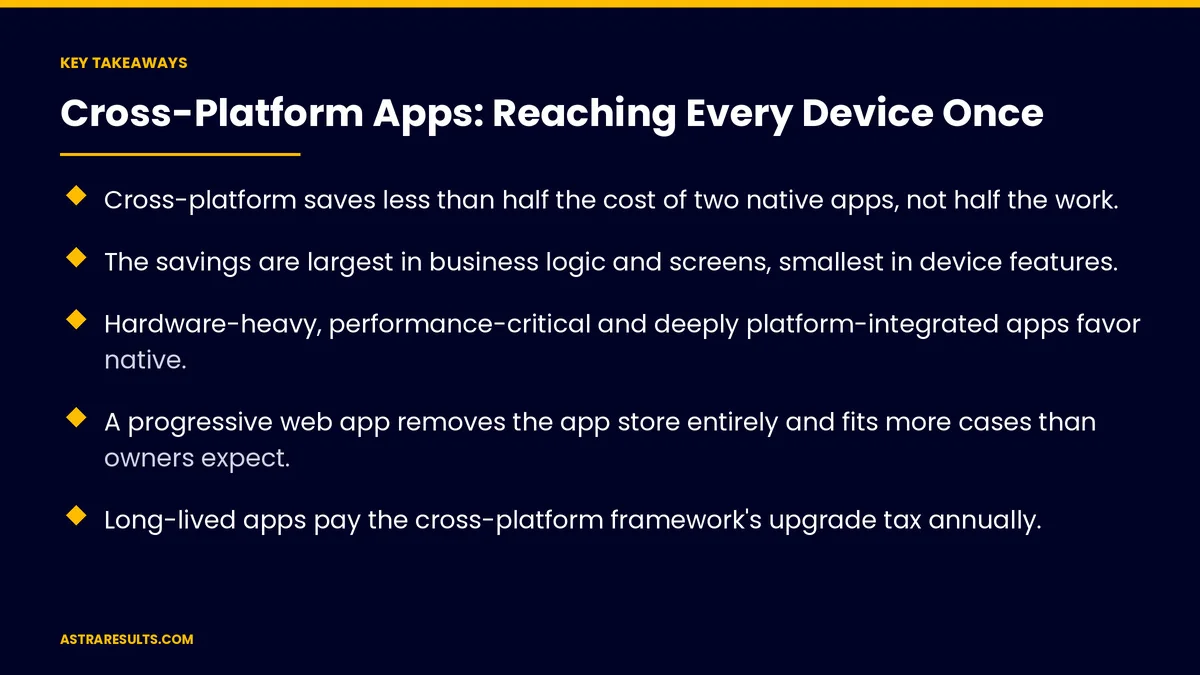
- Cross-platform saves less than half the cost of two native apps, not half the work.
- The savings are largest in business logic and screens, smallest in device features.
- Hardware-heavy, performance-critical and deeply platform-integrated apps favor native.
- A progressive web app removes the app store entirely and fits more cases than owners expect.
- Long-lived apps pay the cross-platform framework's upgrade tax annually.
- The decision follows the app's requirements, not the framework's popularity.
Published: September 12, 2026 | Reading Time: ~13 minutes | Category: Cross-Platform
This guide is the decision, made plainly. What cross-platform actually saves, where it falls short, when a progressive web app removes the need for an app at all, and the questions that settle it. The one line worth keeping: one codebase saves money on everything except the parts that make an app feel native.
Guidance for owners and operators. Nothing here is legal or technical advice. App store policies, accessibility requirements and data handling obligations vary by platform and jurisdiction and should be reviewed with counsel.
In This Playbook
- What "cross-platform" means now
- What it saves
- Where cross-platform falls short
- The progressive web app question
- The decision framework
- Cost, timeline and what drives them
- Both stores, twice
- How cross-platform projects go wrong
- What the first quarter looks like
- How this is done at Astra
What "cross-platform" means now
- The approach. One codebase, written once, compiled or rendered into apps that run on both iPhone and Android, using a framework that translates to each platform's native components.
- What it is not. A website in an app shell. Modern cross-platform frameworks produce real apps with real native components, which is why the quality gap closed.
- The mature options. Two or three frameworks dominate, each with large ecosystems and long track records. The choice between them matters less than the choice of approach.
- Where the industry landed. Most business apps that are not games and not hardware-heavy are now built cross-platform, and users cannot tell.
- What still separates them from native. Access to the newest platform features on release day, performance at the extremes, and the last ten percent of polish that platform-specific design conventions require.
What it saves
The honest arithmetic, because the common claim overstates it.
- Where the saving is real. Business logic, data handling, API integration, screens and navigation — the majority of most apps — written once instead of twice.
- Where it is not. Design still has to respect two platforms' conventions. Testing still happens on both. Store submission, review and release management happen twice. Platform-specific bugs still appear.
- The realistic number. Meaningful savings against two native builds, but well short of half, and the gap narrows as the app gets more platform-specific.
- Where it compounds. Maintenance and new features. Every subsequent change is written once, which over three years is a larger saving than the initial build.
- The team argument. One team that knows one codebase, rather than two teams that do not talk, discussed in the maintenance nobody budgets.
Where cross-platform falls short
- Heavy hardware use. Continuous camera processing, computer vision on device, complex sensor work, Bluetooth peripherals, rugged scanner hardware. Native handles these better and sometimes exclusively.
- Performance at the extremes. Long lists with rich content, real-time graphics, animation-dense interfaces. Most business apps never approach this line; some do.
- Day-one platform features. A new operating system capability is available natively immediately and in a framework when the framework supports it, which can be months.
- Deep platform integration. Widgets, watch apps, platform payment and wallet features, background execution that fights each platform's rules differently.
- Very long-lived apps. Over five to ten years, the accumulated framework migrations may cost more than platform-native maintenance would have.
- The practical filter. If the app spends most of its time showing information and capturing input, cross-platform fits. If it spends most of its time talking to hardware, it may not.
The progressive web app question
Before building any app, this deserves a serious answer.
- What it is. A website built to behave like an app: installable to the home screen, works offline, sends notifications on most platforms, and updates without a store.
- What it removes. App store review, store policies, two submission processes, install friction, and update delays. Users reach it by link.
- Where it fits well. Tools customers use occasionally, internal tools for staff, content and account access, booking and ordering — anything that does not need deep device features.
- Where it does not. Heavy offline use, complex hardware access, and cases where being in the app store is itself the point for credibility or discovery.
- The real limitation. Platform support for web app capabilities is uneven, particularly on iOS, and changes over time. The question has to be re-asked rather than answered once.
- The pattern worth considering. A progressive web app first to prove demand, and a native or cross-platform app once usage justifies it.
The decision framework
Six questions, answered in order.
- Does this need to be an app at all? If the answer is a link and a home-screen icon, a progressive web app may finish the conversation.
- Who uses it? A workforce on company Android devices needs one platform. Customers need both.
- How hardware-heavy is it? Camera, sensors, Bluetooth, scanners, background location. Heavy points to native.
- How long will it live? Two years favors cross-platform. Ten years shifts the calculation.
- What is the release cadence? Frequent feature releases benefit most from one codebase.
- What does the team look like? An existing team's skills are a legitimate input, not an afterthought.
- The sequence that saves money. Answer question one before discussing frameworks.
Cost, timeline and what drives them
- Scope drives cost far more than platform choice. The number of screens, the integrations, the offline requirements and the edge cases dominate any framework difference.
- Integration is usually the largest variable. Connecting to existing systems with modern interfaces is straightforward; connecting to an old system without one is a project of its own.
- Design is not halved. Two platforms have different navigation patterns, and an app that ignores one feels wrong to half its users.
- Testing is not halved. Both platforms, multiple devices, multiple OS versions.
- Maintenance is where cross-platform wins. One set of updates, one set of dependency upgrades, one security patch cycle — although the framework itself must be kept current, which is its own annual tax.
- The three-year view. Compare build plus three years of maintenance, not the build quote alone.
Both stores, twice
Even with one codebase, distribution is two processes.
- Two review processes with different policies, different reviewers and different timelines.
- Two sets of requirements for privacy disclosures, permissions justification and account deletion.
- Two release schedules to coordinate so users on both platforms get the same version.
- Two sets of store assets: screenshots at platform-specific sizes, descriptions and previews.
- Two feedback streams of reviews to monitor and answer.
- The planning implication. Store work is a real line in the schedule, not an afterthought at launch, according to distribution requirements.
How cross-platform projects go wrong
- Choosing the framework before the requirements. The decision made on popularity, then the requirements discovered to fight it.
- Ignoring platform conventions. An app that looks like an Android app on iPhone reads as cheap to iPhone users, and the reverse.
- Underestimating the native bridge. The one feature that needs platform-specific code becomes the majority of the difficulty.
- No maintenance plan for the framework itself. Framework versions age, dependencies break, and a two-year-old project can require significant work to build at all.
- Building an app that should have been a web app, and discovering it after paying for two store listings nobody installs.
What the first quarter looks like
Days 1–30: decide on the evidence
The six questions answered in writing, starting with whether this needs to be an app. Hardware requirements listed. Expected lifespan and release cadence stated. If a progressive web app fits, that path tested first with a prototype.
Days 31–60: build the core
The smallest useful version on the chosen approach, respecting both platforms' navigation conventions. Tested on real devices at both ends of the supported range. Store accounts, policies and assets prepared in parallel rather than at the end.
Days 61–90: submit and learn
Both submissions, with time budgeted for rejection and resubmission. A pilot group using it daily. Crash and performance data by platform. The maintenance plan and framework upgrade cadence agreed before launch.
How this is done at Astra
Astra Results Marketing answers whether the thing needs to be an app before discussing frameworks, and recommends a progressive web app where one fits, because two store listings nobody installs is an expensive way to learn. When an app is right, the approach follows the requirements: hardware-heavy and long-lived work points native, information-and-input work points cross-platform.
Both platforms' navigation conventions are respected so the app does not read as cheap to half its users, store work is scheduled rather than improvised, and the estimate compares build plus three years of maintenance rather than the build alone. Engagements begin with the six-question assessment through our UI/UX development and design team.
Related reading
Frequently asked questions
How much does cross-platform save?
Meaningfully, but well short of half. The saving is real in business logic, data handling, integrations, screens and navigation — the majority of most apps. It is not real in design, which must respect two platforms' conventions, in testing, which happens on both, or in store submission and release management, which happen twice. The larger saving arrives in maintenance, where every change is written once.
When is native the better choice?
When the app uses hardware heavily — continuous camera processing, on-device vision, complex sensors, Bluetooth peripherals, rugged scanners — when performance is at the extremes, when day-one access to new platform features matters, when deep platform integration like widgets or wallet features is central, or when the app is expected to live five to ten years and accumulate framework migrations.
What is a progressive web app and when does it fit?
A website built to behave like an app: installable to the home screen, works offline, sends notifications on most platforms, updates without a store. It removes review, policies, two submissions, install friction and update delays. It fits tools used occasionally, internal staff tools, content and account access, booking and ordering. It does not fit heavy offline use, complex hardware access, or cases where store presence is itself the point.
How should the decision be made?
Six questions in order: does this need to be an app at all, who uses it, how hardware-heavy is it, how long will it live, what is the release cadence, and what does the team look like. Answering the first before discussing frameworks is what saves money — the most common expensive mistake is building an app that should have been a web app.
Does one codebase mean one release process?
No. Two review processes with different policies and timelines, two sets of privacy and permission requirements, two release schedules to coordinate, two sets of store assets at platform-specific sizes, and two feedback streams to monitor. Store work is a real line in the project schedule rather than an afterthought at launch.
What should the cost comparison include?
Build plus three years of maintenance, not the build quote alone. Scope drives cost far more than platform choice, integration with existing systems is usually the largest variable, and design and testing are not halved by a shared codebase. Cross-platform wins on maintenance — one set of updates and patches — though the framework itself must be kept current, which is its own annual tax.
READY TO FIND OUT WHETHER YOU NEED AN APP AT ALL? Astra Results Marketing answers that question before discussing frameworks, recommends a web app where one fits, and compares build plus three years of maintenance rather than the build quote alone. Astra Results Marketing · 1101 Brickell Ave, Miami, FL 33131 · +1 (786) 321-2866 · [email protected] Find us on Google · Yelp ▸ CALL (786) 321-2866 · ▸ REQUEST YOUR CONSULTATION