Rated 5 star on

iPad Apps for Business: The Larger Screen, Used Well
Quick answer
The iPad wins where the screen is shared with another person or the work is spatial: signing, presenting, marking up plans, checking people in. An enlarged phone layout fails on it. Kiosk deployments need device management and physical planning, not just an app, and field apps have to work with no signal at all.
The iPad sits in a specific place in business: too large for a pocket, too limited to replace a workstation, and better than both at a particular set of jobs. It is the device handed to a customer to sign, the plans a foreman holds on site, the check-in counter that used to be a laptop and a printer.
Key Takeaways
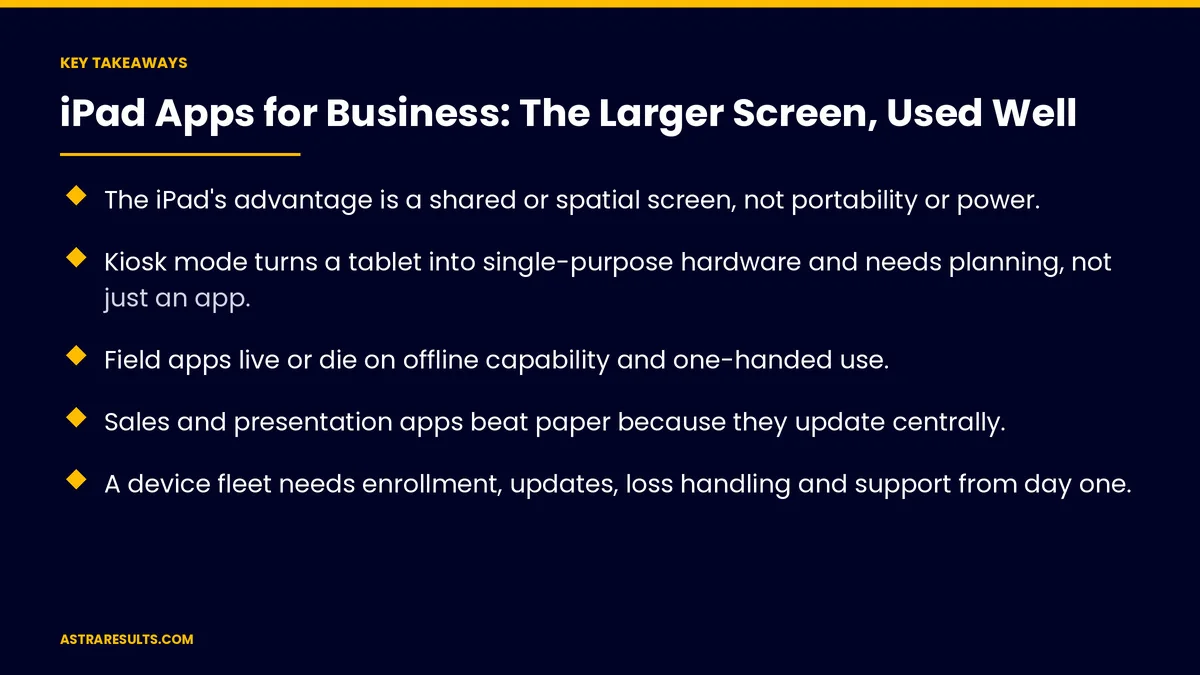
- The iPad's advantage is a shared or spatial screen, not portability or power.
- Kiosk mode turns a tablet into single-purpose hardware and needs planning, not just an app.
- Field apps live or die on offline capability and one-handed use.
- Sales and presentation apps beat paper because they update centrally.
- A device fleet needs enrollment, updates, loss handling and support from day one.
- A phone app enlarged is not an iPad app; layout is the work.
Published: September 15, 2026 | Reading Time: ~13 minutes | Category: iPad
This guide covers those jobs and what building for them requires. Where an iPad genuinely beats a phone or a laptop, what a kiosk deployment involves, why field apps need offline-first design, and how to manage a fleet of devices that customers and staff will handle all day. The sentence to carry out of this: the iPad wins where the screen is shared or the work is spatial.
Guidance for owners and operators. Nothing here is legal advice. Device deployment involving customer data, employee monitoring or regulated records carries obligations that vary by jurisdiction and sector and should be reviewed with counsel.
In This Playbook
- Where the iPad wins
- Which jobs suit a kiosk deployment?
- Field apps: plans, forms and evidence
- Sales and presentation apps
- Layout: why an enlarged phone app fails
- Managing a fleet
- Security and customer data
- How the first quarter runs
- In practice, with Astra
Where the iPad wins
- The shared screen. Handing a device to a customer to review, choose, sign or pay. A phone is too small to share; a laptop faces the wrong way.
- Spatial work. Plans, drawings, floor layouts, seating charts, diagrams — anything where seeing the whole thing matters and pinching to zoom on a phone is a workaround.
- Fixed-position tasks. Check-in counters, self-service stations, showroom displays, order stations. The device sits somewhere and does one job.
- Forms with context. A long inspection form where the previous answers, a reference photo and the current field all need to be visible at once.
- Where it does not win. Anything done while walking and carrying something else, anything needing a real keyboard for hours, and anything a phone already does adequately.
- The blunt test. If a phone would do, build for the phone. The iPad's cost is justified by the screen, which is the subject of choosing the device for the job.
Which jobs suit a kiosk deployment?
Turning a tablet into single-purpose hardware is a project, not a setting.
- What kiosk mode does. Locks the device to one app, disables the home gesture and switching, and prevents anyone wandering into settings or a browser.
- What it does not do. Protect against theft, handle the power cable, or stop a customer leaving the app in a strange state.
- The physical layer. Mounting, enclosures, cable management, charging, and orientation that survives being pushed around all day. This is often more of the project than the software.
- Session hygiene. Resetting to a clean state between customers, clearing entered data, and timing out an abandoned session so the next person does not see the previous one's information.
- Failure behavior. What the screen shows when the network is down or the app crashes. A blank tablet at a check-in desk is a staff problem immediately.
- Accessibility. A kiosk that only works for a standing adult with good vision excludes customers and, in many jurisdictions, creates legal exposure. Counsel confirms the requirements.
Field apps: plans, forms and evidence
- The job. Replacing the clipboard, the printed plan and the camera roll with one device that captures structured work on site.
- Offline first. Construction sites, warehouses and remote locations lose signal. The app must function fully without it and sync when it returns, the mechanics of which are in what field apps must survive.
- Markup on documents. Annotating a plan, drawing on a photo, flagging a location. This is where the larger screen earns its place.
- Evidence capture. Photographs tied to the item they document, timestamped and located, so the record is defensible later.
- One-handed reality. A person holding an iPad in one hand and a tool in the other needs large targets and minimal typing. Voice input where it fits.
- Durability. Cases rated for drops, and an acceptance that site devices have a shorter life than office devices.
Sales and presentation apps
- Why they beat printed material. Always current, personalized to the customer in front of you, and able to show configurations, calculations and comparisons that paper cannot.
- The core pattern. A guided conversation: options presented, choices captured, a price produced, and a document generated and sent before the salesperson leaves.
- The integration that matters. Pushing the outcome into the CRM and the quoting system immediately, so nothing is rekeyed and the follow-up is automatic, set out in closing the loop in the CRM.
- Offline again. Showrooms have poor signal more often than anyone expects, and a sales app that stalls in front of a customer is worse than a brochure.
- Content control. Updated centrally so every representative shows the current pricing and the approved claims, which is a compliance benefit as much as a marketing one.
Layout: why an enlarged phone app fails
- The temptation. Run the phone app on the tablet and call it supported.
- Why it reads badly. Stretched layouts, enormous touch targets, a single column of content across a wide screen, and wasted space that makes the app feel unfinished.
- What the larger screen expects. Multiple panes — a list beside a detail view — so navigation happens less and context is visible.
- Orientation. Both, handled properly. A kiosk may be locked to one; a field device will be rotated constantly.
- External input. Keyboard and trackpad support where people will attach them, and pencil input where annotation is the job.
- Multitasking. Sharing the screen with another app, which some business users expect and which affects how layouts must behave.
- The effort involved. Supporting the iPad properly is real design work, which is why "we support iPad" and "we designed for iPad" are different claims.
Managing a fleet
Devices in customers' and staff hands all day need an operational plan.
- Enrollment. Devices registered in a management system that pushes the app, enforces settings and restrictions, and can wipe remotely.
- Supervised configuration. Locking down what a device can do so a staff member cannot install personal apps on a work tablet or a customer cannot leave a kiosk app.
- Update control. Staged rollout so a bad version does not reach every location at once, and control over OS updates that could break the app.
- Loss and damage. A replacement process measured in a day, not a week, because a missing check-in tablet stops a counter working.
- Charging and battery life. Devices in constant use degrade; plan replacement cycles rather than discovering them.
- Support. Someone staff can call, with a path to escalate, according to device fleet management.
Security and customer data
- Devices handled by the public hold or display customer information and need care that office hardware does not.
- At rest. Encryption, short auto-lock, and no sensitive data cached longer than needed.
- Between sessions. Clearing everything the previous customer entered, verifiably.
- Lost devices. Remote wipe tested before deployment, not after an incident.
- What is shown. Screens visible in public should not display more customer data than the task requires.
- The regulated case. In health, financial or legal contexts, device deployment is part of the compliance picture and goes to counsel before rollout.
How the first quarter runs
Days 1–30: justify and design
The job named, and tested against whether a phone or a laptop would do. The layout designed for the larger screen rather than adapted. Offline behavior specified. Physical requirements — mounting, cases, charging — scoped. Privacy and accessibility requirements confirmed with counsel.
Days 31–60: build and configure
The app built with multi-pane layouts, both orientations and offline-first sync. Device management configured with enrollment, restrictions and staged updates. Session reset and failure screens built for kiosk deployments.
Days 61–90: pilot in place
One location or one crew using it in real conditions for several weeks. Failure modes recorded: signal loss, battery, drops, confused customers. Support path and replacement process tested before wider rollout.
In practice, with Astra
Astra Results Marketing starts by testing whether the iPad is the right device at all, because a phone app or a web tool is the better answer and costs less. When the screen is the reason — shared with a customer, spatial, or fixed in place — the layout is designed for it rather than enlarged from a phone.
Offline-first behavior, session hygiene, failure screens and the physical setup are specified before the build, and device management, replacement and support are in place before rollout rather than after the first lost tablet. Engagements begin with a device and workflow assessment through our UI/UX development and design team.
Related reading
Frequently asked questions
When is an iPad the right device rather than a phone or laptop?
When the screen is shared — handing a device to a customer to review, choose, sign or pay — or when the work is spatial, such as plans, layouts and diagrams where seeing the whole thing matters. Also for fixed-position tasks like check-in counters and order stations, and for long forms where previous answers and a reference photo must be visible at once. If a phone would do, build for the phone.
What does a kiosk deployment involve beyond the app?
Kiosk mode locks the device to one app and prevents switching, but the project is mostly physical and operational: mounting, enclosures, cable management, charging and orientation that survives all-day handling. Plus session hygiene that resets to a clean state between customers, failure screens for when the network drops, and accessibility that does not exclude customers — which counsel should confirm.
Why must field apps work offline?
Because construction sites, warehouses and remote locations lose signal, and an app that fails there gets abandoned within a week. It must function fully offline and sync when connection returns. The larger screen earns its place through markup on plans and photos, and the design has to assume one-handed use with large targets and minimal typing, since the other hand is holding a tool.
What makes a sales app better than printed material?
It is always current, personalized to the customer present, and can show configurations, calculations and comparisons paper cannot. The pattern is a guided conversation that captures choices, produces a price and generates a document before the salesperson leaves, pushed straight into the CRM and quoting system so nothing is rekeyed. Content updated centrally also means every representative shows approved pricing and claims.
Why is an enlarged phone app not an iPad app?
Because stretched layouts, enormous touch targets and a single column across a wide screen read as unfinished. The larger screen expects multiple panes — a list beside a detail view — so navigation happens less and context stays visible, both orientations handled properly, keyboard and pencil input where relevant, and multitasking behavior. "We support iPad" and "we designed for iPad" are different claims.
What does managing a fleet of tablets require?
Enrollment in a management system that pushes the app, enforces restrictions and can wipe remotely; supervised configuration so staff cannot install personal apps and customers cannot exit a kiosk; staged update rollout including control over OS updates; a replacement process measured in a day, because a missing check-in tablet stops a counter working; planned battery replacement cycles; and a support path staff can call.
READY TO PUT THE RIGHT DEVICE IN THE RIGHT HANDS? Astra Results Marketing tests whether an iPad is the right device before building one, designs for the larger screen rather than enlarging a phone app, and puts fleet management and support in place before rollout. Astra Results Marketing · 1101 Brickell Ave, Miami, FL 33131 · +1 (786) 321-2866 · [email protected] Find us on Google · Yelp ▸ CALL (786) 321-2866 · ▸ REQUEST YOUR CONSULTATION