 Rated 5 star on

SaaS SEO: Ranking for the Problem, Not the Product
Quick answer
SaaS companies win organic search by answering the problems buyers search before they know a product exists. Build content in layers: problems, solutions, comparisons, integrations, use cases and documentation. Show the product solving the problem with real examples. Keep comparison pages fair, avoid thin mass-produced pages and measure signups from organic search.
Most software companies optimize for their product name and category, then wonder why organic signups stay flat. The trouble is timing. Long before someone searches "scheduling software for clinics," they search "how to reduce patient no-shows." The company that answers that first question earns the visit, the trust and often the trial.
Key Takeaways
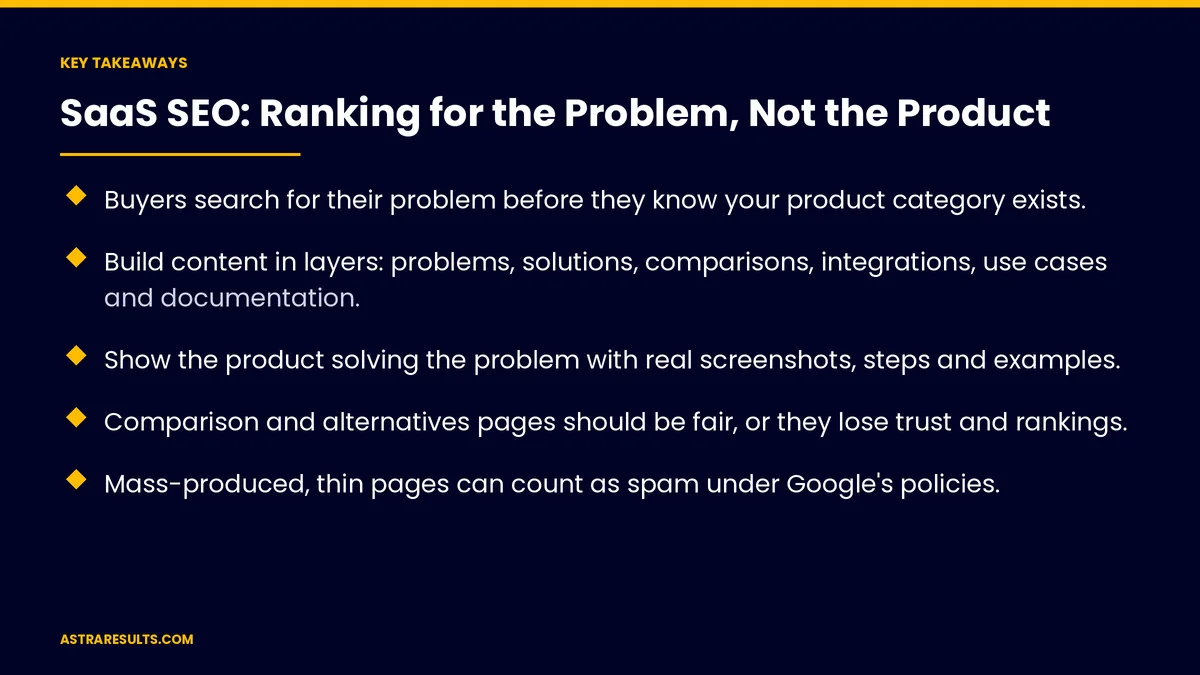
- Buyers search for their problem before they know your product category exists.
- Build content in layers: problems, solutions, comparisons, integrations, use cases and documentation.
- Show the product solving the problem with real screenshots, steps and examples.
- Comparison and alternatives pages should be fair, or they lose trust and rankings.
- Mass-produced, thin pages can count as spam under Google's policies.
- Measure signups, activation and pipeline from organic search, not visits alone.
Published: October 23, 2026 | Reading Time: ~9 minutes | Category: Search Engine Optimization
This guide covers how SaaS companies build search around the problems buyers have: problem content, solution pages, fair comparisons, integrations, use cases and documentation, plus the pitfalls of mass-produced pages and how to measure what matters. Put plainly: answer the problem first, show the product solving it second, and measure trials, not traffic.
In This Playbook
- Why product keywords aren't enough
- How should SaaS problem content be planned?
- Layer 2: solution and product pages
- Layer 3: comparisons and alternatives
- Layer 4: integrations and use cases
- Layer 5: documentation and help content
- Mass-produced pages: a real risk
- Technical basics for SaaS sites
- What to measure
- The first three months
Why product keywords aren't enough
Few people know your category yet. Searches for software categories are small compared with searches for the problems behind them.
Category searches are crowded. Large competitors and review sites dominate them.
Problem searches come earlier. They reach buyers before a shortlist forms.
AI answers start here too. People ask assistants about problems first, as covered in AI Overviews vs classic rankings.
How should SaaS problem content be planned?
Start with real questions. Ask sales, support and customers what problems bring people to you.
Answer fully. Explain the problem, its causes and the ways to solve it, including ways that don't need your product.
Earn trust first. A useful answer that mentions your product naturally beats a sales pitch.
Link to the next step. From the problem page to the solution page that shows how your product helps.
Layer 2: solution and product pages
Show the product solving the problem. Real screenshots, short steps and examples.
One problem per page. A page for "reducing no-shows" and another for "filling cancellations," not one page for everything.
Clear next action. Start a trial, book a demo or see pricing, with one main action per page, as covered in conversion-focused design.
Video helps. Short product demos on their own pages can appear in video results, as covered in video pages that rank.
Layer 3: comparisons and alternatives
People search them late in the decision. "Tool A vs Tool B" and "alternatives to Tool A."
Be fair. Say where competitors are stronger and who they suit. Readers notice spin.
Keep facts current. Pricing and features change; date your comparisons and update them.
Paid search for competitor terms has its own rules and costs, weighed in Search, Performance Max or both.
Layer 4: integrations and use cases
Integration pages. "Your product + their tool": what connects, how it works and why it helps.
Use-case pages. How a specific team or task uses the product.
Industry pages. Only where you have real customers and examples in that industry.
Avoid copies. Each page needs its own substance, not the same text with a new name.
Layer 5: documentation and help content
Docs are search content too. People search how to do specific tasks, often after they've signed up.
Make them findable. Clear titles, one task per page and plain steps.
They help sales as well. Prospects read docs to see whether the product does what they need.
Mass-produced pages: a real risk
The temptation. Generate hundreds of pages from a template, one per city, industry or keyword.
The risk. Thin, near-identical pages can count as scaled content abuse under Google's spam policies and hurt the whole site.
The safer path. Fewer pages, each with real substance: examples, data, screenshots and answers.
Check partners too. Be wary of anyone promising rankings from mass-produced content, as covered in AI SEO partners.
Technical basics for SaaS sites
Marketing pages must be readable by search engines. Content that only appears after scripts run can be missed.
Fast pages. Especially on mobile.
Clean structure. Logical links from problems to solutions to pricing.
Keep the app separate. Logged-in app pages generally shouldn't be indexed.
The wider approach is covered in SEO for growth companies.
What to measure
Trials and demos from organic search. The first real signal.
Activation. How many organic signups become active users.
Pipeline and revenue. Deals and subscriptions traced to organic visits, as covered in website KPIs.
Problem-page assists. How often problem content appears in the path to a signup.
Rankings for problem topics. Not just product and category terms.
The first three months
Days 1–30: map problems
Collect the questions buyers ask from sales, support and customers. Map each problem to a solution page and a product feature. Set up tracking for trials, activation and pipeline from organic search.
Days 31–60: publish the core
Publish the most important problem pages and their matching solution pages, with real screenshots and examples. Add fair comparison pages for the competitors buyers mention most.
Days 61–90: expand and measure
Add integration and use-case pages where you have real substance, and improve the documentation that prospects read. Measure trials, activation and problem-page assists, and plan the next set of topics.
How Astra builds SaaS SEO
Astra Results Marketing builds SaaS search programs around the problems buyers search for first. We map real questions from your sales and support teams, publish problem pages that lead to solution pages showing your product at work, and add fair comparisons, integrations and documentation.
We avoid mass-produced pages and measure trials, activation and pipeline, not traffic alone. Engagements begin with a problem and keyword review through our search engine optimization team.
Related reading
Frequently asked questions
Why shouldn't SaaS companies focus on product keywords?
Product and category searches are small and crowded. Buyers search for their problems first, so answering those earlier questions reaches them before a shortlist forms.
What is problem-first content?
Pages that explain a problem buyers have, its causes and the ways to solve it, including options that don't need your product. They earn trust and lead naturally to pages showing how your product helps.
Should we publish comparison pages?
Yes, if they're fair and current. Say where competitors are stronger and who they suit, date the comparison and update pricing and features as they change.
Are programmatic SEO pages safe?
Thin, near-identical pages made from a template can count as scaled content abuse under Google's spam policies. Publish fewer pages with real substance instead.
Does documentation help SEO?
Yes. People search for how to do specific tasks, and prospects read docs to check whether a product fits. Clear, task-focused docs help both.
What should we measure?
Trials and demos from organic search, activation, pipeline and revenue, and how often problem pages appear in the path to signup, not just visits and rankings.
Ready to meet buyers at their first question? Astra Results Marketing builds SaaS search around the problems your buyers search for, connects problem content to product pages, adds fair comparisons and docs, and measures trials and pipeline from organic search. ▸ CALL (786) 321-2866 · ▸ REQUEST YOUR CONSULTATION





