 Rated 5 star on


Black Friday Planning Starts in August
Quick answer
Black Friday planning should start in August, because stock, lists and site testing all take time. In August, set goals, order inventory and plan offers that protect margin. In September, build creative and grow lists with consent. In October, test the site and freeze big changes. In November, launch on schedule and watch orders daily.
Stores that win Black Friday rarely start in November. Stock takes months to arrive, lists take time to grow and the site must be stable before traffic spikes. With this season just ended, now is the time to write down what worked and set the plan for next year, when Black Friday falls on November 26, 2027.
Key Takeaways
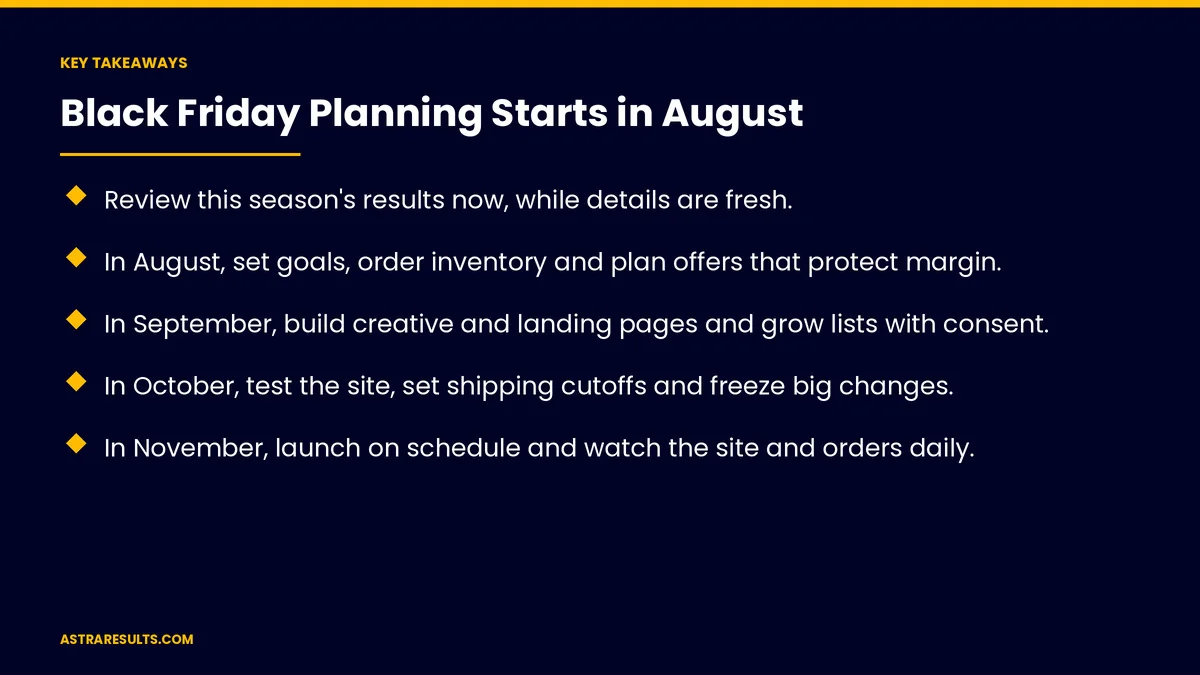
- Review this season's results now, while details are fresh.
- In August, set goals, order inventory and plan offers that protect margin.
- In September, build creative and landing pages and grow lists with consent.
- In October, test the site, set shipping cutoffs and freeze big changes.
- In November, launch on schedule and watch the site and orders daily.
- Use real former prices, real deadlines and shipping promises you can keep.
Published: October 1, 2026 | Reading Time: ~8 minutes | Category: E-Commerce Marketing
This guide is a month-by-month plan: what to review now, August goals and stock, September creative and lists, October testing and freezes, the November launch, after the sales, pricing and shipping rules and what to measure. Put plainly: decide in August, build in September, test in October and run a calm November.
In This Playbook
- Review this season now
- August: goals and stock
- September: creative and lists
- What should online stores test in October?
- November: launch and watch
- After the sales
- Pricing and shipping rules
- What to measure
- The first three months of the plan
Review this season now
What sold. Top products, offers and bundles.
What didn't. Slow items and offers that hurt margin.
Where traffic came from. Email, ads, search and social.
What broke. Site slowdowns, stockouts or shipping delays.
Write it down. A short report you'll use in August.
August: goals and stock
Set goals. Revenue, orders and new customers.
Order inventory. Allow for supplier lead times.
Plan offers. Discounts, bundles and gifts that protect margin.
Check the stack. Platform, email and analytics, as covered in the e-commerce stack.
September: creative and lists
Creative. Images, video and copy for each offer.
Landing pages. One per major offer, as with launch pages.
Grow email and text lists. With clear consent.
Early access. Sign-ups for subscribers who want first pick.
Site speed. Remove apps you don't need, as covered in Shopify apps.
What should online stores test in October?
Test checkout. On phones, with every payment method.
Load and uptime checks. As covered in uptime monitoring.
Shipping cutoffs. Dates for holiday delivery, by method and region.
Freeze big changes. Finish updates early, as covered in plugin and theme updates.
Support and fraud. Staff schedules and fraud screening ready.
Warm up ads. Start campaigns early enough to learn.
November: launch and watch
Launch on schedule. Early access first, then public offers.
Daily reviews. Sales, stock, ad spend and site health.
Fast fixes. A short list of who can change what.
Cyber Monday. November 29, 2027, with its own offers.
After the sales
Returns. Clear rules and fast processing.
Keep new customers. Welcome emails and a reason to come back.
International orders. Duties and delivery, as covered in international shipping.
January review. Compare results with goals.
Pricing and shipping rules
Real former prices. "Was" prices must reflect real past prices.
Real deadlines. Countdowns only for actual end times, as covered in creative compliance.
Shipping promises. The FTC's mail order rule requires shipping within the time you state, or within 30 days if you don't state one.
Giving season. Nonprofits plan their own peak, as in nonprofit online stores.
What to measure
Revenue and margin. Not just sales.
New customers. And how many buy again.
Conversion rate. On mobile and desktop.
Site uptime. During peak days.
On-time shipping. Against promised dates.
The first three months of the plan
August
Review last season's notes, set goals, order inventory with lead times in mind and plan offers that protect margin.
September
Build creative and landing pages, grow email and text lists with consent and remove apps that slow the site.
October
Test checkout and uptime, set shipping cutoffs, freeze big changes and warm up ad campaigns.
How Astra plans Black Friday
Astra Results Marketing plans Black Friday and Cyber Monday for online stores starting in August. We review last season, set goals and offers, build creative and pages, grow lists with consent, test the site and run a calm November.
Engagements begin with a holiday plan through our e-commerce marketing team.
Related reading
Frequently asked questions
When should Black Friday planning start?
In August, with goals, inventory and offers, so creative, lists and site testing are done before November.
When is Black Friday in 2027?
Friday, November 26, 2027, with Cyber Monday on November 29.
What should we review after this season?
What sold, what didn't, where traffic came from and what broke, written down while details are fresh.
Why freeze site changes in October?
Big updates close to peak traffic can break checkout. Finish them early and test.
What pricing rules apply to holiday sales?
"Was" prices must reflect real past prices, countdowns must match real deadlines and shipping promises must be kept.
What happens after Cyber Monday?
Process returns quickly, welcome new customers and review results against goals in January.
Ready for a calm, profitable Black Friday? Astra Results Marketing plans holiday sales from August: goals, stock, offers, creative, lists and site testing, so November runs smoothly and margins hold. ▸ CALL (786) 321-2866 · ▸ REQUEST YOUR CONSULTATION





