 Rated 5 star on

Uptime Monitoring: Knowing Before Customers Do
Quick answer
Uptime monitoring checks your site from outside every minute or few and alerts the right person when something breaks. Watch key pages, forms and checkout, not just the home page. Track certificate and domain expiry dates. Confirm outages from more than one location. Keep a written plan for who acts and how to roll back.
Too many businesses learn their website is down from a customer, or from a quiet week of no leads. By then, the damage is done: lost bookings, wasted ad spend and visitors who won't come back. Uptime monitoring checks the site around the clock and alerts the right person within minutes, so problems get fixed before most customers notice.
Key Takeaways
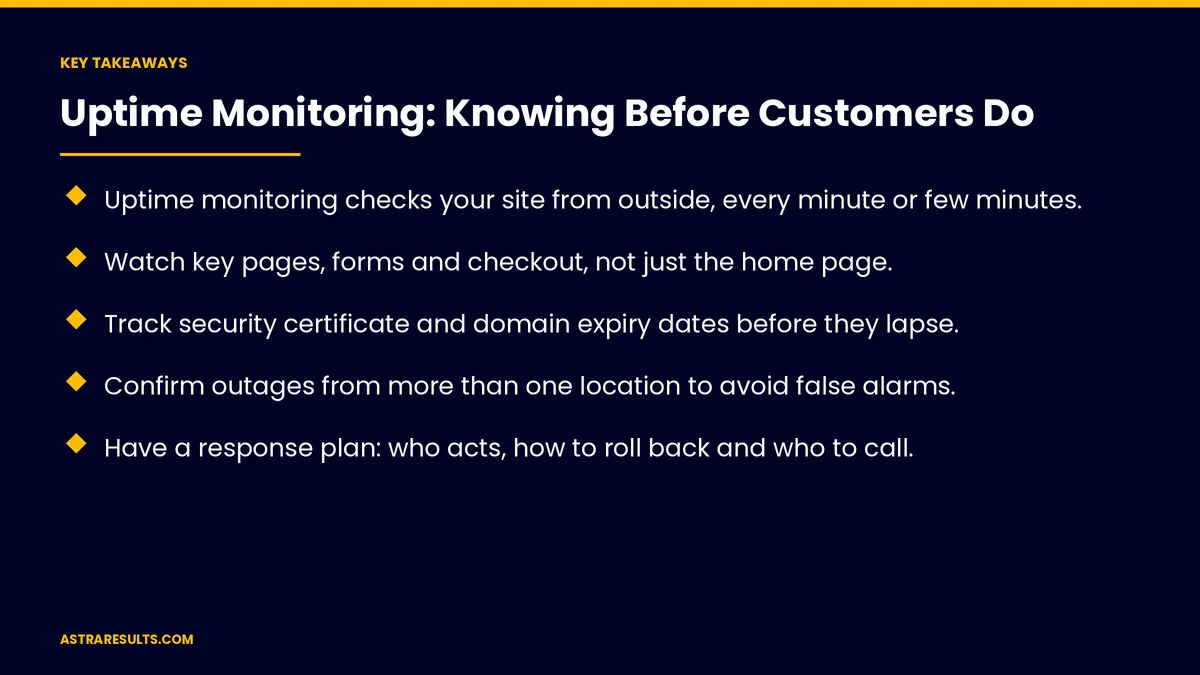
- Uptime monitoring checks your site from outside, every minute or few minutes.
- Watch key pages, forms and checkout, not just the home page.
- Track security certificate and domain expiry dates before they lapse.
- Confirm outages from more than one location to avoid false alarms.
- Have a response plan: who acts, how to roll back and who to call.
- 99.9% uptime still allows about 43 minutes of downtime a month.
Published: October 27, 2026 | Reading Time: ~8 minutes | Category: Website Care Plans
This guide covers uptime monitoring: how it works, what to watch beyond the home page, alerts that matter, responding to an outage, uptime targets in plain numbers, status pages, reports and what to measure. Put plainly: check the site every few minutes, alert the right person fast and have a plan ready.
In This Playbook
- How monitoring works
- What to watch
- Alerts that matter
- Responding to an outage
- Uptime targets in plain numbers
- Status pages
- Reports
- Who should watch
- What to measure
- The first three months
How monitoring works
Outside checks. A service visits your site from the internet every minute or few minutes.
Several locations. Checks from different places confirm a real outage.
Alerts. Sent within minutes when checks fail.
Recovery notices. Sent when the site is back.
What to watch
Key pages. Home, services, contact and top landing pages.
Forms. Scripted tests that fill in and send a form.
Checkout and booking. Test transactions, as covered in website integrations.
Security certificates. Alerts weeks before they expire.
Domains. Renewal reminders before the name lapses.
Speed and errors. Slow pages and error messages.
Connected systems. Integrations that can fail quietly, as covered in when integrations break.
Alerts that matter
The right person. Whoever can act, not a shared inbox.
The right channel. Text or chat for urgent problems, email for warnings.
Confirm first. Alert only when more than one location sees the failure.
Escalate. If nobody responds, alert the next person.
Avoid alert fatigue. Too many alerts get ignored.
Responding to an outage
A written plan. Who checks, who fixes and who tells customers.
Common fixes. Hosting issues, an expired certificate or a bad update.
Roll back updates. If an update caused it, as covered in plugin and theme updates.
Restore from backup. When needed, as covered in backups and restores.
Pause ads. If the site will be down for long.
Uptime targets in plain numbers
99% uptime. About 7 hours of downtime a month.
99.9% uptime. About 43 minutes a month.
99.99% uptime. About 4 minutes a month.
Pick a target that fits. Higher targets cost more in hosting and support.
Status pages
Tell customers what's happening. For sites people depend on, such as portals or booking.
Updates during outages. Short and regular.
Reports
Monthly uptime. Against your target.
Outages and causes. What happened and what was fixed.
Response times. From alert to fix.
Trends. Recurring problems to solve for good.
Part of website care. As covered in website care plans.
Who should watch
In-house or care plan. Either works with a clear owner, as weighed in care plan or freelancer.
Apps too. Apps need monitoring of their servers as well, as in taking over an app.
What to measure
Uptime percentage. Monthly.
Time to detect. From failure to alert.
Time to fix. From alert to recovery.
False alarms. Alerts that weren't real.
Expired certificates and domains. Should be zero.
Revenue impact. As tracked in website KPIs.
The first three months
Days 1–30: set up checks
Monitor key pages, forms and checkout from several locations, and add certificate and domain expiry alerts.
Days 31–60: alerts and plan
Route alerts to the people who can act, set escalation and write the outage response plan.
Days 61–90: report and improve
Report uptime and response times monthly, fix recurring causes and tune alerts to cut false alarms.
How Astra monitors websites
Astra Results Marketing monitors websites around the clock. We check key pages, forms and checkout from several locations, watch certificates and domains, alert the right person fast and follow a response plan.
We report uptime and fixes every month. Engagements begin with a monitoring setup through our website care plans team.
Related reading
Frequently asked questions
What is uptime monitoring?
A service that checks your website from outside every minute or few minutes and alerts you when it's down or broken.
Is checking the home page enough?
No. Also check key pages, forms, checkout, security certificates, domain expiry and connected systems.
How do we avoid false alarms?
Confirm failures from more than one location before alerting, and tune alerts so only real problems reach people.
What does 99.9% uptime mean?
About 43 minutes of downtime a month. 99% allows about 7 hours; 99.99% about 4 minutes.
What should we do when the site goes down?
Follow a written plan: check the cause, roll back recent updates or restore from backup, pause ads if needed and tell customers.
Who should get the alerts?
The person who can act, by text or chat for urgent problems, with escalation if nobody responds.
Ready to know about outages before your customers do? Astra Results Marketing monitors key pages, forms and checkout around the clock, alerts the right person fast and follows a plan that gets your site back quickly. ▸ CALL (786) 321-2866 · ▸ REQUEST YOUR CONSULTATION





