 Rated 5 star on

Choosing a Mobile App Development Partner
Quick answer
The right app development partner shows live apps in the stores and offers references you can call. A good partner asks about your business before recommending native, cross-platform or web. Code, accounts and intellectual property should belong to you. Check testing and security habits, agree support terms before the build, and never choose on price alone.
Choosing who builds your app matters more than choosing the technology. A strong team with a clear process will steer you to the right approach and ship what works. A weak one can burn the budget and leave you with code and accounts you don't control. The difference shows up in a few conversations, if you ask the right questions.
Key Takeaways
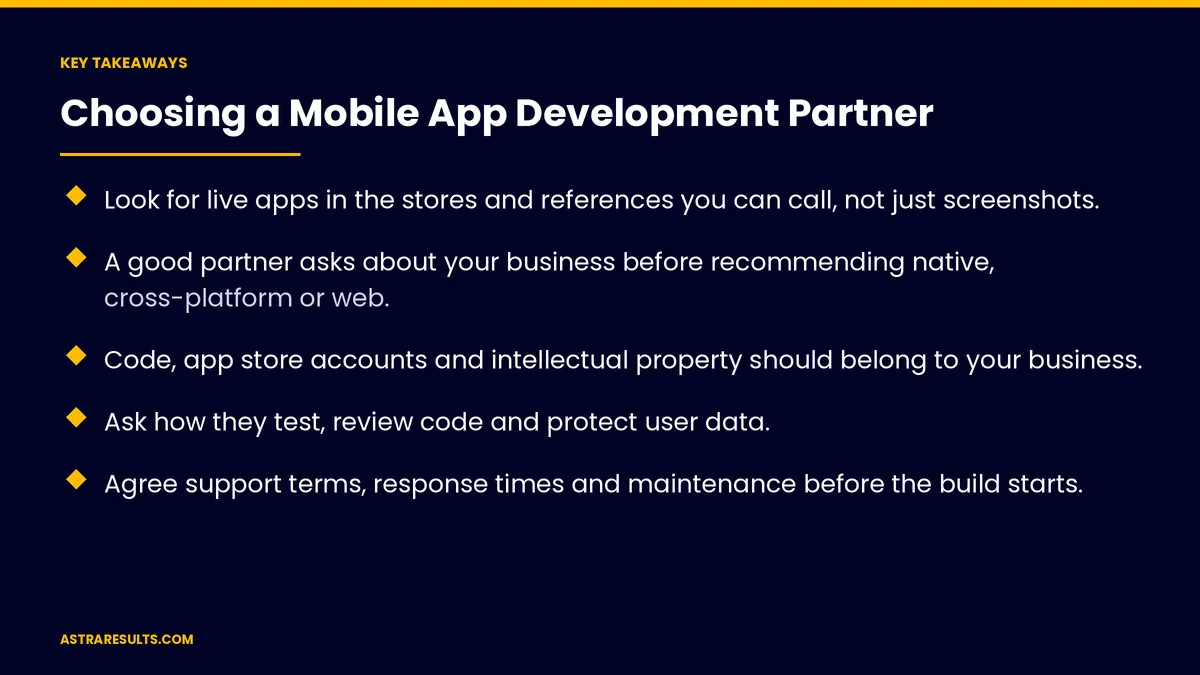
- Look for live apps in the stores and references you can call, not just screenshots.
- A good partner asks about your business before recommending native, cross-platform or web.
- Code, app store accounts and intellectual property should belong to your business.
- Ask how they test, review code and protect user data.
- Agree support terms, response times and maintenance before the build starts.
- Compare partners on scope, process and ownership, not price alone.
Published: October 9, 2026 | Reading Time: ~10 minutes | Category: Mobile App Development
This guide covers choosing an app development partner: their work, how they run projects, who owns what, quality and security, support after launch and the red flags. Put plainly: pick the team whose process, ownership terms and support you'd trust for years, not just the lowest quote.
In This Playbook
- What past work should an app developer show us?
- How they run projects
- Who does the work
- Ownership and accounts
- Quality and security
- Price and structure
- After launch
- Red flags
- Questions to ask
- What to measure once you choose
- The first three months
What past work should an app developer show us?
Live apps. Ask for apps you can download today, ideally similar in size and type to yours.
References. Speak with past clients about deadlines, communication and life after launch.
Relevant experience. Industry knowledge helps, especially in health, finance or logistics, like the needs in logistics customer apps.
Ask what went wrong. Good teams can describe a project that struggled and what they changed.
How they run projects
They start with questions. About your customers, goals and constraints, not just features.
A discovery phase. A short paid phase to define scope before committing to the full build.
Clear technology advice. A clear reason for native, cross-platform or web, as weighed in native, cross-platform or web.
Regular demos. Working software shown every week or two, not just status reports.
One point of contact. Someone who knows your project and answers quickly.
Who does the work
In-house or subcontracted. Ask who will build your app and where they're based.
Time zones. Overlapping hours make questions and fixes faster.
Team mix. Design, development, testing and project management, not just developers.
Continuity. What happens if a key person leaves.
Ownership and accounts
Code in your name. The contract should assign the code and intellectual property to your business.
Your repositories. Code stored in accounts you control, with access given to the partner.
App store accounts. Apple and Google developer accounts registered to your business, as recommended in Google Play review and policy basics.
Services and hosting. Servers, databases and third-party tools in your accounts.
Documentation. Enough for another team to take over if needed.
Quality and security
Testing on real devices. Older phones and both platforms, before every release.
Code reviews and automated tests. Habits that catch problems early and make changes cheaper.
Security basics. Safe sign-in, encrypted data and limited access.
Privacy. Collecting only what's needed and filling app store privacy forms accurately.
Compliance. Experience with any rules in your industry.
Price and structure
Compare scopes, not prices. Make sure each quote covers the same features, platforms and support.
Fixed time, flexible scope. A structure that protects the launch date, as covered in MVP timelines and budgets.
The full cost. Ask about hosting, maintenance and changes after launch, as covered in what custom software costs over five years.
Payment tied to progress. Milestones linked to working software.
After launch
Support terms. Severity levels and response times agreed in writing, as covered in response times and severity levels.
Maintenance. Yearly platform updates, security fixes and library upgrades.
Improvements. How new features are planned, priced and scheduled.
Exit plan. How code, accounts and documentation are handed over if you change partners.
Red flags
No questions about your business. A quote within hours of a first call.
Guarantees about results. Downloads, rankings or revenue promised upfront.
Very low quotes. Often missing features, testing or support.
No references or live apps. Only screenshots and mockups.
Reluctance on ownership. Code or accounts kept in the partner's name.
Vague after launch. No clear support, maintenance or response times.
Questions to ask
"Can we speak with two recent clients?"
"Who exactly will work on our app?"
"How do you decide between native and cross-platform?"
"Whose name are the code and app store accounts in?"
"How do you test before each release?"
"What happens in the first three months after launch?"
What to measure once you choose
Demos delivered on schedule. Working software every week or two.
Scope changes. How many, and how they were handled.
Bugs found after release. Falling over time.
Response times. Against the agreed support terms.
Launch date versus plan. And budget versus plan.
The first three months
Days 1–30: shortlist and check
Shortlist partners with live apps similar to yours. Call references, ask the questions above and compare scopes, process and ownership terms.
Days 31–60: start with discovery
Begin with a paid discovery phase. Confirm the approach, scope, timeline and support terms in writing, with code and accounts in your name.
Days 61–90: build and review
Watch for regular demos, clear communication and testing habits. Track scope changes, budget and schedule against the plan.
How Astra works as your partner
Astra Results Marketing builds mobile apps with the habits we'd want in any partner. We start with your business, recommend the approach that fits, show working software every week or two, test on real devices and keep code and app store accounts in your name.
Support terms, response times and maintenance are agreed before the build begins. Engagements begin with a discovery conversation through our mobile app development team.
Related reading
Frequently asked questions
What should we look for in an app development partner?
Live apps you can download, references you can call, a clear process with regular demos, code and accounts in your name, good testing and security habits, and agreed support after launch.
Who should own the app's code and accounts?
Your business. The contract should assign the code and intellectual property to you, and app store, code and hosting accounts should be registered in your name.
Should we choose the cheapest quote?
Not on price alone. Compare scopes, process, ownership and support. Very low quotes often leave out features, testing or support you'll need later.
Why start with a discovery phase?
It defines scope, approach and cost before you commit to the full build, and shows how the partner works before the larger investment.
What are the red flags?
No questions about your business, guaranteed results, very low quotes, no references or live apps, code or accounts kept in the partner's name, and vague support after launch.
What should be agreed about support?
Severity levels, response and resolution times, coverage hours, maintenance tasks, how improvements are priced, and how everything is handed over if you change partners.
Ready for an app partner you'd trust for years? Astra Results Marketing starts with your business, recommends the right approach, shows working software every week or two, keeps code and accounts in your name and agrees support terms before the build begins. ▸ CALL (786) 321-2866 · ▸ REQUEST YOUR CONSULTATION





