 Rated 5 star on

Logistics Customer Apps: Tracking on Any Phone
Quick answer
A logistics customer app cuts where-is-my-shipment calls by showing status and arrival times on demand. One cross-platform app reaches customers on iPhone and Android alongside a web portal. Arrival estimates should update from real progress. Bills of lading, delivery proof and invoices should be one tap away, and delay alerts should arrive early.
A shipper's most common question is simple: where is my freight? Every time they have to call or email to ask, it costs your team time and their patience. A customer app answers that question, and the next few, on whatever phone they carry: current status, a realistic arrival time, the documents they need and an alert when something changes.
Key Takeaways
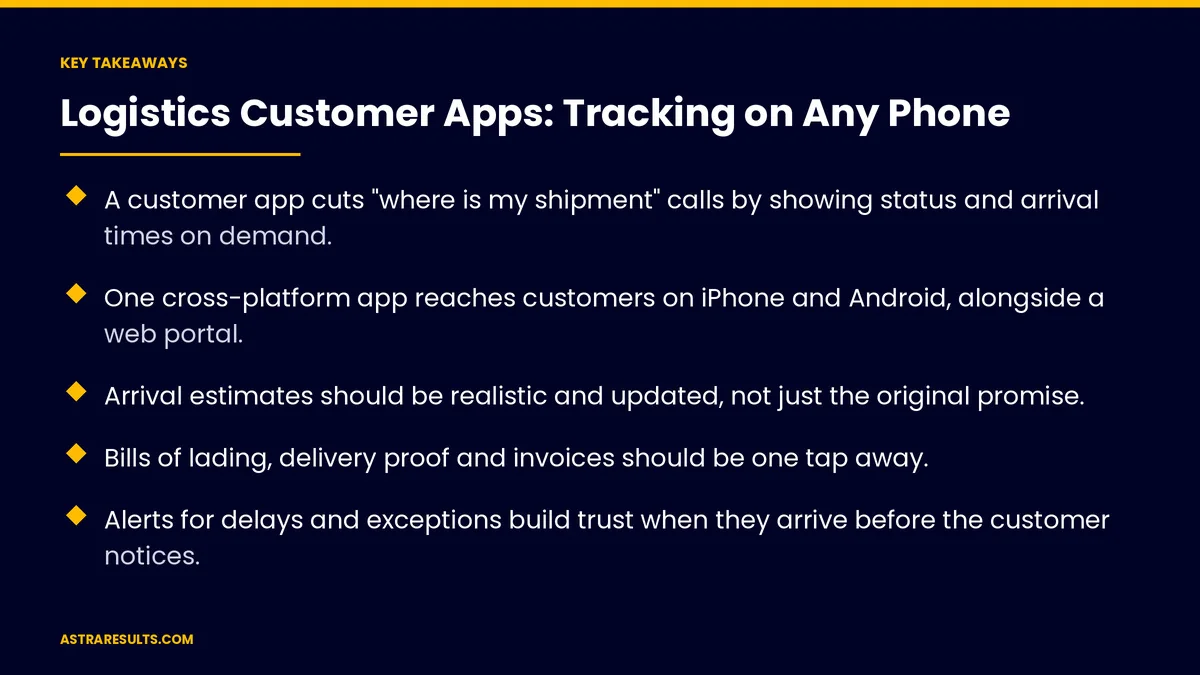
- A customer app cuts "where is my shipment" calls by showing status and arrival times on demand.
- One cross-platform app reaches customers on iPhone and Android, alongside a web portal.
- Arrival estimates should be realistic and updated, not just the original promise.
- Bills of lading, delivery proof and invoices should be one tap away.
- Alerts for delays and exceptions build trust when they arrive before the customer notices.
- Company accounts, languages and clean connections to your systems decide whether customers use it.
Published: October 16, 2026 | Reading Time: ~9 minutes | Category: Cross-Platform Apps
This guide covers how forwarders, 3PLs, carriers and couriers build customer apps that work: tracking and arrival times, documents, alerts, exceptions, company accounts, languages and the connections behind it all. Put plainly: give customers the answers they'd otherwise call for, on any phone, before they think to ask.
In This Playbook
- Why do logistics customers want a tracking app?
- One app, every phone
- Tracking and arrival times
- Documents on demand
- Alerts that build trust
- Exceptions and claims
- Quotes and bookings
- Company accounts and security
- Languages and markets
- The connections behind it
- Which numbers show a logistics app is working?
- The first three months
Why do logistics customers want a tracking app?
Fewer calls and emails. Status, documents and updates without waiting for someone to reply.
Planning ahead. Accurate arrival times help customers schedule receiving staff and production.
Proof and paperwork. Delivery proof and invoices when their accounting team asks.
Confidence. A business that shows its work earns repeat freight.
One app, every phone
Cross-platform by default. Customers use iPhone and Android in roughly every mix, so one codebase that ships to both stores makes sense, as covered in cross-platform apps.
A web portal too. Office staff often prefer a browser. The same logins and data should work in both.
Shared design and logic. Web and app share rules and look, as described in React Native strategy.
Tracking and arrival times
Clear milestones. Booked, picked up, departed, arrived at port, cleared customs, out for delivery, delivered.
Realistic arrival times. Updated estimates based on actual progress, not just the original schedule. Better estimates come from the methods in logistics ML.
One view for many shipments. Filters by status, lane, date and reference number.
Map where it helps. For trucks and last-mile deliveries, a live or recent location.
Documents on demand
Bills of lading and delivery proof. Available as soon as they exist.
Invoices and statements. Downloadable for accounting teams.
Customs documents. Where relevant, organized by shipment.
Search by reference. Customers find documents by their own purchase order or reference numbers.
Alerts that build trust
Status changes. Pickup, departure, arrival and delivery notifications, chosen by the customer.
Delays first. Tell customers about a delay before they notice it, with a new estimate.
The right person. Alerts go to the people at the customer's company who need them.
The right channel. Push notifications, email or text, based on preference.
Exceptions and claims
Report problems in the app. Customers can flag damage, shortages or delivery issues with photos.
Evidence from the dock. Photos taken at receipt support the case, as covered in damage detection at the dock.
Track resolution. Customers see the status of each exception until it's closed.
Quotes and bookings
Request a quote. Lane, freight details and timing in one form. Fast replies matter, as covered in logistics intake.
Book repeat shipments. Copy a previous shipment and adjust the dates.
Saved addresses and contacts. Less typing for frequent shippers.
Company accounts and security
Many users per customer. Logistics managers, accounting and receiving staff, each with the right access.
Customer admins. A person at the customer's company can add and remove their own users.
Separate data. Each customer sees only their own shipments and documents.
Secure sign-in. Two-step verification and quick sign-out for lost devices.
Languages and markets
Spanish and Portuguese. For Latin American shippers and consignees, written for each audience.
Local formats. Dates, units, phone numbers and addresses as each market expects.
Older phones and data costs. Keep the app light, as covered in Android apps for Latin American markets.
The connections behind it
Transport and warehouse systems. The source of shipments, milestones and documents.
Carrier and port updates. Tracking events from partners, matched to your shipments.
Plan it carefully. Which system owns each kind of data and how records match, as covered in planning an integration.
Which numbers show a logistics app is working?
Status calls and emails. "Where is my shipment" contacts, before and after.
Active customer users. By customer and role.
Document downloads. Requests handled in the app instead of by staff.
Alert accuracy. Delays flagged before customers asked.
Repeat bookings. Shipments booked again through the app.
The first three months
Days 1–30: plan with customers
Ask your top customers what they call about most. Map shipment, milestone and document data in your systems. Decide milestones, alerts and account roles.
Days 31–60: build the core
Build tracking, arrival estimates, documents and alerts in a cross-platform app and web portal. Add company accounts with customer admins. Test with a few friendly customers.
Days 61–90: launch and improve
Roll out to more customers, add exceptions, quotes and repeat bookings, and add Spanish and Portuguese where needed. Track status calls, active users and repeat bookings.
How Astra builds logistics apps
Astra Results Marketing builds customer apps for logistics companies that answer questions before customers call. We connect your transport and warehouse systems, show clear milestones and realistic arrival times, put documents one tap away and send alerts for delays first.
Apps work on iPhone, Android and the web, with company accounts, customer admins and the languages your shippers need. Engagements begin with a customer and systems review through our cross-platform app development team.
Related reading
Frequently asked questions
What should a logistics customer app include?
Shipment tracking with clear milestones and realistic arrival times, documents like bills of lading and delivery proof, delay and exception alerts, quote requests and repeat bookings, and company accounts with the right access for each user.
Do we need an iPhone app, an Android app or a web portal?
Usually all three, from one cross-platform app plus a web portal, with the same logins and data, so every customer can use the device they prefer.
How do we keep arrival times accurate?
Update estimates from actual progress and partner tracking events, rather than showing only the original schedule. Better prediction methods can improve them further.
How should delay alerts work?
Notify the right people at the customer's company as soon as a delay is known, with a new estimate, through the channel they prefer.
How do company accounts work?
Each customer has multiple users with different roles, a customer admin who manages their own users, and access only to their own shipments and documents.
What systems does the app need to connect to?
Your transport and warehouse systems for shipments, milestones and documents, and partner or carrier feeds for tracking events, matched to your shipment records.
Ready to answer "where is my shipment" before anyone asks? Astra Results Marketing builds logistics customer apps with clear tracking, realistic arrival times, one-tap documents, early delay alerts and company accounts, on iPhone, Android and the web. ▸ CALL (786) 321-2866 · ▸ REQUEST YOUR CONSULTATION





