 Rated 5 star on


Logistics Outbound to Shippers by Lane
Quick answer
Logistics outbound works best when it targets shippers already moving freight on your strongest lanes. A message about the shipper's own lane gets read, while generic pitches lose. Public trade data and expansion news show who ships where. Time outreach to capacity and contract cycles. Turn every reply into a complete quote request within minutes.
Most logistics outbound starts with a list of companies and a pitch about service. Shippers delete it, because every forwarder says the same thing. The outreach that gets answered starts somewhere else: with a lane the forwarder runs well, and a shipper who already moves freight on it. Then the message is about their freight, not your company.
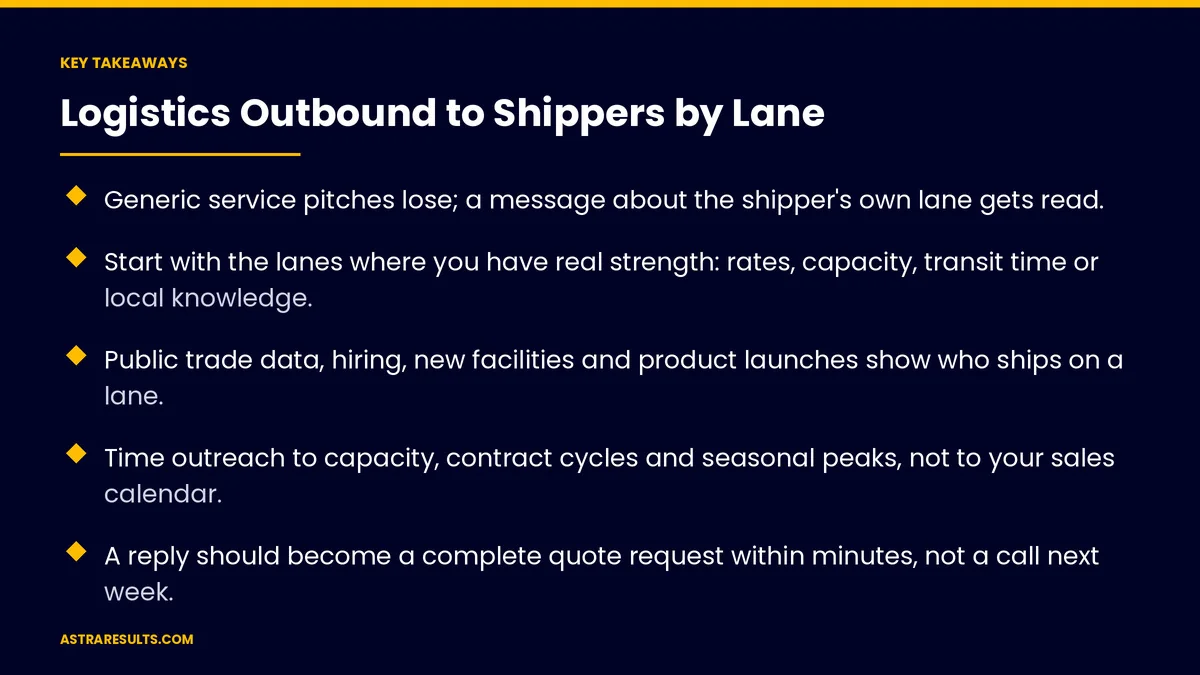
Key Takeaways
- Generic service pitches lose; a message about the shipper's own lane gets read.
- Start with the lanes where you have real strength: rates, capacity, transit time or local knowledge.
- Public trade data, hiring, new facilities and product launches show who ships on a lane.
- Time outreach to capacity, contract cycles and seasonal peaks, not to your sales calendar.
- A reply should become a complete quote request within minutes, not a call next week.
- Measure meetings and quotes by lane, and feed lost-quote reasons back into targeting.
Published: October 12, 2026 | Reading Time: ~11 minutes | Category: Outbound Sales
This guide covers how forwarders, 3PLs, NVOCCs and carriers build outbound around lanes. It explains where to find shippers on a lane, what to say, when to say it, and how to turn a reply into a quote fast. Put plainly: sell the lane you are strongest on to the shipper already using it.
This is general guidance for logistics businesses. Outbound calls, texts and emails are covered by consent and opt-out rules, and screening rules apply to every quote. Confirm both with counsel and your compliance team.
In This Playbook
- Why lane-first outbound works
- Which shipping lanes should outbound target first?
- Find the shippers on each lane
- What to say
- When to reach out
- Channels that reach shippers
- From reply to quote
- Measuring lane outbound
- The first three months
Why lane-first outbound works
Shippers buy lanes, not forwarders. A shipper moving containers from Miami to Bogotá wants the best option for that move. A pitch about your global network doesn't help them decide. A rate, a transit time and a booking window on their lane does.
Your strength is lane-specific. No forwarder is strongest everywhere. You may have a carrier contract on one trade, a warehouse near one port, or a customs team that knows one country well. Outbound should lead with those.
It filters the list. Starting from a lane cuts thousands of possible targets down to the few hundred that ship where you are strong. That makes personal outreach possible at the volume a small team can handle. The broader method is in outbound without a sales floor.
Miami's lanes are a real advantage. A Miami forwarder with depth in Latin America and the Caribbean can say things a national firm can't. Lead with that, in the shipper's language.
Which shipping lanes should outbound target first?
Where you win on price. Lanes where your carrier contracts, consolidation volume or backhaul give you a cost edge.
Where you win on service. Lanes where your transit time, schedule reliability or customs handling is better than average.
Where you win on knowledge. Destinations where your team knows the paperwork, the ports and the local agents, often the countries your staff come from.
Where you have capacity to fill. Space you have committed to and must sell, such as a block of container slots or warehouse space.
Pick three to five. More than that and the messages go generic again. Review the list every quarter as rates and capacity change.
Find the shippers on each lane
Public trade data. In the US, ocean import records are generally available through trade-data providers, unless the importer has asked for confidential treatment. They show who imports what, from where, and roughly how often. Air cargo records are not public in the same way.
Hiring and expansion. Job posts for logistics coordinators, a new warehouse lease, a new distribution center or a new store opening in a destination market.
Product and market launches. A brand entering Colombia, a manufacturer adding a Caribbean distributor, a retailer opening in Puerto Rico.
Your own history. Old quotes you lost, shippers who stopped booking, and inbound requests that never converted. These are often the warmest leads you have.
Check before you contact. Screen the company against sanctions and denied-party lists before any outreach, the same check described for inbound quotes in quote requests answered in minutes.
What to say
One lane, one fact, one offer. Name their lane, mention one specific thing you know about it, and make one small offer. "We run weekly consolidations Miami to Santo Domingo with a five-day transit. Want a rate for your next two pallets?"
Use what you know. Their typical volume, their ports, their season. If you found it in trade data, you can refer to it plainly without sounding invasive.
Make the offer easy to accept. A spot rate for one shipment, a transit-time comparison, a backhaul slot. Not a "discovery call."
In their language. Many Latin American shippers prefer Spanish or Portuguese. Write the first message in the language their team uses, for the reasons covered in what changes when Spanish is a channel.
A person approves every message. AI can research the shipper and draft the note, but a person reads it before it sends, as set out in drafts humans approve. A wrong lane or a stale rate in an outbound email costs credibility you won't get back.
When to reach out
Capacity windows. When you have space to fill on a lane, the shippers who use that lane are your list for the week.
Contract cycles. Many shippers retender ocean contracts once a year. Find out when, and reach them a few weeks before.
Seasonal peaks. Holiday retail, harvest seasons and back-to-school all move freight on predictable dates. Shippers plan ahead, so outreach should too.
Disruption. Port congestion, a carrier leaving a trade, or a rate spike sends shippers looking for options. Be the forwarder with a clear, workable alternative ready.
Not every week. A shipper who hears from you every Monday stops reading. Two or three well-timed messages beat a weekly drip.
Channels that reach shippers
Email first. It is where logistics buyers work, and it carries rates and schedules well. Every message needs a real address, a truthful subject line and a working unsubscribe.
LinkedIn for the people. Logistics managers and procurement teams are easy to find. A connection note that names their lane works better than a pitch.
Phone for warm leads. Calls work best after a reply or a quote. Calls to mobile numbers and marketing texts come with consent rules covered in outbound compliance.
WhatsApp where it's normal. In much of Latin America, business happens on WhatsApp. Use it when the shipper starts the conversation there or has agreed to it.
From reply to quote
Answer in minutes. A shipper who replies "send me a rate" is comparing you against others right now. The speed to lead rules apply here too.
Ask for everything at once. Origin and destination, pieces, weight and dimensions, commodity, Incoterms, ready date. One message with every question, not five.
Quote fast on known lanes. For the lanes you picked, rates should be ready. That is the point of starting with them.
Follow up until it's decided. Check in before the rate expires and again after. If they book elsewhere, ask why, and log the answer.
Hand off cleanly. When the shipper books, the file goes to operations complete, with nothing retyped.
Measuring lane outbound
Replies by lane. Which lanes and which offers get answered.
Quotes requested by lane. The real sign of interest.
Quote-to-booking rate. By lane, by shipper type and by source.
Lost reasons. Price, transit time, timing or relationship, reported by lane every month. These tell you whether to keep a lane on the list.
Revenue and margin from outbound. Bookings traced back to the first message, with the method in attribution across every channel.
Opt-outs and complaints. If they rise, the list or the message needs work.
The first three months
Days 1–30: lanes and lists
Choose three to five lanes where you have a real edge. Build a shipper list for each from trade data, expansion signals and your own lost quotes. Screen every company. Write the first message for each lane in English and Spanish, and set up consent and opt-out handling.
Days 31–60: first outreach
Send the first lane messages, with a person approving each one. Answer replies within minutes and capture complete quote requests. Quote known lanes the same day. Follow up before rates expire.
Days 61–90: learn and adjust
Review replies, quotes and bookings by lane. Read every lost-quote reason. Drop a lane that isn't working, add one where capacity or rates have improved, and time the next round to contract cycles and peaks.
How Astra builds it
Astra Results Marketing starts outbound from your lanes, not from a list of company names. We help you choose the three to five lanes where you win. Then we find the shippers already moving freight on them and screen each one before any outreach.
Messages name the shipper's lane and make one clear offer, in their language, approved by a person before they send. Replies become complete quote requests within minutes, and every lost quote feeds back into the lane list. Reporting covers replies, quotes and bookings by lane. Engagements begin with a lane review through our AI outbound sales team.
Related reading
Frequently asked questions
Why start outbound with lanes instead of companies?
Because shippers buy the best option for a specific move, and your strength is specific to certain lanes. Starting with your strongest lanes narrows the list to shippers who already move freight there, and lets every message be about their freight rather than your company.
Where do we find shippers on a lane?
Public ocean import records through trade-data providers, hiring and expansion news, product launches in destination markets, and your own lost quotes and lapsed customers. Screen every company against sanctions and denied-party lists before contacting them.
What should the first message say?
Name the shipper's lane, share one specific fact about your service on it, and make one small offer, such as a spot rate for the next shipment. Write it in the language their team uses, and have a person approve it before it sends.
How often should we contact a shipper?
Two or three well-timed messages, tied to your capacity windows, their contract cycle or a seasonal peak, work better than a weekly drip. Frequent generic messages get ignored and draw opt-outs.
Can we use WhatsApp for outbound?
Where it is normal for that market and the shipper has started the conversation there or agreed to it. Marketing texts and messages carry consent and opt-out rules, so confirm your approach with counsel.
How do we measure lane outbound?
Track replies, quote requests and bookings by lane, plus quote-to-booking rate, margin from outbound bookings and the reasons for lost quotes. Review them monthly and adjust the lane list each quarter.
Ready to sell your best lanes to the shippers already using them? Astra Results Marketing helps you pick the lanes where you win, find and screen the shippers on them, send approved lane-specific messages in their language, and turn every reply into a quote within minutes. ▸ CALL (786) 321-2866 · ▸ REQUEST YOUR CONSULTATION





