Rated 5 star on


AI Outbound + Generative AI: Drafts Humans Approve
Quick answer
The model researches each prospect and drafts a message that states its sources. A person then reads every draft and decides to send, edit or skip it. This keeps volume high without wrecking reply rates. Astra judges the program on replies, booked meetings and how often approvers edit drafts, not on messages sent.
There are two ways to use a language model in outbound sales, with opposite results. The first lets the model write and send. Volume goes up, replies go down, the domain's reputation follows. The second lets the model research and draft, and a person reads every message before it goes. Volume rises less. Replies rise a lot.
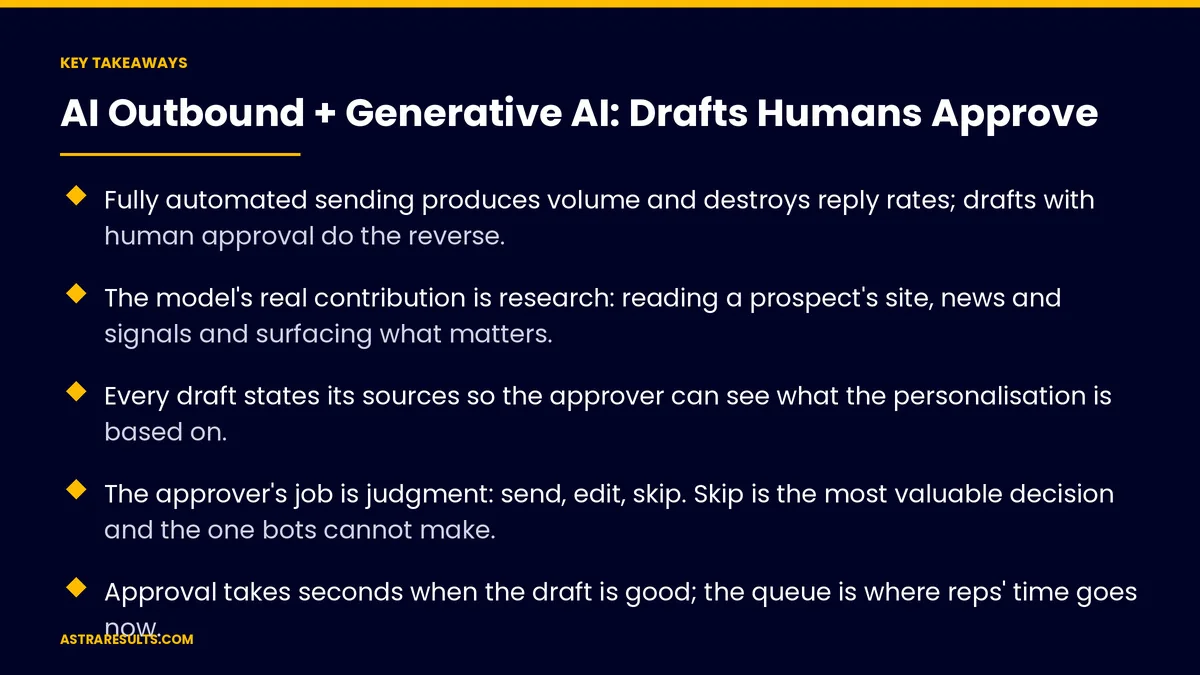
Key Takeaways
- Fully automated sending produces volume and destroys reply rates; drafts with human approval do the reverse.
- The model's real contribution is research: reading a prospect's site, news and signals and surfacing what matters.
- Every draft states its sources so the approver can see what the personalization is based on.
- The approver's job is judgment: send, edit, skip. Skip is the most valuable decision and the one bots cannot make.
- Approval takes seconds when the draft is good; the queue is where reps' time goes now.
- Measure by reply rate, meeting rate and approver edit rate, never by messages sent.
Published: October 4, 2026 | Reading Time: ~12 minutes | Category: Outbound Sales
This piece is about the second way. It covers what the model does well in outbound, which is research and first drafts. What it does badly, which is knowing when a message should not be sent at all. And the approval workflow that lets a small team send personal outreach at a scale it could never write by hand.
Put plainly: the model does the reading and the typing; a person does the deciding, every time.
Guidance for owners and sales leads. Nothing here is legal advice. Consent, do-not-call, anti-spam and disclosure rules for outbound communication vary by jurisdiction and channel. The compliance side of outbound is covered in its own piece in this series and must be confirmed with counsel.
In This Playbook
- Two ways to use the model
- What the model does well: research
- What the model does well: the first draft
- What the model does badly: knowing when not to send
- The approval workflow
- Learning from the queue
- Replies and the handoff
- What to measure
- The first three months
- What Astra does here
Two ways to use the model
Write and send. The model generates a message from a template and a few merge fields, and it goes out. Each message is slightly different, which defeats spam filters for a while. Each is equally hollow, which prospects notice immediately. Reply rates collapse, and the sending domain's reputation goes with them.
Research and draft. The model reads what is publicly available about the prospect, identifies a reason this business should be talking to them now, and drafts a message around it. A person reads the draft, decides, and sends or does not. Fewer messages, more replies, and a domain that stays healthy.
Why the difference is so large. A prospect can tell within one sentence whether the sender knows anything about them. The first approach cannot know anything. The second knows what the model read and the approver confirmed. The list and sequence discipline that outbound rests on is set out in pipeline without a sales floor.
This piece is about the words.
What the model does well: research
Reading at scale. A prospect's website, recent news, job postings, public filings, reviews, the industry's trade press. A rep can do this for five prospects a morning. The model does it for five hundred and surfaces the two facts that matter for each.
Finding the reason. Outbound works when there is a reason to write now: a new location, a hiring surge, a leadership change, a product launch, a bad review pattern, a regulatory change in their sector. The model's job is to find that reason and name it, or to report that there is none.
Structuring it for the approver. Not a paragraph of research but a short brief: who they are, what changed, why it connects to what the business sells, and the one line the message should be built around. The approver reads the brief before the draft.
Knowing the limits. Public information only, from named sources. No inference about people beyond their public professional role. No scraping where terms forbid it. The research brief cites where each fact came from, so an approver can check and a compliance review can audit.
What the model does well: the first draft
From the brief, in the voice. The message is built around the reason found, in the business's voice as defined in its guide, at the length the channel supports. The voice-guide discipline is the one described in replies in your voice, applied to a stranger rather than a customer.
One reason, one ask. A good outbound message has one observation about the prospect and one small request. The draft is constrained to that shape. The model's tendency to add a second paragraph of benefits is suppressed by the template.
Variants, not volume. For a given prospect, the model can offer two or three angles. The approver picks one. This is where the model's fluency is useful: options for a human to choose between, not messages for a machine to send.
Sources visible. Every specific claim in the draft is marked with where it came from. "Congratulations on the Coral Gables opening" carries a link to the announcement. If the model cannot source a claim, the claim is not in the draft.
What the model does badly: knowing when not to send
The bad fit. A prospect the research shows is not a fit: wrong size, already a customer, a competitor, recently churned, in the middle of a crisis. The model will draft a message anyway. A person sees that the message should not exist.
The wrong moment. Public news of layoffs, a death, a lawsuit. The model may treat these as "reasons to write." A person knows they are reasons not to.
The stale reason. A "new" location that opened eighteen months ago. A "recent" hire who has left. Research from a source that has not updated. The approver's familiarity with the market catches what the model cannot.
The tone that misses. Technically in the voice, but wrong for this prospect: too casual for a hospital administrator, too formal for a food-truck owner. Tone judgment is human.
Why this matters more than the writing. The skip decision protects the domain, the brand and the relationship with a prospect who may be right in a year. It is the decision fully automated outbound cannot make, and it is why the person stays in the loop.
The approval workflow
The queue. Each morning, the approver opens a queue of drafts, each with its research brief, its sources and its variants. Fifty to two hundred, depending on the team.
Three decisions per draft. Send as is. Edit and send. Skip, with a reason. The reason is a single tap: bad fit, wrong moment, stale, tone, other.
Seconds, not minutes. A good draft with a clear brief takes ten to twenty seconds to approve. Editing takes a minute. The approver's day is a queue, not a blank page, which is the shift in the rep's job described for support teams in this series and applied here to sales.
Who approves. The person whose name is on the message. Not an assistant, not the vendor. A message signed by a rep is one the rep read.
Volume caps. Per sender, per domain, per day, set below what deliverability tolerates and never raised because the queue is long. A long queue is a signal to sharpen the list, not to send faster.
Learning from the queue
Edit patterns. What approvers change most: openings, length, the ask. Each pattern becomes a rule in the template or an example in the voice guide, so the next week's drafts need less editing.
Skip reasons. A high skip rate for "bad fit" means the list is wrong, not the drafts. "Stale" means a source needs a freshness rule. "Tone" means the voice guide is missing a tone.
Reply patterns. Which reasons-to-write earned replies. Which angles earned meetings. Fed back into the research step so the model looks for the signals that work.
The metric that shows learning. Approver edit rate, falling over weeks. The approach to controlled improvement is the one in AI pilots that fail safely. A small scope, measured, widened when the numbers justify it.
Replies and the handoff
When a prospect replies. The sequence stops. A person, the one who approved the message, takes the conversation. The model may draft a reply from the thread and the brief, but the same rule applies. A person reads it and decides.
Speed of the reply to the reply. A prospect who answers outbound has done the sender a favor. The sender's response within minutes, not hours, is the difference between a meeting and a cold thread. The intake discipline applies to outbound replies too.
Booking. A meeting offered with real times, booked in the conversation, confirmed and reminded. The model handles the logistics. The person owns the conversation.
Spanish and Portuguese. For a Miami business selling into Latin America or to Spanish-speaking owners locally, research and drafts in the prospect's language, in the register their public presence suggests, with a bilingual approver. The considerations in what changes when Spanish is a channel apply to the first message as much as the tenth.
What to measure
Reply rate. Positive replies per hundred messages sent, by angle, by sender, by segment. The number that shows whether the drafts are good.
Meeting rate. Meetings per hundred sent. The number that shows whether the list and the ask are right.
Approver edit rate. Falling means the system is learning the voice. Rising means something changed.
Skip rate by reason. Diagnostic for the list, the sources and the guide.
Domain health. Bounce rate, spam complaints, inbox placement. The number that fully automated outbound destroys and this approach protects.
Pipeline attributed to outbound. Meetings that became opportunities that became revenue, with the discipline in attribution across every channel.
Never: messages sent. A volume metric rewards exactly the behavior that fails.
The first three months
Days 1–30: the list, the voice, the rules
Target list defined and cleaned. Consent and suppression rules confirmed with counsel. Voice guide for outbound written with the reps whose names go on messages, including tone rules by segment and language. Research sources approved and freshness rules set. Approval queue set up with volume caps below deliverability limits.
Days 31–60: the queue in front of reps
Research briefs and drafts live for the first segment. Reps approving daily: send, edit, skip with reason. Every reply routed to the approving rep within minutes. Edit patterns and skip reasons reviewed weekly; template and guide revised.
Days 61–90: widen and measure
Second segment added where skip rates support the list. Angles that earned replies fed back into research. Reply rate, meeting rate, edit rate, skip reasons, domain health and attributed pipeline compared to the first month; volume caps held.
What Astra does here
Astra Results Marketing starts with the list and the voice, because generated drafts amplify whatever they are given. A bad list produces well-written messages to the wrong people. A missing voice guide produces the vendor's voice under the rep's name.
The research step is built on approved public sources with freshness rules and visible citations, so every personalization can be checked.
The approval queue sits in front of the reps whose names go on the messages, with three decisions per draft and volume caps never raised because the queue is long. Edit patterns and skip reasons are reviewed weekly and fed back into the template, the guide and the list.
Reporting runs on reply rate, meeting rate, edit rate and domain health, never on messages sent. Engagements begin with a list and voice workshop through our AI outbound sales team.
Related reading
Frequently asked questions
Why not let the model send the messages?
Because fully automated sending produces volume and destroys reply rates and domain reputation. Prospects recognize the hollow pattern within a sentence. Drafts a person reads before sending produce fewer messages and far more replies.
What does the model do in this workflow?
Research and first drafts. It reads a prospect's public presence, finds a reason to write now, cites where each fact came from, and drafts a message in the business's voice with one observation and one ask. It offers variants for a person to choose between.
What does the approver do?
Reads the brief and the draft and makes one of three decisions. Send, edit and send, or skip with a reason. The skip decision, catching bad fits, wrong moments and stale facts, is the most valuable one and the one no automated system can make.
How long does approval take?
Ten to twenty seconds for a good draft, about a minute with edits. The rep's outbound work becomes a morning queue rather than hours of writing, at volumes set by caps below what deliverability tolerates.
How does the system improve?
Edit patterns become template rules and voice-guide examples. Skip reasons diagnose the list, the sources and the guide. Angles that earned replies are fed back into research. Approver edit rate falling over weeks is the sign it is working.
How is the return measured?
Positive reply rate and meeting rate per hundred sent, approver edit rate, skip rate by reason, domain health, and pipeline attributed to outbound. Messages sent is never a metric, because it rewards the behavior that fails.
Ready to send outreach your reps have read? Astra Results Marketing builds the list and the voice, puts a research-backed draft queue in front of your reps with sources they can check, and reports on replies, meetings and domain health, never on volume. ▸ CALL (786) 321-2866 · ▸ REQUEST YOUR CONSULTATION