 Rated 5 star on

Staffing Agency Outbound to Hiring Managers
Quick answer
Staffing agencies win job orders by writing to hiring managers about a specific open role. Job posts, reposts, expansions and new contracts show who needs people now. Lead with a fitting candidate, shared only with that candidate's permission. Describe candidates by skills, never protected traits. The first qualified submittal usually wins the order.
Hiring managers get pitched by staffing agencies every week. Most look the same: we have great talent, we understand your industry, can we set up a call? They go unread. The agency that wins the job order does something different. It writes to the manager with an open role, and it brings a candidate who could fill it.
Key Takeaways
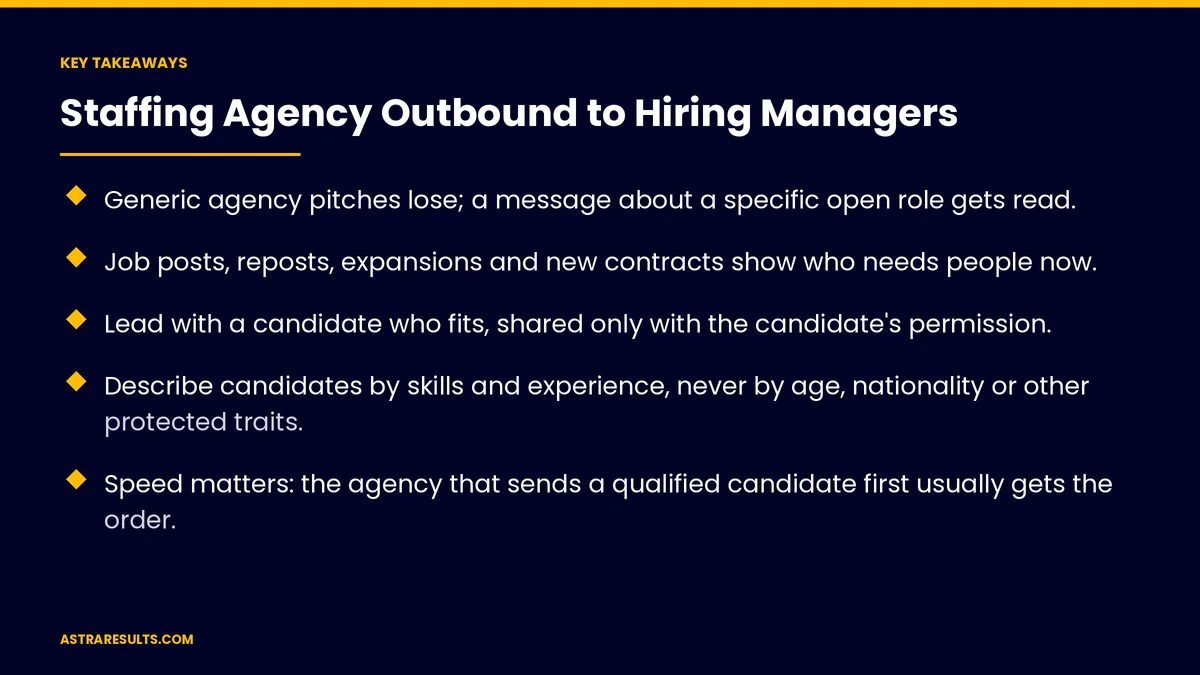
- Generic agency pitches lose; a message about a specific open role gets read.
- Job posts, reposts, expansions and new contracts show who needs people now.
- Lead with a candidate who fits, shared only with the candidate's permission.
- Describe candidates by skills and experience, never by age, nationality or other protected traits.
- Speed matters: the agency that sends a qualified candidate first usually gets the order.
- Measure job orders, submittals and fills by source, not emails sent.
Published: October 24, 2026 | Reading Time: ~11 minutes | Category: Outbound Sales
This guide covers outbound for temp, contract and direct-hire agencies: how to find managers who are hiring now, what to send them, how to present candidates fairly, and how to turn a reply into a filled role. Put plainly: don't pitch your agency. Answer the job post.
This is general guidance for staffing businesses. Outbound calls, texts and emails follow consent and opt-out rules. Candidate data and hiring decisions are covered by privacy and fair-hiring laws. Confirm your process with counsel.
In This Playbook
- Why most agency outreach fails
- How do staffing agencies find managers hiring now?
- Lead with a candidate, fairly
- What to say when there's no candidate yet
- Timing and cadence
- Channels that work
- From reply to filled role
- Staffing outbound metrics
- The first three months
- The Astra approach
Why most agency outreach fails
It's about the agency. "We are a leading staffing firm" tells a hiring manager nothing they need. They don't have a vendor problem. They have an empty seat.
It arrives at the wrong time. A manager with no open roles has no reason to reply. A manager who posted a job yesterday has every reason.
It asks for too much. A "quick call to learn about your needs" is work for the manager. A candidate profile they can say yes to is not.
It sounds like every other agency. The same templates go out from dozens of firms. The fix is the same as in every outbound program: specific signals, specific offers, and a person approving each message, as covered in outbound without a sales floor.
How do staffing agencies find managers hiring now?
Fresh job posts. A role posted in the last week, in a category you fill well, in a region you cover. This is the strongest signal there is.
Reposts and long-open roles. A job posted again, or still open after 30 days, usually means the company is struggling to fill it. They are more open to help.
Several similar roles at once. Five warehouse posts or three nursing posts in one week suggest a new shift, a new site or high turnover.
Expansion news. A new location, a new contract, a funding round or a seasonal ramp. Hiring follows a few weeks later.
Your own history. Clients who used you before and went quiet, and roles you lost to another agency. They already know you.
Find the right person. The hiring manager or department head who owns the role usually decides faster than HR. Reach them, and copy HR when the process calls for it.
Lead with a candidate, fairly
One role, one candidate, one ask. "You posted for a forklift-certified warehouse lead in Doral. I have someone with six years' experience and weekend availability. Want her profile?" That is a message a manager can answer in a word.
Get the candidate's permission first. Don't share a name, résumé or details without the candidate agreeing to be presented to that employer. It protects the candidate and your reputation.
Describe skills, not traits. Talk about certifications, experience, shift availability, languages spoken for the job and location. Never describe or select candidates by age, race, national origin, religion, sex, disability or any other protected trait, even if a client asks.
Languages are skills. "Bilingual in English and Spanish" is a job qualification when the role needs it. Nationality is not.
Keep a short bench. For the roles you fill most, keep a few pre-screened candidates who have agreed to be presented. That lets you answer a job post the same day.
What to say when there's no candidate yet
Speak to the role. "Your CNC machinist role has been open five weeks. We filled four similar roles in Hialeah this quarter. Want to see who we have?"
Use real numbers. Your typical time to submit, your fill rate in that category, how many similar roles you've filled nearby. If you don't track them yet, start.
Keep it short. Three or four sentences. One offer. No attachment until they ask.
AI drafts, a person sends. AI can read the job post and draft the note, but a recruiter reads it before it goes out. It's the method in drafts humans approve, and it matters more here because a wrong detail about a role is obvious to the manager.
Timing and cadence
Within a day of the post. Managers review early applicants and agency submittals first. Being third is often too late.
Before the seasonal ramp. Retail, logistics, hospitality and tax season all hire on a calendar. Reach managers a few weeks ahead.
After a reply, fast. When a manager says "send the profile," send it within the hour. The rules from speed to lead apply.
Then step back. Two or three messages per role is enough. If there's no reply, wait for the next signal.
Channels that work
Email first. It carries profiles and job details well. Every message needs a real address, a truthful subject line and a working unsubscribe.
LinkedIn for warm contact. A connection note that names the open role works far better than a generic request.
Phone after a signal. A call works best once the manager has replied or a role has stayed open. Calls to mobile phones and marketing texts carry consent rules, covered in outbound compliance.
In the manager's language. In Miami, many managers in construction, hospitality and logistics prefer Spanish. Write to them that way, for the reasons in what changes when Spanish is a channel.
From reply to filled role
Get the job order details at once. Pay range, shift, start date, must-have skills, location and interview steps, in one message rather than five.
Submit quickly and cleanly. A short profile with the reasons this person fits the role, not a stack of résumés.
Keep the manager updated. Interview times, candidate feedback and start-date confirmation without being chased. Task tools can keep these steps from slipping, as covered in work that moves itself.
Ask what's next. After a fill, ask about other roles on the team. One good placement often leads to the next three.
Log the losses. If another agency filled it, ask why: speed, rate, candidate quality. Use the answers.
Staffing outbound metrics
Replies by signal. Which signals, fresh posts, reposts or expansions, lead to answers.
Job orders won. By source and by role category.
Time to submit. Hours from job order to first candidate submitted.
Submittal-to-interview and interview-to-hire rates. The quality of the candidates you send.
Fills and gross margin from outbound. Traced back to the first message, using attribution across every channel.
Opt-outs and complaints. A rising rate means the list or the message needs work.
The first three months
Days 1–30: signals and bench
Pick the role categories and regions where you fill best. Set up daily tracking of new posts, reposts and long-open roles in them. Build a small bench of pre-screened candidates who have agreed to be presented. Write fair-hiring rules for how candidates are described. Set up consent and opt-out handling.
Days 31–60: first outreach
Answer fresh job posts within a day, with a candidate where you have one. A recruiter approves every message. Send profiles within the hour of a reply, and capture the full job order.
Days 61–90: learn and adjust
Review replies, job orders and fills by signal and role. Read every loss reason. Grow the bench for the roles that convert, drop the signals that don't, and time the next round to seasonal ramps.
The Astra approach
Astra Results Marketing builds staffing outbound around open roles, not agency pitches. We track the job posts, reposts and expansions in your categories every day and help you keep a bench of candidates ready to present.
Messages name the role and lead with a fit, describe candidates by skills only, and are approved by a recruiter before they send. Replies become complete job orders and fast submittals. Reporting covers job orders, time to submit and fills by source. Engagements begin with a signal and bench review through our AI outbound sales team.
Related reading
Frequently asked questions
What is the best signal for staffing outbound?
A fresh job post in a role category and region you fill well. Reposts and roles open for 30 days or more are next, because they show the company is struggling to hire. Expansion news and returning clients round out the list.
Should we send candidate profiles without being asked?
Only with the candidate's permission to be presented to that employer. A short note that names the role and offers a fitting candidate's profile usually works better than attaching it unasked.
How should candidates be described in outreach?
By skills, certifications, experience, availability and job-related languages. Never describe or select candidates by age, race, national origin, religion, sex, disability or any other protected trait, even if a client asks for it.
How fast should we respond to a job post?
Within a day, and within an hour once a manager replies. Managers often review the first few qualified candidates and stop. Keeping a bench of pre-screened candidates makes that speed possible.
Is it better to contact HR or the hiring manager?
Usually the hiring manager or department head who owns the role, since they feel the vacancy and decide faster. Copy HR when the company's process requires it.
What should we measure?
Replies by signal, job orders won, time to submit, submittal-to-interview and interview-to-hire rates, and fills and margin traced to outbound. Track opt-outs and complaints to keep the list healthy.
Ready to answer job posts before other agencies do? Astra Results Marketing tracks the open roles in your categories daily, helps you keep a bench of candidates ready to present, and sends recruiter-approved outreach that names the role, describes candidates fairly and turns replies into job orders fast. ▸ CALL (786) 321-2866 · ▸ REQUEST YOUR CONSULTATION





