Rated 5 star on


Miami Beach Practice Marketing: An Island Is Its Own Market
Quick answer
A Miami Beach practice should treat the island as its own market. Causeway access makes island patients easy to win and mainland patients hard. Astra builds on-island local SEO first, then adds one mainland niche. Residents and seasonal households drive most volume. Visitors matter mainly for urgent dental and walk-in care.
Miami Beach is a barrier island, and that single physical fact governs its marketing more than any demographic. Access runs through a handful of causeways, which means a practice on the island competes for mainland patients on unfavorable terms and for island patients on extremely favorable ones.
Key Takeaways
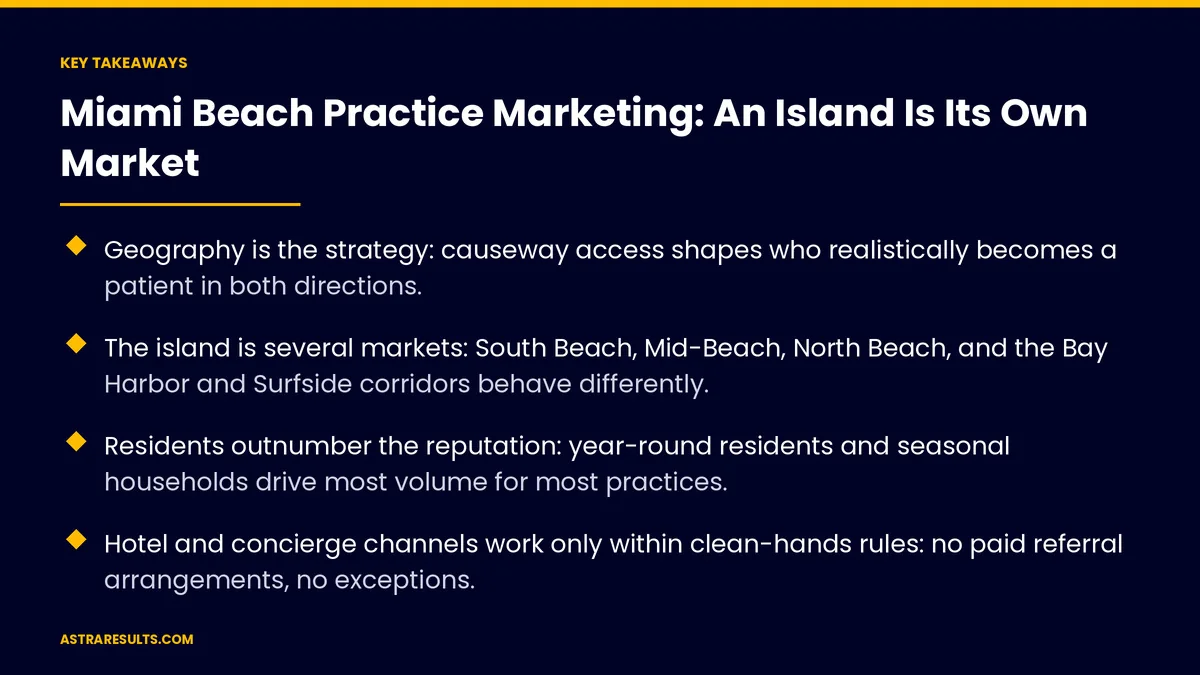
- Geography is the strategy: causeway access shapes who realistically becomes a patient in both directions.
- The island is several markets: South Beach, Mid-Beach, North Beach, and the Bay Harbor and Surfside corridors behave differently.
- Residents outnumber the reputation: year-round residents and seasonal households drive most volume for most practices.
- Hotel and concierge channels work only within clean-hands rules: no paid referral arrangements, no exceptions.
- Trilingual capability is table stakes here: Spanish, Portuguese, and often more, on the staff-it rule.
- Measure by origin: island resident, seasonal resident, mainland, and visitor cohorts have entirely different economics.
Published: October 11, 2026 | Reading Time: ~11 minutes | Category: Local SEO · Miami Beach
The crossing is a real deterrent in both directions, and every candid local strategy starts there.
Layered on top of that geography is a visitor economy that dominates the island's reputation and a resident population that dominates its actual patient volume: tens of thousands of people who live here year-round, plus the seasonal households that arrive for months at a time. Most practices market to the reputation and serve the population, which is exactly backward.
The kicker states the frame: an island is its own market.
This is the local-SEO companion to the library's seasonal and event-week playbooks, where those addressed calendar strategy, this one addresses geography, findability, and the channels the island specifically offers.
The disciplines that govern it are the ones Astra holds everywhere: real service-area claims, never-gated reviews, no compressed clinical timelines for a visitor's itinerary, and the destination doctrine wherever out-of-area patients are served. Marketing guidance for licensed practices and firms only. Nothing here is medical, dental, or legal advice. Compliance review precedes publication of every asset.
In This Playbook
- Geography Is the Strategy
- The Island Is Several Markets
- Residents Outnumber the Reputation
- Hotels, Concierges, and Clean Hands
- Local SEO Mechanics for an Island
- Trilingual Is Table Stakes
- Channels and Operations
- What belongs on a Miami Beach practice's marketing dashboard?
- A 90-Day Build
Geography Is the Strategy
The physical reality that determines everything downstream.
The crossing deterrent, both ways. Mainland patients weigh a causeway plus island parking against a comparable practice ten minutes from home and frequently choose the latter. That means a Beach practice's mainland ambitions should be modest and specific rather than broad. Conversely, island residents strongly prefer not to cross.
That makes an on-island practice the default for a captive and affluent population if it is findable. The real service-area claim per the geo-honesty standard. Claim the island and the immediately adjacent corridors, name real drive times including bridge and parking reality, and skip the metro-wide radius that reads as a chain.
The parking and access disclosure. On this island, parking is a real decision variable: publishing where to park, whether validation exists. What the drop-off situation looks like removes friction no campaign can compensate for.
The strategic conclusion. For most Beach practices, the correct target is on-island dominance plus a specific mainland niche (a sub-specialty, a language, an access advantage) rather than general mainland competition.
The Island Is Several Markets
The neighborhood map, because a single "Miami Beach" page serves none of them. South Beach below roughly Dade Boulevard: the densest visitor concentration, a young resident population, hospitality workforce, and the nightlife economy's own patient needs. Urgent dental and walk-in medical demand is real here.
Mid-Beach along the Collins corridor: residential towers, established households, and the resort concentration, a mix where resident volume and hotel-adjacent demand coexist.
North Beach. Much more residential, more family-oriented, with a large Spanish-speaking and Latin American population and a different price sensitivity than the South Beach reputation implies.
The Venetian and Sunset islands and the residential enclaves. High-net-worth households where discretion and referral networks matter more than any campaign.
Bay Harbor Islands, Surfside, and Indian Creek northward. Their own established communities, including a significant Jewish community with its own institutions and networks, plus a distinct family-practice market.
The implication. Separate corridor pages written plainly, and a positioning decision about which neighborhoods the practice serves rather than a claim over the whole island.
Residents Outnumber the Reputation
The cohort correction most Beach practices need.
The volume reality. For nearly every practice type except urgent dental and walk-in medical, year-round residents and seasonal households produce the majority of value. They complete treatment plans, return annually, refer within tight island networks, and show up in the annual-value ledger rather than as single transactions.
The hospitality-workforce cohort. The island's restaurants, hotels, and venues employ a large workforce with real healthcare and dental needs, evening and early-morning availability requirements, and a strong preference for Spanish-language service, an underserved market hiding in plain sight for practices willing to schedule around it.
The seasonal-household nuance. The November-to-April resident is neither visitor nor year-round patient, and serving her well means candid continuity planning, per the seasonal-resident standard.
The tight-network effect. Island referral networks are unusually dense (a building, a school, a synagogue or church, a gym) which makes reputation and review quality disproportionately powerful and makes any misstep travel unusually fast.
Hotels, Concierges, and Clean Hands
The channel the island uniquely offers, and the one most likely to create a compliance problem.
The legitimate version. Being the practice a hotel concierge or building manager knows about and trusts to handle a guest or resident well: earned through reliability, availability, and clear information, exactly as the referral-systems mechanic describes.
The forbidden version. Paying for referrals, commissions, kickbacks, or any arrangement in which value flows in exchange for patient direction, which in healthcare implicates anti-kickback and self-referral frameworks and in every licensed profession implicates conduct rules.
This is a counsel question before it is a marketing tactic, and the practices that build these relationships on performance keep them while the ones that build on economics lose them and risk considerably more.
What works. A clear one-page capability and access sheet a concierge can act on, real responsiveness when they call, clear scope about what the practice does and doesn't handle, and the forwardable asset a front desk can hand a guest.
The building-and-association layer. Residential building managers, HOAs, and condo associations are the resident-side equivalent, engaged under the participation rules, education when invited, nothing sold from a lobby table.
Local SEO Mechanics for an Island
The technical layer, applied to unusual geography. The profile per the local standard. Exact address and suite, hours that reflect reality including seasonal changes, service and language attributes accurate, and photographs that show the actual entrance and parking situation, which on this island materially reduces no-shows.
The query landscape, which is bimodal. Residents search like residents ("dentist near me," "dermatologist Miami Beach"), while visitors search urgently and geographically ("emergency dentist South Beach," "walk-in clinic near me now"), two distinct content sets, per the one-intent architecture.
The urgent lane, where visitor value concentrates. Real same-day availability published plainly, clear payment and out-of-network information, and the access promise kept, because a visitor with a problem converts on availability rather than on positioning.
The AI-answer layer. "dentist open now near me" and "urgent care South Beach" are increasingly answered by assistants, which cite practices whose hours, services, and access information are accurate and complete, the entity work our AI SEO service builds.
Reviews run never-gated and matter enormously in a dense-network market, with the note that visitor reviews skew toward access and courtesy while resident reviews reflect clinical relationships, and both are worth having.
Trilingual Is Table Stakes
The language layer, at island scale.
The requirement. Spanish and Portuguese natively per the chain rule (the island's resident population, its hospitality workforce, and its international visitor flow all make these operational necessities rather than differentiators) with the regional register variation respected rather than flattened.
Beyond those two. The island's visitor and resident mix brings extra languages, served through qualified interpretation and labeled plainly per the two-tier architecture, with the staff-it rule governing any claim.
The clinical dimension. For the hospitality workforce and international visitors alike, instructions and consent conversations in a first language are care quality rather than convenience.
The profile and content implication. Languages listed accurately, in-language content that is written natively rather than translated, and reviews cultivated on the platforms each community reads.
Channels and Operations
Findability first. Profile, corridor pages, and the two query sets, resident and urgent, built properly before any spend, per the capture-before-attention sequencing.
Paid, narrow. Behind the negatives fortress with hotel-booking, restaurant, nightlife, beach-activity, and travel-planning intent excluded wholesale, the island's largest waste category by a wide margin, and geo-targeting drawn to the island plus realistic adjacent corridors rather than the metro.
Operations that convert on this island. Extended and evening hours for the hospitality workforce, candid same-day slots for the urgent lane, reschedule grace for bridge and traffic reality, clear parking and access instructions, and never-voicemail intake with after-hours coverage where the urgent cohort is real.
The seasonal operational note. Hours, staffing, and availability should change between high season and summer. The profile should reflect those changes rather than carrying a stale schedule.
What belongs on a Miami Beach practice's marketing dashboard?
The dashboard, per the case-level standard:
- Origin cohorts as the flagship. Island resident, seasonal resident, mainland, hospitality workforce, and visitor. Captured through source-of-truth intake with an out-of-area flag, since these five cohorts have entirely different conversion, retention, and value profiles and blending them hides every useful conclusion
- Annual value by cohort, which typically reveals resident and seasonal-resident patients carrying the practice
- The urgent-lane conversion and same-day fulfillment rate
- Corridor performance by neighborhood page
- The concierge and building-relationship ledger with the clean-hands position documented
- Language cohorts read separately
- Review velocity split between access-driven and clinical-relationship reviews
- No-show rate before and after publishing parking and access detail, which is usually a visible improvement
- Cost per kept appointment by cohort and season
A 90-Day Build
Days 1–30: Geography and findability
The real service-area decision made (on-island dominance plus a named mainland niche). Corridor pages drafted for the neighborhoods served. The profile corrected with real hours, languages, access photographs, and parking detail; origin-cohort capture added to intake; the two query sets mapped.
Days 31–60: Content and access
Resident and urgent content published under named-practitioner authorship in English, native Spanish, and Portuguese. Parking and access instructions published prominently; extended and evening hours assessed for the hospitality cohort; same-day availability engineered and published plainly for the urgent lane.
Days 61–90: Relationships and reads
- Concierge and building-manager relationships built on capability sheets and responsiveness with the clean-hands position written and reviewed by counsel
- Community and association presence begun under participation rules
- Narrow paid live behind the fortress
- AI-answer accuracy checked for the urgent queries
- First clear reads — origin cohorts, annual value by cohort, urgent-lane fulfillment, corridor performance — and next quarter allocated toward the cohorts that carry the practice
How Astra Builds Miami Beach Practices
Astra Results Marketing builds Miami Beach practices on the island's geography: real service areas that respect the causeway in both directions, corridor pages for neighborhoods that differ, the resident and hospitality-workforce cohorts served rather than the reputation, hotel and building relationships built on performance with clean hands documented, trilingual capability treated as table stakes, and origin cohorts measured separately because their economics diverge sharply.
Engagements begin with a geography, findability, and cohort audit through our business consulting team.
Related reading
Frequently asked questions
Should we market to the mainland?
Modestly and specifically. The causeway is a real deterrent, mainland patients will usually choose a comparable practice closer to home, so broad mainland competition is expensive and unproductive. The better strategy is on-island dominance plus one named mainland niche where you have a real advantage: a sub-specialty, a language capability, or an access model nobody nearby offers.
Are visitors worth building around?
For urgent dental and walk-in medical, yes. Availability converts them, and the urgent lane is real revenue. For nearly everything else, residents and seasonal households produce most of the value while the visitor economy dominates the island's reputation. Capture origin at intake and compare annual value by cohort. Most practices discover they've been marketing to the smaller half.
Can we pay a hotel concierge for referrals?
Take that to counsel before it exists, arrangements where value flows in exchange for patient direction implicate anti-kickback and self-referral frameworks in healthcare and conduct rules in every licensed profession. Build the relationship on performance instead. A clear capability and access sheet, real responsiveness, clear scope, and a forwardable piece the front desk can hand a guest. Those relationships last. Paid ones create exposure and disappear when someone pays more.
What's the most overlooked cohort on the island?
The hospitality workforce: thousands of people with real healthcare and dental needs, evening and early-morning availability requirements, and a strong preference for Spanish-language service. Practices willing to schedule around their hours and serve them natively find an underserved market with strong word-of-mouth in a very dense network. Almost nobody is competing for it directly.
Does publishing parking information really matter?
On this island it's one of the highest-return details available. Parking is a real decision variable, and publishing where to park, whether validation exists, and what drop-off looks like removes friction no campaign can compensate for. Practices that add access photographs and parking detail to their profile and site typically see a measurable no-show improvement. That is why the measurement section tracks it explicitly.
How many languages do we need?
Spanish and Portuguese natively (content, phone, the visit, and the instructions) because the island's residents, hospitality workforce, and international visitors make both operational necessities rather than differentiators. Beyond those, use qualified interpretation and label the tiers plainly. Never claim a language the chain can't deliver end to end. On an island with networks this tight, a half-served language becomes known quickly.
Ready to Market the Island You're Actually On? Astra Results Marketing builds Miami Beach practices on candid geography, corridor-level pages, the resident and workforce cohorts, clean-hands relationships, and origin-cohort measurement. Start with a geography, findability, and cohort audit for your practice. ▸ CALL (786) 321-2866 · ▸ REQUEST YOUR CONSULTATION