 Rated 5 star on


Shipping and Returns Settings That Build Trust
Quick answer
Online stores build trust when shipping and return terms are clear before checkout. Show shipping costs early and give realistic delivery dates that include handling time. Set free shipping thresholds that protect margin. The FTC requires shipping within the stated time, or 30 days. Make return rules plain, including who pays and how refunds work.
Shoppers decide whether to trust a store partly by its shipping and returns. Surprise costs at checkout send them away. Vague delivery dates make them hesitate. Unclear return rules make them wonder what happens if something goes wrong. Clear settings and plain policies answer those questions before they're asked, and they often decide whether the order happens.
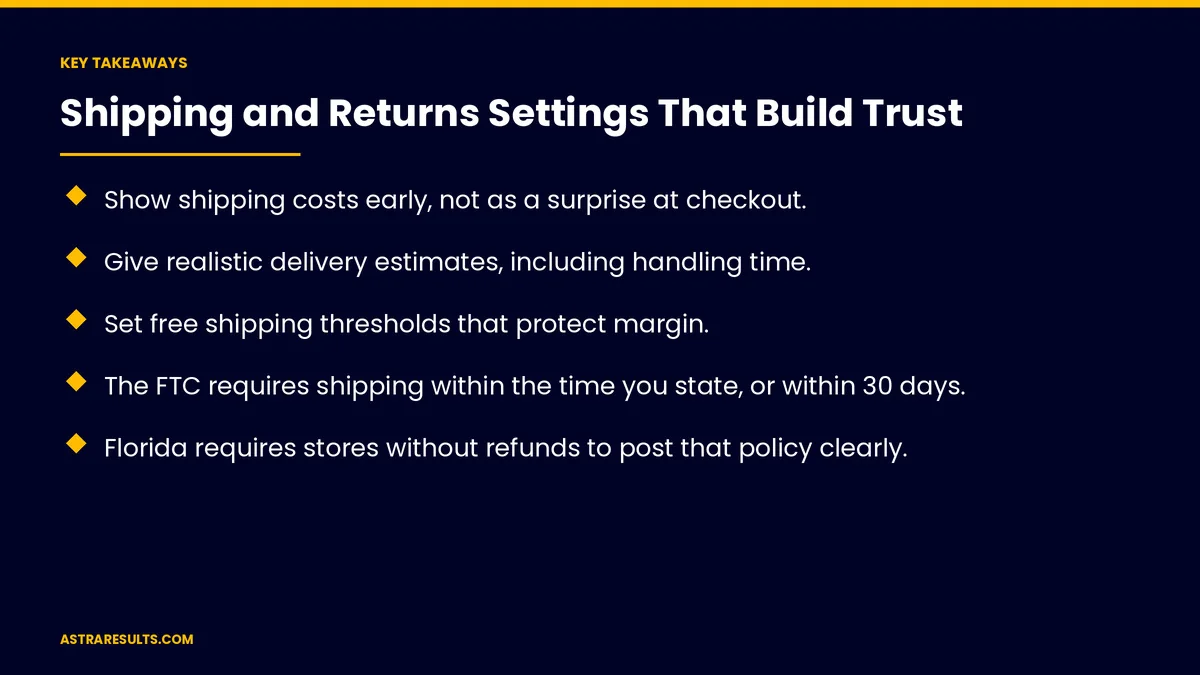
Key Takeaways
- Show shipping costs early, not as a surprise at checkout.
- Give realistic delivery estimates, including handling time.
- Set free shipping thresholds that protect margin.
- The FTC requires shipping within the time you state, or within 30 days.
- Florida requires stores without refunds to post that policy clearly.
- Make return rules plain: window, condition, who pays and how refunds work.
Published: October 16, 2026 | Reading Time: ~8 minutes | Category: E-Commerce Stores
This guide covers shipping and returns settings that build trust: showing costs early, delivery estimates, rates and free shipping, handling time, tracking, the FTC's shipping rule, return rules, refund policy disclosure, returns process, international orders and what to measure. Put plainly: show costs early, promise only what you can deliver and state return rules plainly.
For automating returns, see e-commerce return agents.
In This Playbook
- Show costs early
- How should a store show delivery estimates?
- Rates and free shipping
- Handling time
- Tracking
- The FTC's shipping rule
- Return rules
- Does Florida require stores to post a no-refund policy?
- Returns process
- International orders
- What to measure
- The first three months
Show costs early
On product pages. Shipping cost or a calculator, as in product page conversion.
In the cart. Before checkout begins.
No surprises. Unexpected costs are a common reason shoppers leave.
Good product pages are covered in product pages that convert.
How should a store show delivery estimates?
Dates, not just methods. "Arrives by Friday" beats "Standard shipping."
Include handling time. Packing days count.
Be realistic. Better to beat a date than miss it.
Holiday cutoffs. Posted clearly, as covered in Black Friday planning.
Rates and free shipping
Flat rates. Simple and predictable.
Calculated rates. Accurate for heavy or bulky items.
Free shipping thresholds. Set so they don't erase margin, as in restaurant retail.
Handling time
State it. "Ships within two business days."
Keep it. Staff and stock to meet it.
Update during peaks. When volume rises.
Tracking
Tracking emails. Shipped, out for delivery and delivered.
A tracking page. On your own site.
Problem alerts. Delays and failed deliveries flagged early.
The FTC's shipping rule
Ship on time. Within the time you state, or within 30 days if you don't state one.
Delays. Tell customers and offer the option to cancel for a refund.
Applies to online orders. Including phone and mail orders.
Return rules
Return window. Days from delivery.
Condition. New, unused or with tags.
Who pays return shipping. Free, deducted or customer-paid.
Refund or store credit. Stated clearly.
Final sale items. Marked on the product page.
Restocking fees. Disclosed before purchase.
Does Florida require stores to post a no-refund policy?
Florida's rule. Stores that don't offer refunds must post that policy clearly.
Other states. Have their own disclosure rules.
Easy to find. Footer, checkout and product pages.
Returns process
A returns portal. Start a return without emailing.
Labels and instructions. Clear and fast.
Refunds recorded everywhere. As covered in integrating payment processors.
Taxes reversed. As covered in multi-currency and tax settings.
International orders
Duties shown. Before payment where possible.
Delivery times. Longer and stated.
Return options. Often different from domestic.
The details are covered in international shipping.
What to measure
Cart abandonment at shipping. Where shoppers leave.
On-time delivery. Against promised dates.
Return rate. By product and reason.
Refund time. From return received to refund.
Customer questions. About shipping and returns.
The first three months
Days 1–30: review
Check where shipping costs appear, compare promised and actual delivery times and rewrite return rules in plain language.
Days 31–60: fix settings
Show costs early, add delivery dates and handling time, set free shipping thresholds and add a returns portal.
Days 61–90: measure
Track abandonment at shipping, on-time delivery, returns and refund time, and adjust policies.
How Astra sets up shipping and returns
Astra Results Marketing sets up shipping and returns that build trust. We show costs early, set realistic delivery dates, write plain return rules, follow FTC and state disclosure rules and connect returns to payments and accounting.
Engagements begin with a store review through our e-commerce stores team.
Related reading
Frequently asked questions
Where should shipping costs appear?
On product pages and in the cart, before checkout begins, so there are no surprises.
How should delivery times be shown?
As dates, including handling time, and realistic enough to meet.
What does the FTC require for shipping?
Ship within the time you state, or within 30 days if you don't state one. If delayed, tell customers and offer cancellation.
Do we have to post our refund policy?
In Florida, stores that don't offer refunds must post that clearly. Other states have their own rules.
What should a return policy include?
The return window, item condition, who pays return shipping, refund or store credit, final sale items and any restocking fees.
What should we measure?
Cart abandonment at shipping, on-time delivery, return rate, refund time and shipping questions.
Ready for shipping and returns that build trust? Astra Results Marketing sets up stores that show costs early, promise realistic delivery, state return rules plainly and follow FTC and state rules. ▸ CALL (786) 321-2866 · ▸ REQUEST YOUR CONSULTATION





