 Rated 5 star on


Staffing Data: Candidates, Clients, Placements
Quick answer
Staffing agencies should connect their data into one record per candidate and one per client. Link each job order to submissions, placements, timesheets and invoices. Calculate margin per placement as bill rate minus pay rate and employer costs. Track fill rate and time to fill. Keep background check and eligibility records under their own rules.
Staffing agencies run on data spread across many systems: candidates in an applicant tracking system, clients in a CRM, job orders in client portals, hours in a timekeeping app and money in payroll and billing. When these don't connect, candidates get duplicated, job orders slip and nobody knows real margins until month-end.
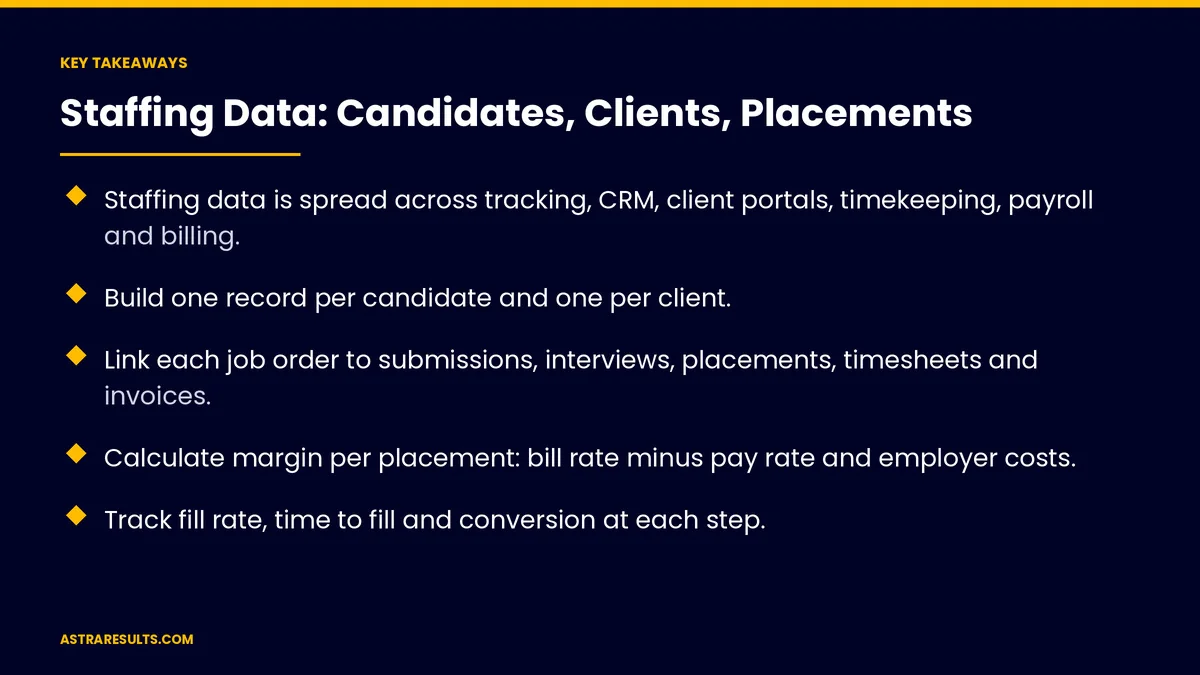
Key Takeaways
- Staffing data is spread across tracking, CRM, client portals, timekeeping, payroll and billing.
- Build one record per candidate and one per client.
- Link each job order to submissions, interviews, placements, timesheets and invoices.
- Calculate margin per placement: bill rate minus pay rate and employer costs.
- Track fill rate, time to fill and conversion at each step.
- Keep background check, equal opportunity and eligibility records under their own rules.
Published: October 30, 2026 | Reading Time: ~9 minutes | Category: Data Engineering
This guide covers where staffing data lives, one candidate and client record, the chain from order to invoice, margin per placement, dashboards and data rules. Put plainly: connect every step from job order to invoice, so you can see fill rates and margins as they happen.
In This Playbook
- Where staffing data lives
- How do you get one record per candidate?
- One client record
- The chain from job order to invoice
- Where does margin per placement start?
- Key measures
- Dashboards for each team
- Rules for candidate data
- Building the connections
- What to measure
- The first three months
Where staffing data lives
Applicant tracking. Candidates, resumes and submissions.
CRM. Clients, contacts and job orders.
Client portals. Large clients often send job orders through their own vendor systems.
Timekeeping. Hours worked, as in staffing apps.
Payroll and billing. Pay, invoices and payments.
How do you get one record per candidate?
Merge duplicates. Match on contact details, with people confirming close calls.
Parsed profiles. Skills and history from resumes, as covered in resume parsing.
Full history. Submissions, placements and ratings in one place.
One client record
Company and contacts. One record, linked across systems.
Job orders from every source. CRM, email and client portals.
Rates and terms. Bill rates, markups and contract details.
Won through outreach. As in staffing agency outbound.
The chain from job order to invoice
Job order. What the client needs.
Submission. Candidates sent.
Interview. Who met the client.
Placement. Who started.
Timesheet. Hours approved, as automated in staffing agency automation.
Invoice. Billed and paid.
Every link connected. So each step traces to the next.
Where does margin per placement start?
Bill rate minus pay rate. The starting point.
Minus employer costs. Payroll taxes, insurance and benefits.
Visible weekly. Not just at month-end.
By client and recruiter. To see where margin comes from.
Key measures
Fill rate. Job orders filled.
Time to fill. From order to start.
Conversion by step. Submission to interview, interview to placement.
Redeployment. Past workers placed again.
Data quality. As covered in data KPIs.
Dashboards for each team
Recruiters. Open orders, submissions and candidates to call.
Account managers. Fill rates and client activity.
Finance. Hours, invoices and margin.
Reports first, predictions later. As weighed in ML vs business intelligence.
Rules for candidate data
Background checks. Need written consent under the Fair Credit Reporting Act.
Equal opportunity data. If collected, kept separate from hiring decisions and access-restricted.
Eligibility records. Kept under federal retention rules.
Privacy and retention. Only the data needed, deleted on schedule.
Check with counsel. Rules vary by state.
Building the connections
Pipelines between systems. As covered in data pipelines explained.
The same pattern elsewhere. As in insurance agency data and franchise reporting.
Worker apps feed the data. As in staffing Android apps.
What to measure
Duplicate candidate rate. Before and after.
Job orders tracked end to end. Share with every link connected.
Margin visibility. Placements with margin calculated.
Time to fill. By client.
Reporting time saved. Hours spent building reports by hand.
The first three months
Days 1–30: map and clean
List every system, merge duplicate candidates and clients and agree on definitions for fill rate and margin.
Days 31–60: connect the chain
Link job orders, submissions, placements, timesheets and invoices, and calculate margin per placement.
Days 61–90: dashboards and rules
Build dashboards for recruiters, account managers and finance, and review candidate data rules with counsel.
How Astra connects staffing data
Astra Results Marketing connects staffing agency data from job order to invoice. We merge candidate and client records, link every step of the placement chain, calculate margin per placement and build dashboards for each team.
Engagements begin with a data review through our data engineering team.
Related reading
Frequently asked questions
Why is staffing data so hard to manage?
It's spread across applicant tracking, CRM, client portals, timekeeping, payroll and billing, and those systems often don't connect.
What is the placement chain?
The link from job order to submission, interview, placement, timesheet and invoice, so each step traces to the next.
How is margin per placement calculated?
Bill rate minus pay rate, minus employer costs like payroll taxes, insurance and benefits.
Which measures matter most?
Fill rate, time to fill, conversion at each step, redeployment and margin.
What rules apply to candidate data?
Written consent for background checks, separate handling of any equal opportunity data, eligibility records kept under federal rules and limited retention. Check with counsel.
Where should we start?
By listing every system, merging duplicates and agreeing on how fill rate and margin are defined.
Ready to see fill rates and margins as they happen? Astra Results Marketing connects staffing data from job order to invoice, merges duplicate records, calculates margin per placement and builds dashboards for every team. ▸ CALL (786) 321-2866 · ▸ REQUEST YOUR CONSULTATION





