 Rated 5 star on

The Business Case for an App, in Numbers
Quick answer
A mobile app business case starts with how many customers will actively use the app, not downloads. Value comes from extra purchases, customers kept and costs saved. Count every cost, including building, store fees, maintenance, security and marketing. Divide first-year cost by monthly net value under low, middle and high adoption cases.
"Customers want an app" isn't a business case. A business case shows who will use the app, what that's worth, what it costs and when it pays back. Most app ideas can be tested on paper in an afternoon. If the math doesn't work at realistic adoption, it's better to know before building.
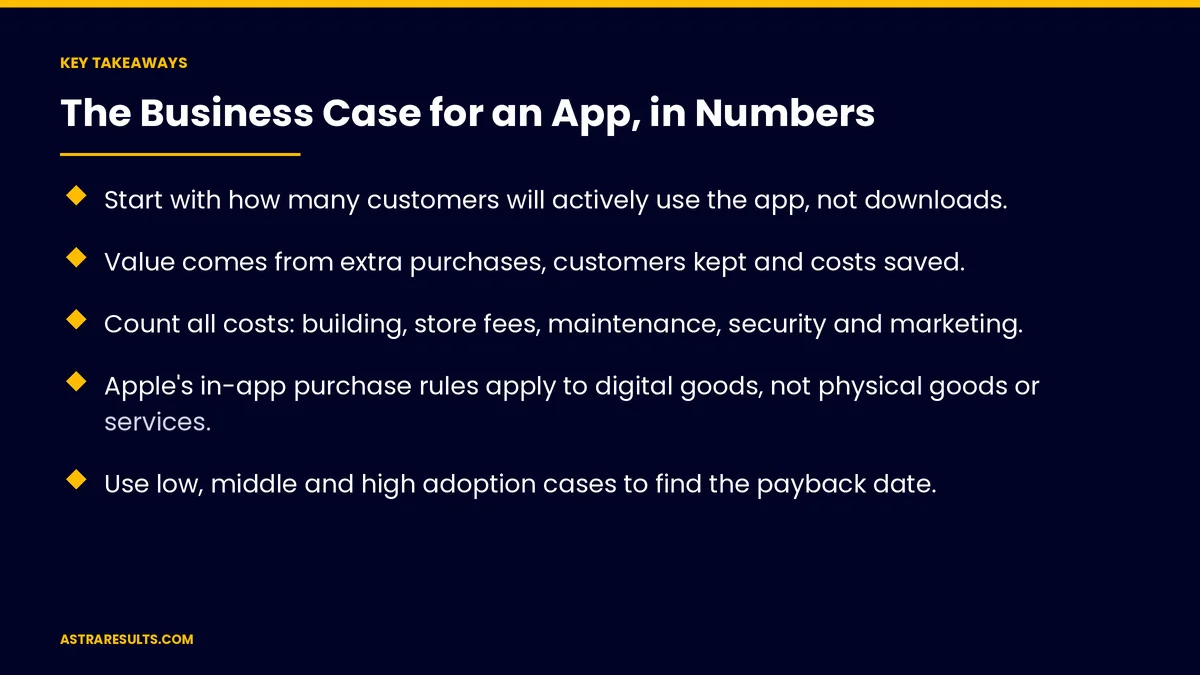
Key Takeaways
- Start with how many customers will actively use the app, not downloads.
- Value comes from extra purchases, customers kept and costs saved.
- Count all costs: building, store fees, maintenance, security and marketing.
- Apple's in-app purchase rules apply to digital goods, not physical goods or services.
- Use low, middle and high adoption cases to find the payback date.
- Test demand cheaply before building, then measure against the case.
Published: October 28, 2026 | Reading Time: ~9 minutes | Category: iPhone App Development
This guide walks through the business case for a mobile app with simple formulas: estimating active users, extra purchases and retention, savings, the full costs, store fees and payment rules, payback, risks and how to test assumptions cheaply. Put plainly: estimate the value from real customer numbers, count every cost and find the payback date.
In This Playbook
- Start with active users
- Estimate the value
- Count the full costs
- Payment rules that affect the math
- Find the payback date
- Risks to the numbers
- Test assumptions cheaply
- How should we present an app business case?
- What to measure after launch
- The first three months
Start with active users
Your customer base. How many customers buy from you in a year?
Likely adopters. What share might download the app? Loyalty members and frequent buyers are the best guide.
Active users. Of those, how many will keep using it month after month?
Be conservative. Downloads drop off; active users are what matter, as covered in iPhone app analytics.
Estimate the value
Extra purchases. Active users × extra orders per year × average order value × profit margin.
Customers kept. Customers who would have left but stay × their yearly profit.
Costs saved. Calls, front-desk time or no-shows reduced × the cost of each.
Example in words. If a few thousand active users each order one extra time a year, multiply by your average order and margin.
Use ranges. Low, middle and high estimates for each line.
Count the full costs
Building the app. Design, development and testing.
Store fees. Apple's developer program costs $99 a year; Google Play charges a one-time $25 registration fee.
Maintenance. Updates for new phone software, store rules and fixes, as covered in the cost after launch.
Security. Reviews and testing, as covered in cross-platform security considerations.
Marketing. Promotion to drive downloads and keep users active.
Integrations. Connecting loyalty, ordering and customer systems.
Payment rules that affect the math
Digital goods. Apple generally requires its in-app purchase system, with its commission, for digital goods and subscriptions used in the app.
Physical goods and services. Food orders, retail products and appointments can usually use regular payment methods.
Check current rules. Store policies change, so confirm what applies to your app.
Card processing fees. Count them for regular payments too.
Find the payback date
First-year cost. Build cost plus a year of fees, maintenance and marketing.
Monthly net value. Monthly value minus monthly running costs.
Payback. First-year cost ÷ monthly net value = months to pay back.
Three cases. Low, middle and high adoption show the range.
Decide your limit. How long a payback the business will accept.
Risks to the numbers
Low adoption. Fewer downloads or active users than hoped.
Cannibalization. App orders that would have happened on the website anyway.
Ongoing costs. Maintenance and marketing that keep running.
Platform changes. New store rules or phone software requirements.
Test assumptions cheaply
Try simpler options first. Wallet passes, text messages or a faster mobile site, as covered in when to add a mobile app.
Ask customers. A short survey of loyalty members.
Measure repeat behavior. How often your best customers buy today.
Start with core features. The smallest app that delivers the main value, as covered in building an iPhone app.
How should we present an app business case?
One page. Active users, value, costs, payback in three cases and key risks.
Native or cross-platform. The build choice affects costs, as weighed in the business case for native iOS.
Go or no-go points. What results after launch would justify more investment.
The same method works elsewhere. As in the business case for predictive analytics.
What to measure after launch
Active users. Against the case.
Extra purchases. App users compared with similar non-users.
Retention. Customers kept, against the estimate.
Costs. Actual running costs against plan.
Payback progress. Value delivered against costs, month by month.
The first three months
Days 1–30: build the case
Gather customer counts, purchase frequency, order values and margins. Estimate active users, value and full costs in low, middle and high cases, and calculate payback.
Days 31–60: test assumptions
Survey loyalty members, test simpler options such as wallet passes or texts and check how often your best customers buy. Update the case with what you learn.
Days 61–90: decide
Present the one-page case with payback ranges and risks. If it works, plan the smallest app that delivers the main value, with clear measures to track after launch.
How Astra builds app business cases
Astra Results Marketing helps businesses decide whether an app pays off. We estimate active users from your real customer numbers, model value and full costs in three cases, account for store fees and payment rules and calculate payback.
When the case holds, we build the smallest app that delivers the value and measure results against the plan. Engagements begin with an app business case review through our iPhone app development team.
Related reading
Frequently asked questions
How do we estimate how many people will use our app?
Start with your yearly customers, estimate what share might download, using loyalty members and frequent buyers as a guide, then estimate how many stay active. Be conservative.
Where does an app's value come from?
Extra purchases from active users, customers kept who would otherwise leave and costs saved, such as fewer calls or no-shows.
What costs should the case include?
Design and development, store fees, maintenance, security reviews, marketing to drive downloads and integrations with your other systems.
Do we have to pay Apple a commission on every sale?
Apple's in-app purchase rules generally apply to digital goods and subscriptions. Physical goods and services, such as food orders or appointments, can usually use regular payment methods. Check current rules.
How do we calculate payback?
Divide the first-year cost by the monthly net value to get months to pay back, using low, middle and high adoption cases.
What if the numbers don't work?
Try simpler options first, such as wallet passes, texts or a faster mobile site, and revisit the case as customer behavior changes.
Ready to know if an app pays off before you build it? Astra Results Marketing builds app business cases from your real customer numbers, with full costs, store rules, payback ranges and a plan to measure results after launch. ▸ CALL (786) 321-2866 · ▸ REQUEST YOUR CONSULTATION





