 Rated 5 star on

When to Add a Mobile App to Your Marketing Stack
Quick answer
A mobile app pays off when customers return often, through weekly orders, regular bookings or ongoing loyalty. If most customers buy once a year, a strong mobile website and email serve them better. Try cheaper options first, such as wallet passes and text messages. Measure active users and repeat purchases, not downloads.
Plenty of businesses build an app because a competitor has one, then watch downloads stall and the app sit unused. Others wait too long, while loyal customers who would reorder in two taps keep calling instead. The question isn't whether apps work. It's whether your customers come back often enough to keep one on their phone.
Key Takeaways
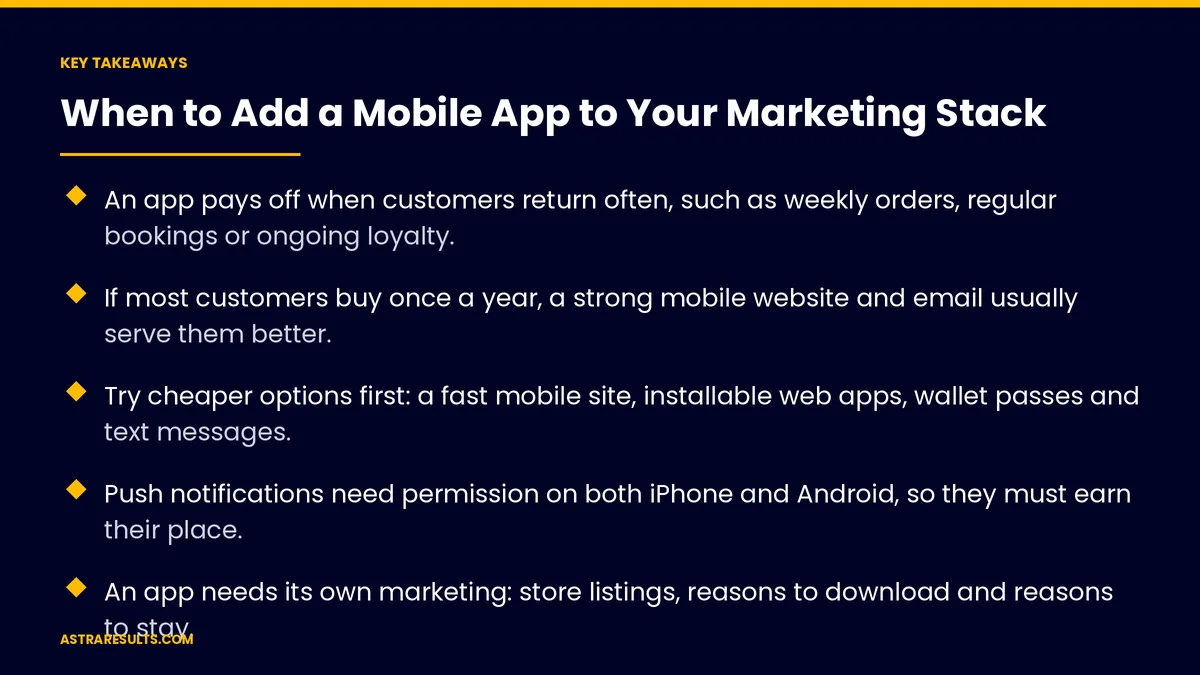
- An app pays off when customers return often, such as weekly orders, regular bookings or ongoing loyalty.
- If most customers buy once a year, a strong mobile website and email usually serve them better.
- Try cheaper options first: a fast mobile site, installable web apps, wallet passes and text messages.
- Push notifications need permission on both iPhone and Android, so they must earn their place.
- An app needs its own marketing: store listings, reasons to download and reasons to stay.
- Measure active users and repeat purchases, not downloads.
Published: October 22, 2026 | Reading Time: ~9 minutes | Category: Cross-Platform Apps
This guide helps you decide when a mobile app belongs in your marketing stack: the signs it will pay off, the signs it won't yet, cheaper options to try first, what an app needs from marketing and how to measure it. Put plainly: build an app when customers return often, and fix the basics first.
In This Playbook
- When will a mobile app pay off for a business?
- Signs it won't pay off yet
- Cheaper options to try first
- Push notifications and permissions
- What an app needs from marketing
- Cross-platform or native
- Examples by industry
- What to measure
- The first three months
When will a mobile app pay off for a business?
Frequent repeat visits. Customers order, book or check in weekly or monthly.
Loyalty that matters. Points, rewards or memberships customers want to track, as covered in mobile apps for loyalty.
Useful timely messages. Order updates, appointment reminders or local offers people want.
Device features help. Location, camera, scanning or offline access make the experience better.
Logged-in experiences. Saved orders, preferences, payment details or a community.
Signs it won't pay off yet
Customers buy rarely. A once-a-year purchase rarely earns a spot on someone's phone.
The website isn't working. A slow or confusing mobile site should be fixed first, using conversion-focused design.
No customer database. Without a system that knows your customers, an app has little to personalize.
No plan to promote it. An app nobody hears about won't be downloaded.
No budget to maintain it. Apps need updates for new phone software and store rules, as covered in React Native maintenance.
Cheaper options to try first
A fast mobile website. Handles most needs for most businesses.
Installable web apps. Websites that can be added to a phone's home screen, with some app-like features.
Wallet passes. Loyalty cards, tickets and coupons in Apple Wallet or Google Wallet, as covered in Apple Pay loyalty.
Text messages. Order updates and reminders without a download, as covered in conversational AI across voice, chat and SMS.
Email. Still the steadiest repeat channel for many businesses.
Test demand. If customers use these heavily, an app may be the next step.
Push notifications and permissions
Permission comes first. iPhones ask users to allow notifications, and newer Android versions do too.
Ask at the right moment. Explain the benefit, such as order updates, before the system prompt.
Send what people value. Too many messages lead to turned-off notifications or deleted apps.
Tracking needs permission too. On iPhone, tracking people across other companies' apps requires their consent.
What an app needs from marketing
A store listing that sells. Clear name, screenshots, description and reviews.
A reason to download. A welcome reward, faster ordering or app-only features.
Promotion everywhere. In store, on the website, in email and in campaigns, such as app banners in seasonal creative.
A reason to stay. Useful features and messages that bring people back.
Connected systems. The app shares data with your loyalty program, customer records and email.
Cross-platform or native
Cross-platform for most. One codebase for iPhone and Android often suits marketing-led apps, as covered in React Native strategy.
Native for heavy device use. Apps that depend on advanced device features may need native builds.
Weigh the options. The trade-offs are covered in native, cross-platform or web.
Choose the right partner. Questions to ask are covered in choosing a development partner.
Examples by industry
Restaurants. Reordering favorites and loyalty, as covered in restaurant iPhone apps.
Retail chains. Rewards, store stock and offers, as covered in retail chain apps.
Fitness studios. Class booking and community.
Service businesses. Often better served by text reminders and a strong website, unless customers book often.
What to measure
Active users. Weekly and monthly, not total downloads.
Retention. The share of users still active after one and three months.
Repeat purchases. App users compared with website-only customers.
Notification opt-in. And how many people turn notifications off later.
Cost to keep users. Promotion and maintenance against the revenue app users bring.
The first three months
Days 1–30: check readiness
Measure how often customers return, review your mobile website and confirm you have a customer database. List what an app would do that your site, email and texts can't.
Days 31–60: try the cheaper path
Improve the mobile site, add wallet passes or text updates and test demand for app-like features. Track how often customers use them.
Days 61–90: decide
If repeat use is strong and the basics work, plan the app's core features, marketing and budget for maintenance. If not, keep improving the cheaper channels and review again next quarter.
How Astra helps with the app decision
Astra Results Marketing helps businesses decide when an app belongs in their marketing stack. We review how often customers return, fix the mobile site and test cheaper options first.
When the case is clear, we plan and build cross-platform apps connected to your loyalty, customer and email systems, with a marketing plan to bring users in and keep them. Engagements begin with an app readiness review through our cross-platform app development team.
Related reading
Frequently asked questions
Does every business need a mobile app?
No. Apps pay off when customers return often, such as weekly orders or regular bookings. For rare purchases, a strong mobile website, email and text messages usually work better.
What should we try before building an app?
A fast mobile website, installable web apps, wallet passes for loyalty and coupons, and text messages for updates. If customers use these heavily, an app may be the next step.
Do push notifications need permission?
Yes. iPhones ask users to allow notifications, and newer Android versions do too. Explain the benefit before the prompt, and send only messages people value.
How do we get people to download our app?
Give them a reason, such as a welcome reward, faster ordering or app-only features, and promote it in store, on the website, in email and in campaigns.
Should we build native or cross-platform?
Cross-platform suits most marketing-led apps. Native builds make sense when the app depends heavily on advanced device features.
What should we measure?
Active users, retention after one and three months, repeat purchases compared with website-only customers, notification opt-in and the cost to keep users against the revenue they bring.
Ready to find out if an app is right for your business? Astra Results Marketing reviews how often your customers return, tests cheaper options first and builds cross-platform apps with a plan to bring users in and keep them when the case is clear. ▸ CALL (786) 321-2866 · ▸ REQUEST YOUR CONSULTATION





