 Rated 5 star on

Email and SMS Flows That Fund the Ad Budget
Quick answer
Automated email and SMS flows bring customers back without paying for new clicks. The core flows are welcome, cart, post-purchase and win-back. Marketing texts need written consent, and Florida limits texting hours. Send fewer, more useful messages. Measure revenue per subscriber and compare it with ad costs.
Paying for ads to win a customer once is expensive. Getting that customer to buy again, without paying for another click, is where profit comes from. Automated email and text flows do that quietly: welcoming, recovering carts, following up and winning back. Done well, they earn back much of what ads cost.
Key Takeaways
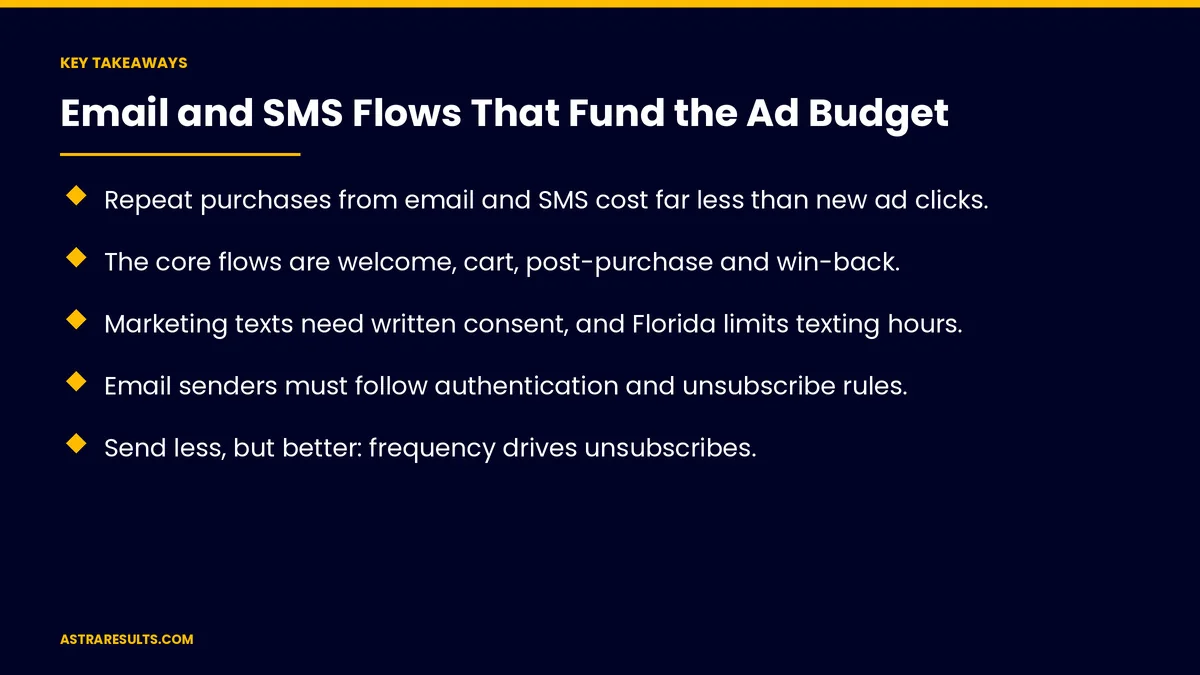
- Repeat purchases from email and SMS cost far less than new ad clicks.
- The core flows are welcome, cart, post-purchase and win-back.
- Marketing texts need written consent, and Florida limits texting hours.
- Email senders must follow authentication and unsubscribe rules.
- Send less, but better: frequency drives unsubscribes.
- Measure revenue per subscriber and compare it with ad costs.
Published: October 6, 2026 | Reading Time: ~9 minutes | Category: E-Commerce Marketing
This guide covers email and SMS flows for online stores: why flows matter, building the list, the welcome flow, cart and browse flows, post-purchase flows, win-back flows, consent rules, deliverability, frequency, Spanish and what to measure. Put plainly: build a consented list, automate the key flows and measure revenue per subscriber against ad costs.
This is general information, not legal advice. Review email and text consent rules with counsel.
In This Playbook
- Why flows matter
- Building the list
- When should a store's welcome email go out?
- Cart and browse flows
- Post-purchase flows
- Who should a win-back flow target?
- Consent rules
- Deliverability
- Frequency
- Spanish
- Loyalty
- What to measure
- The first three months
Why flows matter
Ads find customers. Flows keep them.
Lower cost per sale. No click to pay for.
Always running. Triggered by what customers do.
The tools are covered in the e-commerce stack.
Building the list
Clear sign-up offers. Early access, guides or a first-order perk.
Separate email and text consent. Each asked clearly.
Every channel. Checkout, product pages and pop-ups used sparingly.
When should a store's welcome email go out?
First message right away. While interest is high.
The brand story. Why you exist and what makes products different.
Best sellers and proof. Reviews and popular items.
Cart and browse flows
Cart reminders. For shoppers who leave items behind.
Browse follow-ups. For viewed products, used gently.
Product page fixes help too. As covered in product page conversion.
Post-purchase flows
Order updates. Clear and timely, as in order status to reorder.
How to use it. Care tips and getting started.
Review requests. After delivery.
Reorder reminders. Timed to when products run out.
Who should a win-back flow target?
Customers who've gone quiet. A reminder of what they liked.
New arrivals. Reasons to return.
Stop gracefully. Remove people who never respond.
Consent rules
Marketing texts need written consent. Under federal rules.
Florida limits. Marketing calls and texts only between 8 a.m. and 8 p.m., with limits on repeat messages about the same subject.
Easy opt-out. In every message.
More detail in outbound compliance.
Deliverability
Authenticated sending. Gmail and Yahoo require it for bulk senders.
One-click unsubscribe. Required for bulk marketing email.
Low complaint rates. Send only to people who want your emails.
Frequency
Fewer, better messages. Every send should be useful, and tailored without being creepy, as in personalized engagement.
Peak seasons. More messages, planned in advance, as in Black Friday planning.
Watch unsubscribes. A rising rate means slow down.
Spanish
Messages in the customer's language. Written natively.
Separate flows. Not machine-translated copies.
Loyalty
Points and perks. Reasons to come back, as in loyalty apps.
Fitness brands. As in fitness merch and supplements.
What to measure
Revenue per subscriber. Monthly.
Flow revenue share. Of total store revenue.
Repeat purchase rate. Customers who buy again.
Unsubscribes and complaints. Kept low.
Compared with ad costs. As weighed in paid, organic and AI budgeting.
The first three months
Days 1–30: list and rules
Review consent for email and texts with counsel, set up authenticated sending and add clear sign-up offers.
Days 31–60: core flows
Launch welcome, cart and post-purchase flows in English and Spanish.
Days 61–90: win-back and measure
Add win-back and reorder flows, and track revenue per subscriber against ad costs.
How Astra builds store flows
Astra Results Marketing builds email and SMS flows for online stores. We grow consented lists, launch welcome, cart, post-purchase and win-back flows, follow consent and sending rules and measure revenue per subscriber against ad costs.
Engagements begin with a store review through our e-commerce marketing team.
Related reading
Frequently asked questions
How do email and SMS flows fund the ad budget?
They bring back customers without paying for new clicks, earning back much of what ads cost.
Which flows matter most?
Welcome, cart, post-purchase and win-back flows.
Do marketing texts need consent?
Yes, written consent under federal rules, plus easy opt-outs. Florida also limits texting hours and repeat messages.
What do Gmail and Yahoo require?
Authenticated sending, one-click unsubscribe and low complaint rates for bulk senders.
How often should we send?
Fewer, more useful messages, with more during planned peak seasons and less when unsubscribes rise.
What should we measure?
Revenue per subscriber, flow revenue share, repeat purchase rate, unsubscribes and how flows compare with ad costs.
Ready for flows that earn back your ad spend? Astra Results Marketing builds consented email and SMS flows that welcome, recover, follow up and win back customers, measured against your ad costs. ▸ CALL (786) 321-2866 · ▸ REQUEST YOUR CONSULTATION





