Rated 5 star on


Insurance Engagement: Policy Questions and Claims
Quick answer
An independent insurance agency can let software handle routine service work: ID cards, certificates, billing status, change requests and claim intake. Identity and policy verification come first. Coverage advice, binding and anything that changes coverage stay with licensed staff. First notice of loss is treated as urgent intake, because those minutes shape renewal.
An independent agency's service desk handles the same twenty requests all day. Send my ID card. I need a certificate for tomorrow. Why did my premium change. Add a driver. And at the worst moment of a customer's month. I have had an accident, what do I do now. Each is urgent to the customer and routine to the agency.
Key Takeaways
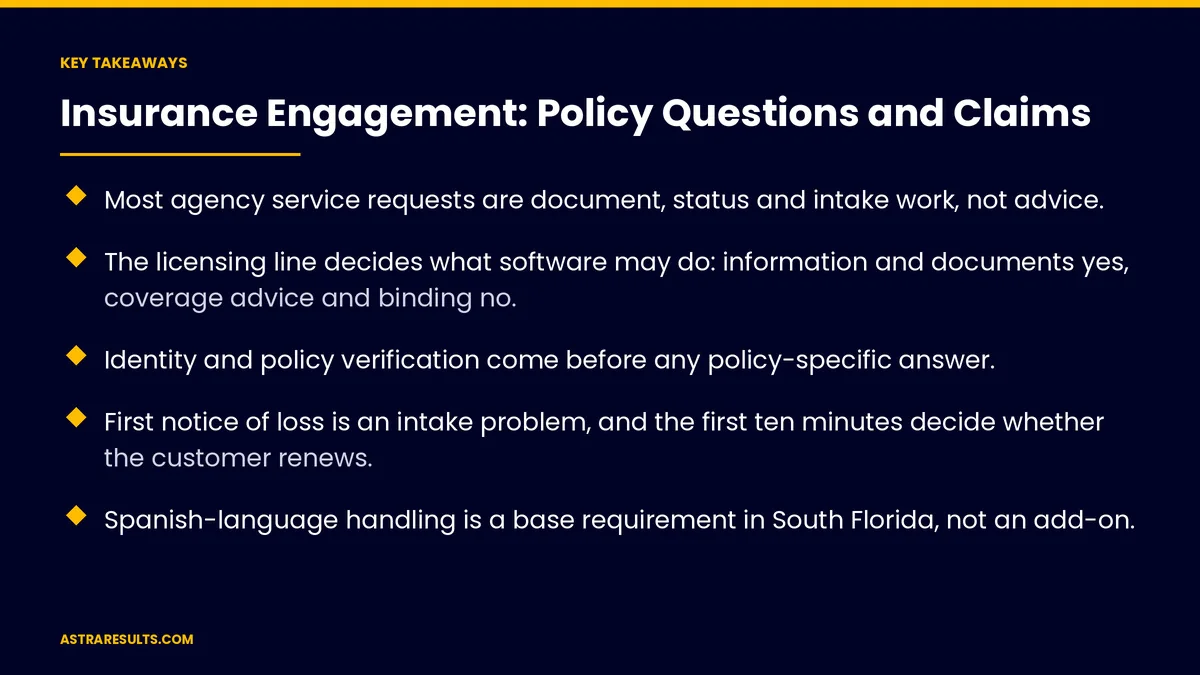
- Most agency service requests are document, status and intake work, not advice.
- The licensing line decides what software may do: information and documents yes, coverage advice and binding no.
- Identity and policy verification come before any policy-specific answer.
- First notice of loss is an intake problem, and the first ten minutes decide whether the customer renews.
- Spanish-language handling is a base requirement in South Florida, not an add-on.
- Measure by service hours returned to producers, after-hours requests handled and retention at renewal.
Published: October 16, 2026 | Reading Time: ~12 minutes | Category: Customer Engagement
This piece is about answering those requests in seconds without crossing the line that separates service from advice, and about handling the first minutes of a claim well enough that the customer stays. It draws the licensing line first, because in insurance it decides the structure.
Put plainly: let software handle documents, status and intake; keep advice, coverage decisions and binding with licensed people.
Guidance for agency owners and service leaders. Nothing here is legal or regulatory advice. What unlicensed staff and automated systems may say to a policyholder is governed by state insurance law, and consent rules for texting and recording vary by jurisdiction. Both must be confirmed with counsel and the agency's compliance function before deployment.
In This Playbook
- The licensing line comes first
- How should an insurance agency verify a policyholder's identity?
- The five service requests that fill the day
- First notice of loss: the ten minutes that matter
- Channels and language
- Connecting to the agency management system
- Return, measured
- The first three months
- Astra's part in it
The licensing line comes first
Why it decides everything. In most states, telling a policyholder what their policy covers, recommending a limit, or binding coverage is licensed activity. Software cannot hold a license. Neither can an unlicensed customer service representative, whose permitted tasks are defined by statute and vary by state.
What falls on the service side. Sending documents that already exist: ID cards, declarations pages, certificates from an existing template. Reporting status: payments posted, renewal dates, claim numbers. Collecting information: a change request, a first notice of loss, a callback request. Scheduling.
What falls on the licensed side. Anything that answers "am I covered," "how much should I carry," "should I add this," or "please bind it." These go to a licensed person every time. The system must not attempt them, even when it could guess correctly.
The design consequence. The assistant is built around a list of permitted actions confirmed with counsel and compliance. Everything outside the list routes to a licensed person with the context attached. The list, not the technology, is the product.
How should an insurance agency verify a policyholder's identity?
Before any answer. The requester is matched to a named insured or an authorized contact on the policy. The policy itself is confirmed active. The pattern is the same one distributors apply to contract pricing in wholesaler engagement: who is asking, before what is said.
Who may ask. The named insured. A listed driver, for their own ID card. A mortgagee or lienholder, for evidence of coverage. A certificate holder, for their certificate. Each has a different permitted set, and the system has to know which one it is speaking to.
Sensitive data. Policy numbers, addresses, vehicle identifiers and claim details are personal information. Confirmation steps before disclosure, retention rules for conversation records and encryption in transit and at rest are requirements, not options.
When identity fails. The system stops, states what it can do without verification, and routes to a person. It does not narrow down by guessing.
The five service requests that fill the day
ID cards and declarations. The single most common request. The document exists in the agency management system. The work is finding it, confirming the requester and sending it to the right place.
Certificates of insurance. Contractors need them for a job that starts tomorrow. Where a template exists for that insured and the holder's details are supplied, issuing one is document work. Where the holder asks for wording changes, extra insured status or waivers, it is licensed work and routes.
Billing. Payment posted, amount due, due date, why the premium changed at renewal. Status is reportable. Explaining a rate change in terms of coverage is not.
Policy changes. Add a driver, change an address, add a vehicle. The system collects the complete request and routes it; a licensed person reviews and processes. Confirmation goes back to the customer.
Renewals. Reminders, document delivery, payment collection. The renewal conversation about coverage stays with the producer. The system's job is to make sure that conversation happens before the date.
First notice of loss: the ten minutes that matter
What the customer needs. Calm, structure and certainty about what happens next. They have often never made a claim before. They are on the roadside or in a wet living room, and the agency's phone is the one they trust.
What the system does. Answers immediately, at any hour. Confirms safety first. Collects the facts in order: who, what, when, where, injuries, other parties, photos. Provides the carrier's claim number and next steps. Sends written confirmation. Notifies the agency's claims contact.
What it does not do. Say whether the loss is covered. Estimate a payout. Advise on whether to file. Those are licensed or adjuster decisions and the system says so plainly, then hands off.
The follow-up. Status checks with the carrier, proactive updates to the customer, a call from a person within one business day. The intake discipline described in every lead answered in seconds applies with the difference that this customer is already the agency's. The stakes are renewal rather than sale.
Channels and language
Phone. Still the channel for claims and for older policyholders. After-hours voice is where most agencies leak. A loss at 11 pm reaches voicemail. The customer calls the carrier directly, which is the beginning of losing them to a direct writer.
Text and WhatsApp. The default for ID cards, certificates and reminders. Consent for marketing and servicing messages differs, and the agency's consent records must be checked before the first message goes out.
Email. Where documents move. Reading inbound certificate requests and matching them to the policy removes a large share of manual work.
Spanish. A large share of South Florida policyholders service their policies in Spanish. An assistant that handles Spanish natively, in the register the customer uses, is a base requirement here. The reasons are set out in what changes when Spanish is a channel. Licensing rules do not change with the language, so the permitted-action list is identical in both.
One record. A customer who texts for an ID card and calls about a claim is one policyholder with one history. The channel comparison in voice, chat, SMS and WhatsApp covers what each channel tolerates. The agency management system is the record they all write to.
Connecting to the agency management system
Read first. Policies, insureds, contacts, documents, billing status, claim numbers. Read-only access covers the five service requests and first notice of loss entirely.
Write with care. Logging the conversation to the policy file is a write worth doing from day one, because it creates the audit trail. Processing changes, issuing certificates and binding are writes that stay with licensed staff or are automated only within rules compliance has approved.
Carriers. Claim status, payment posting and document retrieval often live in carrier portals rather than the agency system. Where a carrier offers a connection, use it; where it does not, the system says how current its answer is and when a person will confirm.
Where this sits in the stack. The agency management system is the record layer. The sequence for building around it is the one laid out in the engagement stack explained.
Return, measured
Service hours. Count document, status and change requests per staff member per day before starting. Most agencies find the service desk spends more than half its time on the five requests above.
Producers selling. In smaller agencies, producers handle service because nobody else can. Returning that time is the same shift the marketing side of an agency depends on, as described in insurance and risk advisory marketing.
After-hours claims answered. Losses reported at night reaching a structured intake instead of voicemail. Counted monthly.
Retention. Policyholders who had a claim handled well renew at higher rates than those who did not. Measured at renewal, by whether a claim occurred and how it was handled.
Fewer errors. Certificates with the right holder. ID cards to the right driver. Changes captured completely the first time.
The first three months
Days 1–30: the permitted list and the baseline
Service requests logged for thirty days by type, channel, hour and language. The permitted-action list drafted with counsel and compliance, state by state where the agency is licensed. Identity rules written per requester type. Service hours per staff member recorded.
Days 31–60: documents and status live
ID cards, declarations and status answers live on the two largest channels, in English and Spanish, after identity verification. Conversations logged to the policy file. Every out-of-list request routing to a licensed person with context. Certificate requests from existing templates added once identity proves reliable.
Days 61–90: first notice of loss and review
Structured claim intake live at all hours, with written confirmation, carrier claim numbers and a one-business-day human follow-up. Change requests collected and routed. Service hours, after-hours claims handled and out-of-list routing volumes compared to Day 1, with compliance reviewing a sample of transcripts.
Astra's part in it
Astra Results Marketing begins with the permitted-action list, drafted alongside the agency's counsel and compliance function, because in insurance the line between service and advice is the design. Everything the system does is on that list. Everything else routes to a licensed person with the conversation attached.
Identity verification is built per requester type before any policy-specific answer. Conversations are logged to the policy file from the first day. Documents and status go live first, first notice of loss second, in both English and Spanish, with a compliance review of transcripts each month. Reporting runs on service hours returned, after-hours claims handled and retention at renewal.
Engagements begin with a thirty-day service log and a permitted-action workshop through our AI customer engagement team.
Related reading
Frequently asked questions
What can an automated system do for policyholders?
Send documents that already exist, report status, collect complete change requests and claim information, schedule, and remind. The permitted list is set with counsel and compliance for each state the agency is licensed in. Everything outside it routes to a licensed person.
What must stay with licensed staff?
Anything that answers whether a loss is covered, what limits to carry, whether to add coverage, and any request to bind. Certificate wording changes, extra insured status and waivers also route, because they change what is covered.
How is a claim handled at 11 pm?
The system answers, confirms safety, collects the facts in order, provides the carrier claim number and next steps, sends written confirmation and notifies the agency. It does not say whether the loss is covered. A person follows up within one business day.
Why does identity come before answers?
Because policy details are personal information and each requester type has a different permitted set. The named insured, a listed driver, a mortgagee and a certificate holder may each see different things. The system verifies who is asking, and stops when it cannot.
Does the licensing line change in Spanish?
No. The permitted-action list is identical in both languages. What changes is that a large share of South Florida policyholders service their policies in Spanish, so native handling in the customer's tone is a base requirement.
How is the return measured?
Service hours returned to staff and producers, after-hours claims handled instead of reaching voicemail, out-of-list requests routed correctly, and retention at renewal for policyholders who had a claim, all against a baseline logged before the work.
Ready to answer policyholders in seconds, within the line? Astra Results Marketing drafts the permitted-action list with your counsel and compliance, builds identity verification per requester type, and takes documents, status and claim intake live in English and Spanish, measured in hours returned and retention at renewal. ▸ CALL (786) 321-2866 · ▸ REQUEST YOUR CONSULTATION