Rated 5 star on

AI for Customer Support Teams
Quick answer
AI moves a support agent's work away from searching and typing toward judgment and fixing problems. Astra advises introducing agent assist before any customer-facing automation. New roles grow around knowledge, escalations and automation review. The team should be measured on resolution and effort. Career paths need redrawing so the best agents stay.
Most writing about AI in support is about the software. This piece is about the eight people on the team who were told on a Tuesday that the software was coming. Their questions decide whether the project works. Will I still have a job? Will this make my day worse? Who is measuring me now?
Key Takeaways
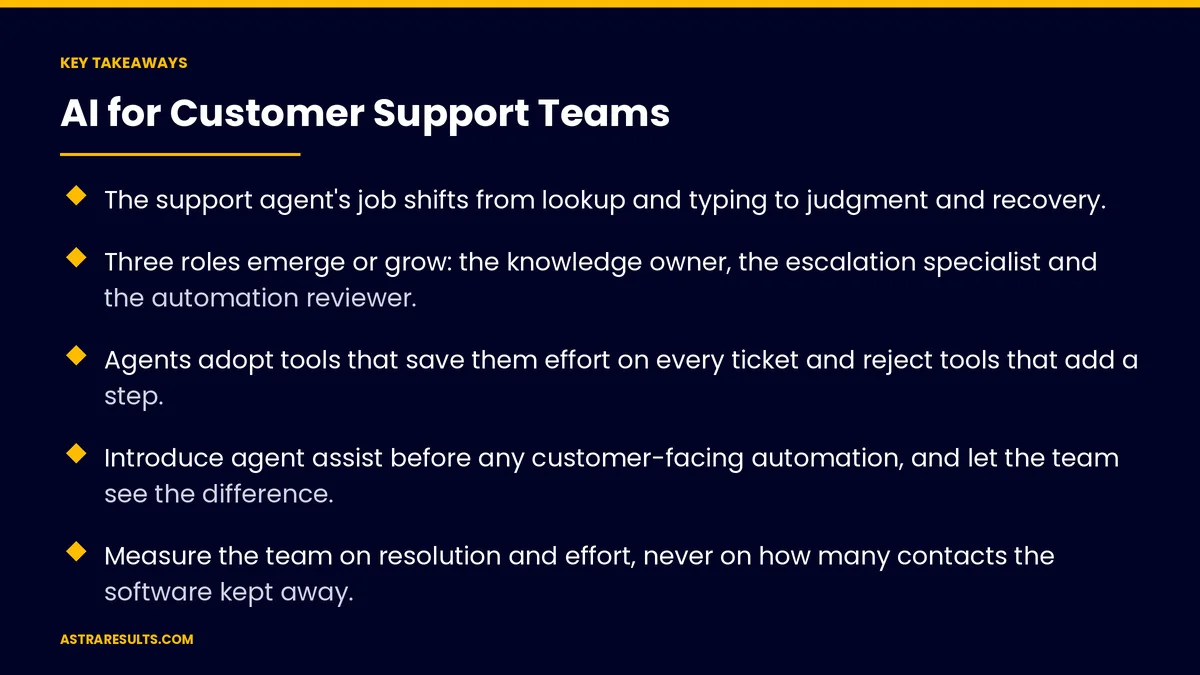
- The support agent's job shifts from lookup and typing to judgment and recovery.
- Three roles emerge or grow: the knowledge owner, the escalation specialist and the automation reviewer.
- Agents adopt tools that save them effort on every ticket and reject tools that add a step.
- Introduce agent assist before any customer-facing automation, and let the team see the difference.
- Measure the team on resolution and effort, never on how many contacts the software kept away.
- Career paths have to be redrawn, or the best agents leave for teams where they were.
Published: October 1, 2026 | Reading Time: ~12 minutes | Category: Customer Engagement
The technology side of intelligent support is covered elsewhere in this series. Here the subject is the team: which roles change and how, what agents need to learn, how to introduce the tools so the people using them want them, and how to measure a team that now works alongside software.
Put plainly: AI does not replace a support team; it changes what a good one is measured on.
Guidance for owners, support leaders and the people who hire for support. Nothing here is legal or employment advice. Monitoring, recording and performance measurement of staff are governed by employment law that varies by jurisdiction and should be confirmed with counsel.
In This Playbook
- What changes in the agent's day
- Three roles that emerge
- What skills do support agents need once AI arrives?
- Introducing it without a fight
- What to measure, and what to stop measuring
- Hiring for the new team
- Career paths, redrawn
- Where teams go wrong
- The first three months
What changes in the agent's day
Less of. Looking up the account. Reading the last three tickets. Typing the summary after the call. Searching for the policy. Filling in the category, priority and disposition fields. Drafting the same reply for the fortieth time.
More of. Deciding. Handling the customer who is upset, the case that does not fit, the exception the policy never anticipated. Editing a drafted reply so it sounds like a person who cares. Catching the software when it is wrong.
The shape of it. Fewer tickets that are easy and more that are hard, because the easy ones were resolved before they reached a person. An agent who was good because they were fast at lookup has to become good at something else. Most can. Some will not want to.
Three roles that emerge
The knowledge owner. Someone who turns resolved tickets into maintained answers, reviews what the assistant is saying every week and retires what is stale. Part-time in a small team, full-time above roughly twenty agents. Without this role, the knowledge decays and the assistant starts confidently citing last year.
The escalation specialist. The person tier-three cases go to: complaints, disputes, distress. Usually the most experienced agent, now doing only the work that needs experience. This is a promotion and should be paid as one.
The automation reviewer. Someone who audits a sample of software-resolved tickets every week, reads the reopens, and decides which intents move up or down a tier. Often the team lead at first; later a named person. The discipline of scoping and rolling back described in AI pilots that fail safely lives here.
What the team lead stops doing. Queue management by hand, shift-by-shift firefighting and reading every ticket. What they start doing: reviewing the tiers, owning the metrics and coaching agents on judgment instead of speed.
What skills do support agents need once AI arrives?
Editing, not writing. Taking a drafted reply and making it right: correct, in the business's voice, specific to this customer. Faster than writing from scratch, harder than it sounds, and a skill that has to be taught.
Reading a summary critically. The assistant summarizes the conversation and suggests a cause. Agents have to learn when to trust it and when to open the full record. Over-trust causes errors. Under-trust wastes the tool.
Recovery. The customer who reached a person after the software failed them is starting angry. Turning that around is the highest-value skill on the team and the one least often trained.
Feedback into the system. Flagging a wrong suggestion, a stale answer, a missing category. Agents are the sensors of the knowledge loop. The loop only works if flagging takes seconds and is visibly acted on.
What they do not need. To understand how the models work. The explanation an operator needs is covered in machine learning for operators, and a two-hour version of it is enough.
Introducing it without a fight
Start beside the agent, not in front of the customer. Agent assist first: summaries, retrieval, drafts. It saves every agent effort on every ticket from day one, and nobody's job is visibly at stake. Teams that see this first ask for more. Teams that see a customer-facing bot first assume the bot is their replacement.
Say what the plan is for headcount, out loud. If the plan is to handle growth without hiring, say so. If it is to move people to sales or success roles, say so. Silence is filled with the worst assumption, and the best agents act on it first.
Let the team place the tiers. Agents know which questions are safe to automate and which are traps. Ask them. They will be more accurate than the vendor and they will own the result.
Make flagging matter. When an agent flags a wrong answer and it is fixed within a week, they flag the next one. When nothing happens, they stop, and the system stops learning.
Measure the team on the new work. If the scorecard still rewards handle time and tickets per hour, the team will optimize for it and resent the tools that changed it. Change the scorecard before the tools arrive.
What to measure, and what to stop measuring
Stop: tickets per agent per hour. The easy tickets are gone; the number falls. The team looks worse while doing harder work.
Stop: contain rate as a team metric. It measures the software, and rewards keeping customers away from the people being scored.
Start: first-contact resolution by agent. Including tier-two cases the software prepared. This is the number that reflects judgment.
Start: reopen rate by agent. Tickets the customer had to come back about. The clearest signal of quality.
Start: customer effort after resolution. Asked immediately, attributed to the agent who closed it.
Start: flags submitted and accepted. How much each agent improves the system. A leading indicator of who should own knowledge next.
Keep: agent hours returned. Counted against a baseline recorded before the tools arrived, using the method in automation KPIs, so the return is visible and the team sees where the time went.
Hiring for the new team
What to hire for. Judgment, writing, calm under hostility, curiosity about why things break. What to stop screening for: typing speed and tolerance for repetition.
Where support talent goes. Agents freed from lookup are the best source of sales, customer success and operations hires a business has, because they know the customers and the product's failure points. Plan for it, or another business will.
Build or partner. Standing up the roles, the tiers and the loop is a program, not a purchase. The build-versus-partner question that applies to marketing in building an internal team vs partnering applies here with the same answer. Own the judgment and the metrics, and partner for the build if the team is small.
Career paths, redrawn
The old ladder. Agent, senior agent, team lead. Promotion meant handling more volume and then supervising people who handled volume.
The new ladder. Agent, escalation specialist or knowledge owner or automation reviewer, then team lead who owns tiers and metrics. Three specialist tracks where there was one, each a real promotion with real pay.
Why it matters. The best agents are the ones most able to leave. A visible path to the specialist roles is what keeps them. It is what makes the whole program work, because those roles are the ones the software depends on.
Where teams go wrong
Announcing the bot before the assist. The team reads it as a replacement and works against it.
Leaving the old scorecard. Agents get measured on numbers the tools were built to lower.
No knowledge owner. Everyone is responsible, so nobody is, and the assistant decays in a quarter.
Ignoring flags. The team stops reporting errors, and the errors reach customers.
Not talking about headcount. The uncertainty costs more than any plan would have.
The first three months
Days 1–30: the conversation and the baseline
The headcount plan stated to the team. Agent hours, first-contact resolution and reopen rate recorded as the baseline. Agents asked to place every ticket category in a tier. Knowledge owner named, with hours allocated. Scorecard redrawn.
Days 31–60: assist first
Agent assist live for every agent on every ticket. Flagging live, with a weekly fix cycle the team can see. Two-hour operator training on what the tools do and do not do. Escalation specialist named.
Days 61–90: tier one and the review
The first two or three low-risk intents automated, chosen by the team. Automation reviewer sampling weekly. Hours returned, resolution and reopen rate compared to Day 1, shared with the team, and the first specialist promotion made.
Where Astra fits in
Astra Results Marketing begins with the team rather than the tools: the headcount conversation, the baseline, the tiers placed by the agents who know the tickets, and the scorecard redrawn before anything goes live. Agent assist is deployed first because it earns the team's trust and returns the most hours.
Customer-facing automation follows one intent at a time, chosen by the team and audited weekly by a named reviewer. The three specialist roles are defined with the client, with pay bands, so the program has owners and the best agents have somewhere to go. Reporting runs on resolution, reopens, effort and hours returned, never on contain rate.
Engagements begin with a team baseline and a ticket-tiering workshop through our AI customer engagement team.
Related reading
Frequently asked questions
Does AI reduce the size of a support team?
Usually it lets a team handle growth without hiring rather than cutting people. Whatever the plan is, it should be stated to the team early and plainly, because silence gets filled with the worst assumption and the best agents act on it first.
What should be introduced first?
Agent assist: summaries, account retrieval and drafted replies working beside the agent. It saves effort on every ticket from day one and threatens nobody's job, so the team trusts what follows. Customer-facing automation comes later, one low-risk intent at a time.
Which new roles does a support team need?
A knowledge owner who maintains what the assistant says, an escalation specialist who takes the cases that need experience, and an automation reviewer who audits software-resolved tickets and moves intents between tiers. Each is a real promotion.
How should agents be measured now?
On first-contact resolution, reopen rate and customer effort, plus the flags they submit that improve the system. Tickets per hour and contain rate should be retired, because the easy tickets are gone and the remaining work is harder.
What skills do agents need?
Editing drafted replies rather than writing from scratch, reading summaries critically, recovering customers who arrive angry after the software failed them, and flagging errors quickly. They do not need to understand how the models work beyond a two-hour operator briefing.
Why redraw career paths?
Because the specialist roles are the ones the whole program depends on. The agents best suited to them are the ones most able to leave. Three specialist tracks with real pay keep them, where the old agent-to-lead ladder would not.
Ready to bring your support team with you? Astra Results Marketing starts with the headcount conversation, the baseline and the tiers your agents place, deploys agent assist first, and measures the team on resolution and effort against a baseline, never on contain rate. ▸ CALL (786) 321-2866 · ▸ REQUEST YOUR CONSULTATION