Rated 5 star on

The Engagement Stack Explained
Quick answer
An engagement stack is the chain of seven layers a customer contact moves through. They run from channels and intake to the shared record, knowledge, follow-up, handoff and measurement. Most businesses own several layers but never connect them. Astra builds the record layer first, then intake, then follow-up. Success is booked outcomes per contact.
Most businesses do not have an engagement stack. They have a phone system from one vendor, a chat widget from another, a CRM someone set up in 2021 and a shared inbox nobody owns. Each tool works on its own. Together they lose customers in the gaps between them, and nobody sees it happen.
Key Takeaways
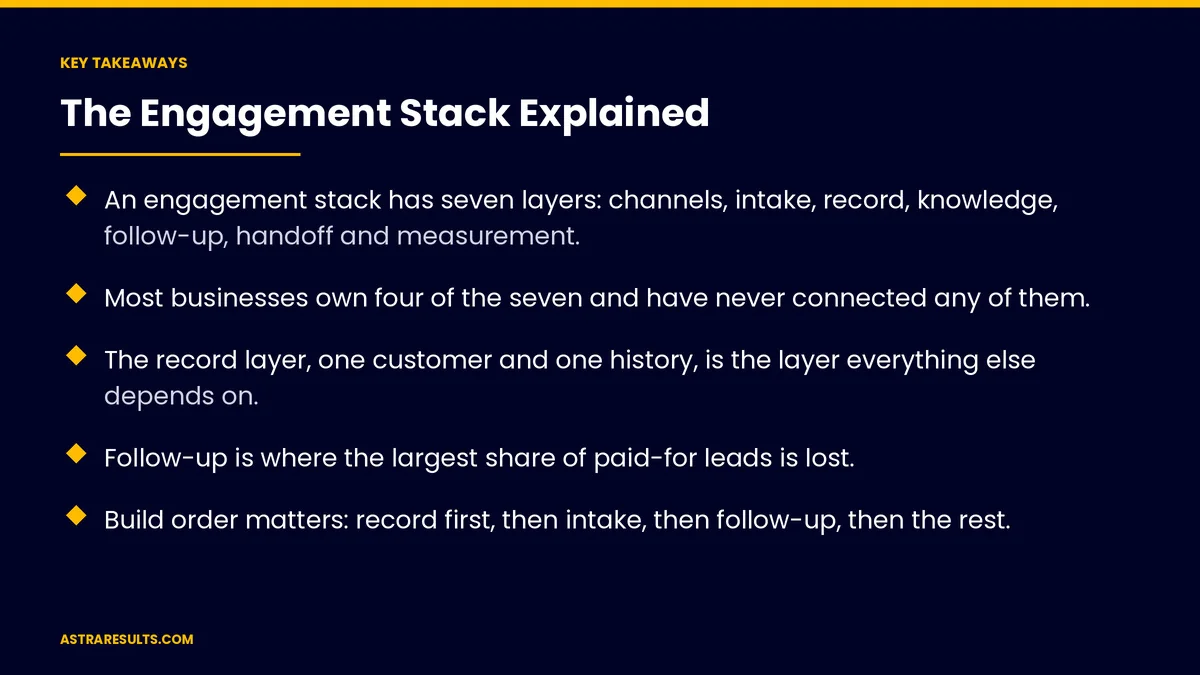
- An engagement stack has seven layers: channels, intake, record, knowledge, follow-up, handoff and measurement.
- Most businesses own four of the seven and have never connected any of them.
- The record layer, one customer and one history, is the layer everything else depends on.
- Follow-up is where the largest share of paid-for leads is lost.
- Build order matters: record first, then intake, then follow-up, then the rest.
- Measure the stack by booked outcomes per contact, not by response time alone.
Published: October 27, 2026 | Reading Time: ~12 minutes | Category: Customer Engagement
An engagement stack is the same tools arranged in layers so that a message entering at the top comes out the bottom as a booked job, a resolved question or a clean record of why neither happened. This piece names the seven layers, shows where each one fails when bought in isolation, and gives the order to build them.
Put plainly: the stack is one system with seven jobs, not seven tools.
Guidance for owners and operators. Nothing here is legal advice. Consent, recording and disclosure rules for customer communication vary by channel and jurisdiction and must be confirmed with counsel before deployment.
In This Playbook
- Why do service businesses need a stack instead of one tool?
- Layer 1: channels
- What does the intake layer of an engagement stack do?
- Layer 3: the record
- Layer 4: knowledge
- Layer 5: follow-up
- Layer 6: handoff
- Layer 7: measurement
- The order to build it
- What it costs and what it returns
- The first three months
Why do service businesses need a stack instead of one tool?
The purchasing pattern. A business feels one pain, buys one tool. Missed calls lead to an answering service. Slow replies lead to a chat widget. Lost leads lead to a CRM. Each purchase solves the symptom it was bought for and creates a seam with everything bought before it.
Where customers fall. In the seams. The chat conversation is not in the CRM. The answering service takes a message that reaches the owner the next morning. The follow-up text goes to a customer who already booked with a competitor. None of these is a tool failure. Each is a gap between tools.
What the word stack adds. A stack implies order and dependency. Layers sit on layers, and a layer cannot do its job if the one beneath it is missing.
Thinking this way turns a pile of subscriptions into a system with a build sequence, which is the point of this piece and the reason the full-funnel view treats conversion as a stage rather than a widget.
Layer 1: channels
What it is. Every door a customer can walk through: phone, web chat, SMS, WhatsApp, email, social messaging, web forms and, increasingly, the AI assistants that answer questions on the business's behalf inside search results.
The job. Be open where the customer already is. Not where the business finds it easiest to build.
How it fails alone. A business offers the channels it can staff, not the channels its customers prefer. After-hours voice is the most common gap. The phone rings into voicemail at 6:40 pm and the customer calls the next listing. The comparison of voice, chat, SMS and WhatsApp covers what each channel tolerates and what each one demands.
The rule. Count what arrives by channel and hour before adding or removing anything. Most businesses have never done this once.
What does the intake layer of an engagement stack do?
What it is. The first minutes of every contact. Who is this, what do they need, how urgent is it, and where does it go next.
The job. Answer in seconds, capture what matters, route correctly. Speed to lead is the single measurement that predicts whether the rest of the stack ever gets a chance.
How it fails alone. Intake without a record layer beneath it produces notes in five places. Intake without a knowledge layer beside it produces "someone will call you back," which is a promise the business then has to keep by hand. The mechanics of answering every lead in seconds are covered in AI inbound intake.
The rule. Intake ends with a structured record and a next action assigned to a person or a system, or it did not happen.
Layer 3: the record
What it is. One customer, one identity, one history, regardless of channel. The CRM in name, but only if it is written to by every layer above and below it.
The job. Make the business remember. A customer who texted on Tuesday, called on Thursday and walked in on Saturday should be one record with three entries, not three strangers.
How it fails alone. A CRM nobody writes to is a list of names. Most CRMs fail this way: bought, populated once, and then bypassed by the tools that came after it. Identity resolution across channels, matching a phone number to an email to a chat session, is data engineering work.
The case for doing it first is made in the foundation every AI project needs.
The rule. If a layer cannot write to the record, it is not in the stack yet.
Layer 4: knowledge
What it is. The business's own answers. Hours, service area, pricing rules, what is and is not offered, policies, the fifty questions customers ask every week. Structured so software and people can both use them.
The job. Answer correctly and consistently without a human retrieving the answer each time.
How it fails alone. The knowledge lives in the owner's head and in a PDF from 2023. Every new hire and every AI assistant learns it differently. Answers drift. A customer told one price by chat and another by phone does not trust either.
The distinction between answering and deflecting, which turns entirely on this layer, is drawn in customers answered, not deflected.
The rule. One maintained source of answers, with a named owner and a review date, before any assistant is allowed to speak for the business.
Layer 5: follow-up
What it is. Everything that happens after the first contact and before the outcome. The quote that was sent, the appointment reminder, the second attempt when the first got no answer, the "are you still looking?" a week later.
The job. Keep the conversation alive until it resolves one way or the other. Most leads are not lost at intake. They are lost in the silence after it.
How it fails alone. Follow-up depends on the record (who to follow up with), on intake (what they wanted) and on knowledge (what to say). Without those, follow-up is a salesperson's memory and a sticky note. Automation here returns more revenue than any other layer because the work is repetitive, time-sensitive and forgotten under load.
The rule. Every open contact has a next action with a date. A contact with no next action is a lead the business has decided to lose.
Layer 6: handoff
What it is. The moment a conversation moves from software to a person, from one person to another, or from the front desk to the field.
The job. Move the customer without making them repeat themselves. The handoff carries the record, the history and the reason for the transfer.
How it fails alone. Handoff is where AI deployments earn distrust. An assistant that cannot recognize its own limits, or that transfers a customer into a queue with no context, is worse than voicemail. Handoff rules must be written before deployment: which questions, which customers, which signals go to a person. How fast a person must pick up.
The rule. The person receiving a handoff sees the full conversation before they say hello.
Layer 7: measurement
What it is. The instrument that says which layer is leaking. Contacts by channel and hour. Speed to lead. Intake completion. Follow-up cadence held or missed. Handoff wait times. Booked outcomes per contact, by source.
The job. Turn the stack from a set of subscriptions into something the business can manage, because a layer that is not measured cannot be improved and cannot be defended when its cost comes up.
How it fails alone. Each tool reports on itself. The phone system reports answer rate. The chat widget reports conversations. The CRM reports pipeline. None of them reports the number that matters, which is how many contacts became customers and what each source cost. That number requires the record layer and the discipline described in attribution across every channel.
The rule. One dashboard, one definition of a booked outcome, reviewed monthly against the prior month.
The order to build it
Record first. Counterintuitive, because the record layer produces nothing visible on its own. But every other layer writes to it, and retrofitting identity across channels after the fact is the most expensive job in the stack.
Intake second. Speed to lead is the fastest revenue win available to most service businesses, and once the record exists, intake has somewhere to put what it captures.
Follow-up third. Now the business knows who contacted it and what they wanted, and can pursue the ones that went quiet. This is where the paid-for leads that were leaking come back.
Knowledge and handoff together. They are two sides of the same rule. Answer what can be answered, transfer what cannot, and never leave the customer in between.
Channels last, not first. Adding a channel before the layers beneath it exist adds a new place to lose customers. Remove or add channels once the count from layer 1 says which ones matter.
Measurement throughout. The dashboard grows one row per layer as each layer goes live.
What it costs and what it returns
The cost pattern. Most businesses already pay for four or five of the seven layers. The stack is rarely a new purchase. It is connecting what exists, replacing the one or two tools that cannot be connected, and writing the rules the tools were bought without.
The return pattern. Follow-up recovery is the first number to move, typically within the first sixty days, because it works on leads the business already paid for. Speed to lead moves booked rate next. Knowledge and handoff reduce repeat contacts and the labor behind them.
The number to hold it to. Booked outcomes per hundred contacts, by source, before and after. Response time and conversation counts are inputs. That ratio is the output, and it is the only one that survives a budget conversation.
The first three months
Days 1–30: count and connect
Contacts counted by channel and hour for thirty days, including the ones that got voicemail. Every existing tool inventoried against the seven layers. The record layer chosen or confirmed, and identity rules written: what makes two contacts the same customer.
Days 31–60: intake and follow-up live
Intake answering in seconds on the two largest channels, writing structured records. Follow-up cadence defined and automated for every open contact. Knowledge source drafted from the fifty most common questions and given an owner.
Days 61–90: handoff, measurement, review
Handoff rules written and tested with real transfers. Dashboard live with one row per layer. Booked outcomes per hundred contacts compared to the Day 1 baseline, and the next leaking layer named.
Where Astra fits in
Astra Results Marketing inventories the seven layers before proposing any tool, because the gap is almost always a missing connection rather than a missing subscription. The record layer is confirmed first, and every subsequent piece is required to write to it.
Intake, follow-up and knowledge are built as one system with shared definitions. Handoff rules are agreed with the client's team before any assistant speaks to a customer. Reporting runs on booked outcomes per contact by source, measured against a baseline taken before the work starts. Engagements begin with a seven-layer inventory through our AI customer engagement team.
Related reading
Frequently asked questions
What is an engagement stack?
The set of layers a customer contact passes through between first message and outcome: channels, intake, record, knowledge, follow-up, handoff and measurement. Arranged as a system, each layer feeds the next. Bought separately, they leave gaps where customers are lost.
Which layer should a business build first?
The record layer: one customer, one identity, one history across channels. It produces nothing visible on its own. But every other layer writes to it, and adding it later means re-matching every contact the business has ever had.
Where are most leads lost?
In follow-up. Intake failures are visible and get fixed. The silence after a first contact, the quote nobody chased and the second attempt nobody made are invisible. They account for the largest share of paid-for leads that never become customers.
Does the stack require replacing existing tools?
Rarely. Most businesses already pay for four or five layers. The work is connecting them to one record, replacing only the tool or two that cannot be connected, and writing the intake, follow-up and handoff rules the tools came without.
How should the stack be measured?
By booked outcomes per hundred contacts, by source, compared to a baseline taken before the work. Response time, conversation counts and answer rates are inputs worth tracking. But the ratio of contacts to customers is the number that justifies the cost.
How is a handoff done well?
The person receiving the conversation sees its full history before speaking, the rules for what transfers and when are written before deployment. The customer never repeats what they already said. A handoff that loses context is worse than no automation at all.
Ready to see where your stack is leaking? Astra Results Marketing inventories all seven layers against what you already own, confirms the record layer first, and measures the result in booked outcomes per contact against a baseline taken before the work begins. ▸ CALL (786) 321-2866 · ▸ REQUEST YOUR CONSULTATION