Rated 5 star on


The South Florida Market Intelligence Report Framework
Quick answer
The South Florida Market Intelligence Report Framework is a six-part analysis a practice runs before planning its marketing. It sizes demand, maps competitors by drive time, studies search behavior, measures the languages spoken, traces referral paths and names the gaps. Each part states its limits. The report ends in three decisions, not a slide deck.
Most practices plan their marketing from three inputs: what they did last year, what a competitor appears to be doing, and what a vendor recommended. Almost none start from a documented understanding of the market they operate in, and it shows.
Key Takeaways
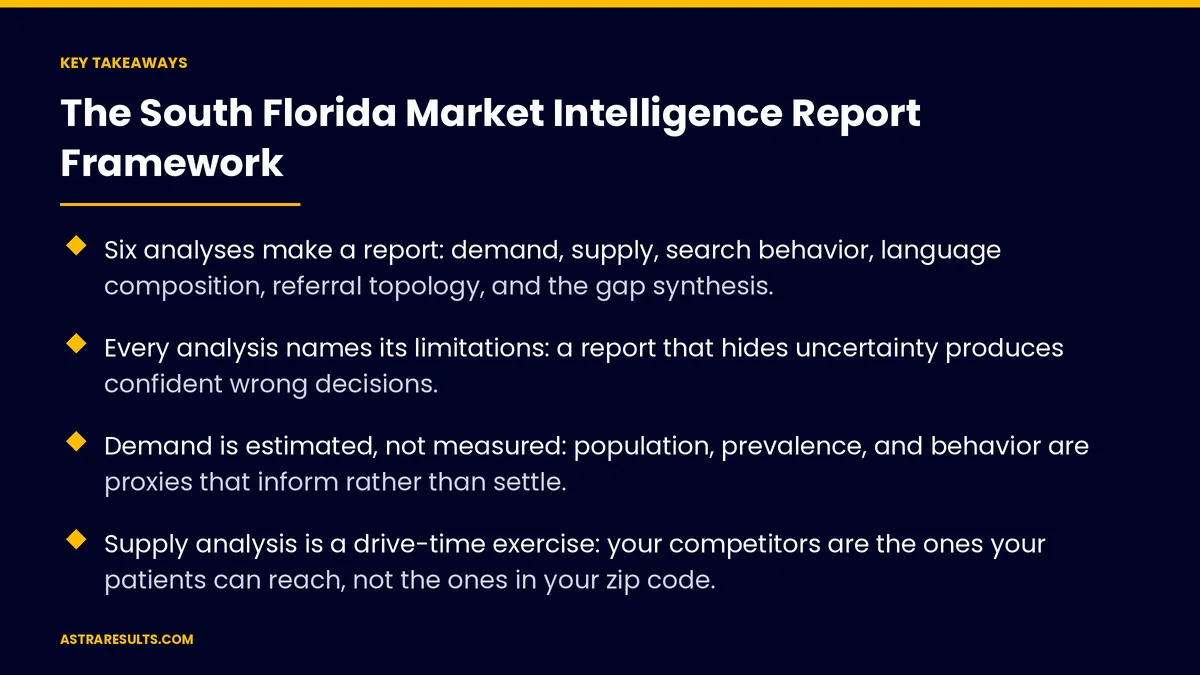
- Six analyses make a report: demand, supply, search behavior, language composition, referral topology, and the gap synthesis.
- Every analysis names its limitations: a report that hides uncertainty produces confident wrong decisions.
- Demand is estimated, not measured: population, prevalence, and behavior are proxies that inform rather than settle.
- Supply analysis is a drive-time exercise: your competitors are the ones your patients can reach, not the ones in your zip code.
- Language composition is a strategic variable here, not a demographic footnote.
- The output is a plan: three decisions the report is built to answer, not a slide deck.
Published: October 23, 2026 | Reading Time: ~13 minutes | Category: Strategy · South Florida
That understanding answers five questions:
- How much demand exists in the catchment
- How it is distributed by corridor and language
- How much competing supply sits inside a realistic drive time
- What prospective patients and clients search for
- Where the real gaps are
That gap between planning and knowing is why so many practices spend a year discovering something a week of analysis would have told them.
This piece is the framework Astra uses to close it: six analyses that together constitute a market intelligence report, each buildable from data a practice can access, each supporting specific decisions, and each designed to produce a plan rather than a document.
It is deliberately methodological: a report structure and the reasoning behind it, not a set of numbers, because the numbers change and the method doesn't. The kicker states the purpose: know the market you're in.
A note on rigor. Every analysis below depends on sources with limitations, and a report that hides those limitations is worse than no report. So each section names what its data can and cannot support. Where the framework touches patient or client information, the privacy discipline
Astra holds applies: internal data stays internal, counsel reviews anything leaving the practice, and no analysis requires transmitting sensitive information anywhere.
In This Playbook
- Why the Report Exists
- Analysis One: Demand Estimation
- Analysis Two: Supply and Competitive Density
- Analysis Three: Search and Question Behavior
- Analysis Four: Language Composition
- Analysis Five: Referral Topology
- Analysis Six: The Gap Synthesis
- What This Framework Refuses to Do
- Turning the Report Into a Plan
Why the Report Exists
The decisions it's built to answer. A report that doesn't change a decision is a document, so the framework starts from the three questions practices face: where to concentrate (which corridors, which service lines, which languages), what to build (which content, which access improvements, which capabilities), and how much to spend where.
Every analysis below exists because it informs one of those three.
What does a South Florida market intelligence report replace?
Planning from last year's spend, competitor mimicry, and vendor recommendation, a process that systematically funds whatever was funded before and reproduces the failure patterns Astra documents.
The cadence
Built once properly, refreshed annually, with the search and supply sections reviewed more often because they move faster.
The clear scope
This is market analysis, not forecasting. It tells a practice what the terrain looks like, not what next quarter will produce.
Analysis One: Demand Estimation
The foundation, with its limits stated first.
The method. Combine public population data for the practice's realistic catchment with published prevalence or use rates for the relevant conditions or services, then adjust for the demographic composition that matters: age structure for cardiology and endocrinology, family composition for pediatric and household practices, income and wealth distribution for elective and advisory services, business density for commercial legal and insurance work.
What it supports. Relative comparisons between corridors and rough order-of-magnitude sizing, enough to know whether a market can support a service line, and where the concentration sits.
What it cannot support. Precise revenue projection, because prevalence estimates carry wide error bars, use varies enormously by access and insurance. Elective demand responds to factors no population model captures.
The regional adjustments this market requires. The seasonal population swing, which materially changes demand for months at a time. The international and medical-tourism inflow that population data misses entirely; and the corridor-level income and household variation that makes a metro-wide average nearly useless.
The plain presentation. Ranges, not points, with the assumptions written down.
Analysis Two: Supply and Competitive Density
The analysis practices most often get wrong.
The drive-time principle. Competitors are the providers your prospective patients can realistically reach, which in a sprawl metro means the analysis is built on drive-time or transit-time bands rather than zip codes or municipal boundaries, the geo-honesty logic Astra applies to service-area claims, turned inward for analysis.
The method. Enumerate providers within the bands, classify them by what they do (service lines, sub-specialties, languages served, insurance participation), and note capacity signals where visible: published availability, appointment lead times, whether they're accepting new patients.
What it supports. Identifying underserved corridors, spotting service-line and language gaps, and calibrating whether a market is saturated on volume but thin on a specific capability.
What it cannot support. Inference about competitors' revenue, patient volume, or marketing effectiveness from their web presence, which practices routinely over-read.
The capability-versus-count distinction. Forty competitors none of whom serve a language, a sub-specialty, or an access need is not a saturated market. It's a specific opening, which is the finding this analysis exists to surface.
Analysis Three: Search and Question Behavior
What the market is asking.
The method. Build the question inventory (the concerns, symptoms, decisions, and cost questions prospective patients and clients express) from keyword data, the practice's own site-search and intake logs, the questions staff field on the phone, and the answers AI assistants currently give to the market's core questions.
What each source contributes.
- Keyword tools give relative scale with known blind spots (they undercount long-tail and conversational phrasing)
- Intake and call logs give real language, which is more valuable than volume
- The assistant check reveals what the market currently learns when it asks, which determines whether the practice's content is even in the conversation, per the answer-layer standard
What it supports. Content prioritization, the one-intent architecture of what to build, and the tone decisions that follow from hearing how people describe their situations.
What it cannot support. Volume-based revenue forecasting, since intent quality varies enormously across superficially similar phrasings, the wrong-patient targeting failure Astra documents.
The AI-era addition. Run the market's ten most important questions through assistants and record what comes back, because that answer set is increasingly the competitive landscape and almost nobody audits it.
Analysis Four: Language Composition
In this region, a strategic variable rather than a demographic note.
The method. Language-spoken-at-home data for the catchment at the smallest available geography, cross-referenced with the practice's own panel composition: which frequently differs sharply from the surrounding population, and that difference is itself the finding, since an English-only chain filters the market before the practice ever sees it.
What it supports. The build-order decision Astra formalized as panel-true prioritization (which language to build completely first, which to serve through interpretation, and what the two-tier architecture should look like) plus the per-language economics the P&L discipline requires.
What it cannot support. Assumptions about preference from ancestry data, since language-at-home and language-of-clinical-preference are different questions, and the second is what matters.
The regional specifics. This market's Spanish is regionally varied rather than monolithic, Haitian Kreyòl and Portuguese are substantial. Corridor-level variation is large enough that a metro-level number will mislead.
The gap this analysis most often finds. A corridor where a large in-language population meets almost no in-language provider capability. The clearest opening this framework produces.
Analysis Five: Referral Topology
The channel map, per the referral-systems playbook.
The method. Map the professional ecosystem that touches the practice's patients or clients before it does (the referring specialties, the adjacent professions, the institutions) then overlay the practice's existing named ledger to see which relationships exist, which are dormant, and which categories are entirely absent.
What it supports. Relationship-development priorities, concentration-risk assessment, and the specific finding that most practices haven't made, which referral categories are missing rather than which people.
What it cannot support. Estimating a relationship's potential volume before it exists. That makes this a prioritization tool rather than a forecast.
The reciprocity read. Mapping where the practice can refer out, since routing out builds routing in and the map makes those opportunities visible.
Analysis Six: The Gap Synthesis
Where the report becomes a plan.
The method. Lay the five analyses over each other and look for coincidences: demand concentration meeting supply thinness, a high-volume question set meeting no local content, a language population meeting no capability, a referral category meeting no relationship. A gap that appears in only one analysis is a hypothesis. A gap that appears in three is a strategy.
The prioritization filter. Each candidate gap tested against the practice's actual capability (can we serve this?), the staff-it gate where language is involved, capacity reality (can we absorb the volume?), and economics on the ledger standard.
The output format. Three decisions with owners and dates (where to concentrate, what to build, how much to spend where) plus the explicit list of what the report doesn't answer, which prevents the false confidence that makes reports dangerous.
The falsifiability discipline. Each decision paired with the metric that will show whether the reading was right, read at a stated interval. So next year's report starts from evidence rather than from the same assumptions.
What This Framework Refuses to Do
The boundaries that keep it candid.
No competitor-revenue estimates. Web presence, ad spend appearance, and office size do not support financial inference. Practices that build plans on guessed competitor numbers plan on fiction.
No demand forecasts presented as projections. Ranges with assumptions, always.
No proprietary-data theater. Analysis built from sources a practice can verify, rather than from a black box, because a report a practice can't interrogate is a sales instrument.
No patient data leaving the practice. Internal panel analysis stays internal per the privacy standard, with counsel reviewing anything that moves.
No conclusions the data can't carry. Every finding labeled by strength (measured, estimated, or inferred) because the strength of a finding determines how much of a budget it should move.
Turning the Report Into a Plan
The last mile most reports never travel.
The three-decision discipline. A market intelligence report that produces more than three priorities produces none, because a practice with limited capacity executing seven initiatives executes zero. The sequencing rule
Astra holds everywhere: capture before attention, if the report reveals an access or intake gap, that gets fixed before any demand-capture investment, because demand routed into a broken funnel is wasted twice.
The measurement pairing. Each decision instrumented on the one-page report before execution begins, since a decision without a metric can't be evaluated and will be defended on instinct next year.
The refresh loop. The search and supply analyses reviewed at mid-year, the full report rebuilt annually with the prior year's decisions scored plainly, including the ones that didn't work, which are the most informative entries in the whole document.
How Astra Builds Market Intelligence
Astra Results Marketing builds market intelligence as a decision instrument rather than a deliverable.
Demand estimated with ranges and stated assumptions, supply mapped by drive time and capability rather than count, question behavior gathered from real language and the current answer layer, language composition treated as the strategic variable it is in this region, referral topology mapped against the named ledger, and the gap synthesis reduced to three decisions with owners, dates, and metrics.
Engagements begin with a market intelligence build through our business consulting team.
Related reading
Frequently asked questions
How is this different from a competitor analysis?
Competitor analysis asks what others are doing. Market intelligence asks what the market contains. The difference matters because mimicking competitors reproduces their positioning, including their blind spots, while mapping demand, supply capability, question behavior, language composition, and referral topology surfaces the openings nobody is serving. The most valuable finding this framework produces is usually a gap every competitor shares.
Can you tell us how much revenue a new service line would generate?
No, and any report that claims to is selling confidence rather than analysis. Demand estimation supports relative comparison and order-of-magnitude sizing, enough to know whether a market can support a service line and where concentration sits. But prevalence estimates carry wide error bars and use varies by access, insurance, and behavior no population model captures. Ranges with written assumptions, always.
Why analyze competitors by drive time instead of by area?
Because your competitors are the providers your prospective patients can reach, which in a sprawl metro has little to do with zip codes or municipal lines. Drive-time bands also surface the finding that matters most. Forty competitors none of whom serve a language, sub-specialty, or access need isn't saturation. It's a specific opening, and count-based analysis hides exactly that distinction.
What's the AI-era addition to search analysis?
Running the market's ten most important questions through AI assistants and recording what comes back. That answer set is increasingly the competitive landscape for high-consideration decisions, it determines whether a practice appears in the conversation at all, and almost nobody audits it. Pair it with keyword data for scale and your own intake logs for real language, since how people describe their situations drives tone decisions more than volume does.
How many priorities should the report produce?
Three. A report producing seven priorities produces none, because a practice with finite capacity executing seven initiatives executes zero. The sequencing rule applies: if the report reveals an access or intake gap, fix that before investing in demand capture, since demand routed into a broken funnel is wasted twice. Attach an owner, a date, and a metric to each of the three before execution starts.
How often should this be rebuilt?
Annually in full, with search behavior and supply reviewed at mid-year since they move fastest. Each rebuild should score last year's three decisions plainly, including the ones that didn't work. Those entries are the most informative in the document, because they're the only ones that tell you something about your own reasoning rather than about the market.
Ready to Plan From What the Market Actually Contains? Astra Results Marketing builds market intelligence as a decision instrument. Demand, supply capability, question behavior, language composition, referral topology, and a gap synthesis reduced to three decisions with owners and metrics. Start with a market intelligence build for your practice. ▸ CALL (786) 321-2866 · ▸ REQUEST YOUR CONSULTATION