 Rated 5 star on

AI Task Manager vs Virtual Assistant
Quick answer
Pick an AI task manager to route and track work, and a virtual assistant for tasks needing judgment. Software wins on speed, consistency and tracking at any hour. People win on calls, relationships and unusual situations. Both need clear access rules and an owner. Many teams combine them, with software sending people-only tasks to the assistant.
When work slips through the cracks, owners usually consider two fixes: software that tracks and routes tasks, or a virtual assistant who handles them. They solve different problems. An AI task manager makes sure work starts, moves and gets finished. A virtual assistant is a person who handles tasks needing judgment. Many use both.
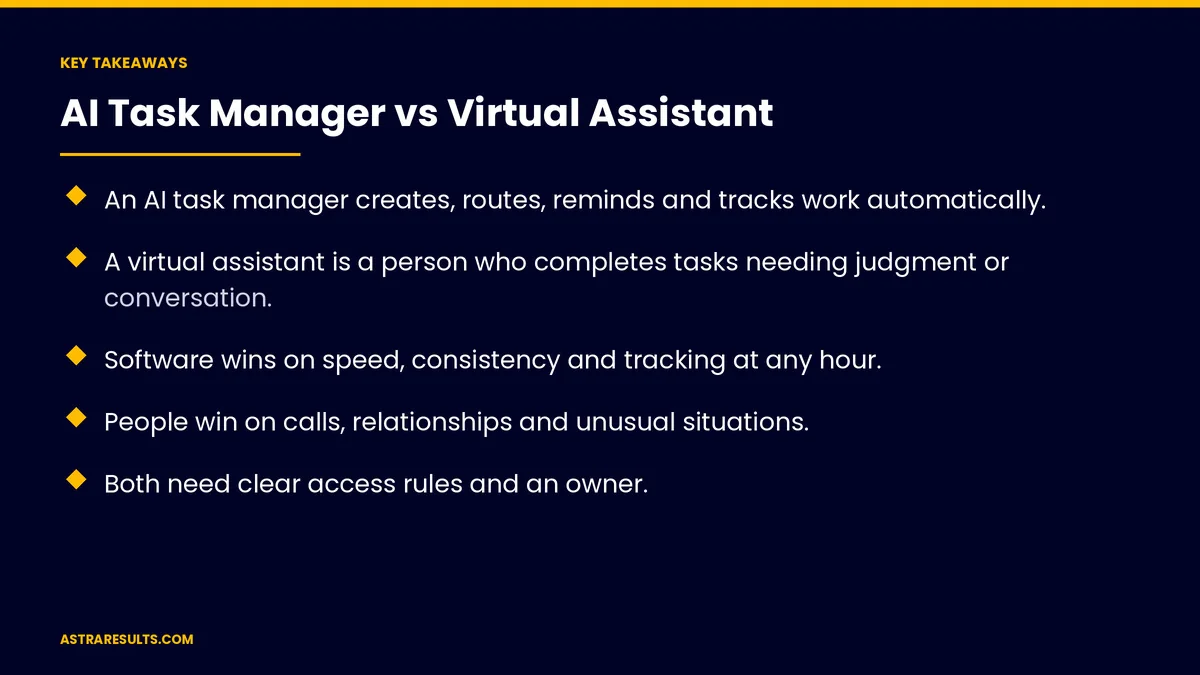
Key Takeaways
- An AI task manager creates, routes, reminds and tracks work automatically.
- A virtual assistant is a person who completes tasks needing judgment or conversation.
- Software wins on speed, consistency and tracking at any hour.
- People win on calls, relationships and unusual situations.
- Both need clear access rules and an owner.
- Many teams use both: software routes work, the assistant handles what needs a person.
Published: October 7, 2026 | Reading Time: ~8 minutes | Category: AI Task Manager
This guide covers AI task managers versus virtual assistants: what each is, what each does well, costs, setup, risks, using both together and how to decide. Put plainly: use software to route and track work, use people for judgment and relationships and connect the two.
In This Playbook
- What each is
- What a task manager does well
- What a virtual assistant does well
- Costs
- Setup
- Risks
- Using both together
- How to decide
- What to measure
- The first three months
What each is
AI task manager. Software that creates tasks from events, assigns them, sends reminders and tracks progress, as covered in AI task management.
Virtual assistant. A remote person who handles scheduling, inbox work, data entry, research or calls.
Not a chatbot. "AI assistant" sometimes means chat software; here, it means a person.
What a task manager does well
Starts work automatically. From forms, emails and system events, as covered in task manager triggers.
Never forgets. Reminders and follow-ups on schedule.
Shows what's stuck. As covered in work that never stalls.
Works with your tools. As covered in connecting the task manager.
What a virtual assistant does well
Judgment. Unusual requests and gray areas.
Phone calls. Vendors, customers and scheduling.
Relationships. A familiar voice for clients.
Research and cleanup. Tasks that don't follow a pattern.
Costs
Task manager. A subscription plus setup and upkeep.
Virtual assistant. Hourly or monthly pay, plus training and management time.
Compare the work, not the price. Repeatable routing versus judgment.
Setup
Task manager. Map triggers, owners and rules once.
Virtual assistant. Train on your processes, tools and tone.
Both need documented processes. Software and people follow the same map.
Risks
Task manager. Misrouted or stalled work if rules or connections break, as covered in automation failures.
Virtual assistant. Turnover, availability and access to sensitive systems.
Access for both. Least access and clear permissions, as covered in task manager security.
Using both together
Software routes, people handle. Tasks needing a person go to the assistant automatically.
Exceptions to people. Anything unusual lands with the assistant.
Shared visibility. Owners see all work in one place.
Nearshore teams are weighed in nearshore automation teams.
How to decide
Mostly handoffs and reminders? Start with a task manager.
Mostly calls and judgment? Start with a virtual assistant.
Both? A task manager first, so the assistant's work is organized from day one.
For work AI can do itself, see AI agents.
Versus project tools. As weighed in AI task manager vs project tools.
What to measure
Tasks completed on time. Before and after.
Work stuck waiting. Count and age.
Owner hours saved. Each week.
Exceptions handled. By people.
Cost per completed task. For each approach.
The first three months
Month one: map the work
List recurring work, mark which tasks need judgment or calls and which are handoffs and reminders.
Month two: set up
Set up the task manager for handoffs and reminders, and define what goes to a person.
Month three: measure
Track on-time completion, stuck work and hours saved, and adjust what software and people handle.
How Astra helps teams choose
Astra Results Marketing sets up AI task management that routes and tracks work, and connects it with the people who handle judgment and relationships. We map your work, decide what goes where and measure the results.
Engagements begin with a workflow review through our AI task manager team.
Related reading
Frequently asked questions
What's the difference between an AI task manager and a virtual assistant?
A task manager is software that routes and tracks work; a virtual assistant is a person who completes tasks that need judgment or conversation.
Which is cheaper?
It depends on the work. Compare repeatable routing with tasks that need a person, including setup and management time.
Can a task manager replace a virtual assistant?
For handoffs, reminders and tracking, often yes. For calls, relationships and unusual situations, people are still needed.
Can they work together?
Yes. Software routes tasks needing a person to the assistant and tracks everything in one place.
What are the risks of each?
Broken rules or connections for software; turnover and system access for people. Both need clear permissions.
What should we measure?
On-time completion, stuck work, hours saved, exceptions handled and cost per completed task.
Not sure whether you need software, a person or both? Astra Results Marketing maps your work, sets up AI task management for routing and tracking and connects it with the people who handle the rest. ▸ CALL (786) 321-2866 · ▸ REQUEST YOUR CONSULTATION





