 Rated 5 star on

Making the Business Case for One Codebase
Quick answer
One codebase usually saves money because most features are built once for iPhone and Android, often by one team. Some device features still need native code. Compare five-year costs, not just the first build. Forms, booking, shopping and internal tools suit one codebase. Heavy graphics and AR may favor native apps.
Most businesses need their app on both iPhone and Android. Building two separate native apps means two codebases, often two teams and every feature built twice. A cross-platform app uses one codebase for both. For many business apps, that saves money every year the app exists, but it comes with trade-offs worth weighing before you commit.
Key Takeaways
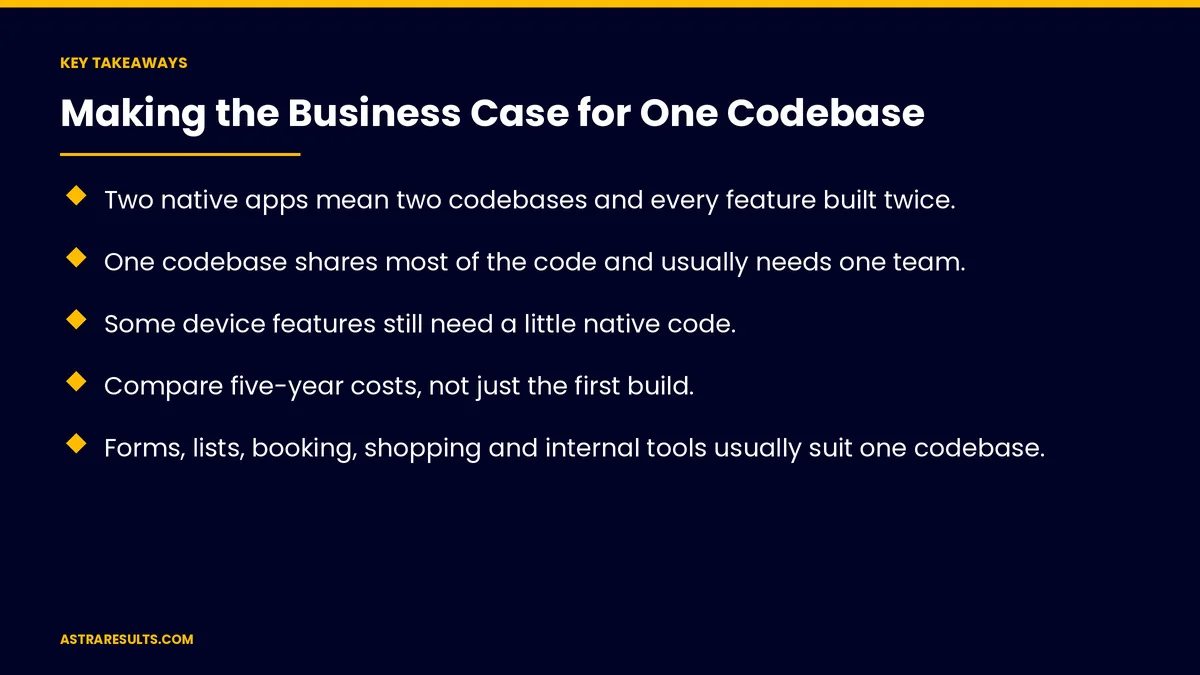
- Two native apps mean two codebases and every feature built twice.
- One codebase shares most of the code and usually needs one team.
- Some device features still need a little native code.
- Compare five-year costs, not just the first build.
- Forms, lists, booking, shopping and internal tools usually suit one codebase.
- Heavy graphics, AR and deep device features may favor native apps.
Published: October 13, 2026 | Reading Time: ~8 minutes | Category: Cross-Platform Apps
This guide covers the business case for one codebase: the cost of two native apps, what one codebase saves, the trade-offs, five-year costs, a worked example, when one codebase fits, when native fits better, hiring and a decision checklist. Put plainly: one codebase usually wins for business apps, unless the app depends on heavy graphics or deep device features.
In This Playbook
- The cost of two native apps
- What does a single codebase actually save?
- The trade-offs
- Five-year costs
- A worked example
- Which apps are a good fit for one codebase?
- When native fits better
- Hiring
- A decision checklist
- What to measure
- The first three months
The cost of two native apps
Two codebases. iPhone and Android built separately.
Two skill sets. Often two teams or two specialists.
Every feature twice. Building, testing and fixing.
Coordinated releases. Keeping both apps in step.
What does a single codebase actually save?
Shared code. Most of the app is written once.
One team. Fewer handoffs and simpler planning.
Faster features. New work reaches both stores together.
Consistent experience. The same features on both platforms.
The basics are covered in cross-platform apps and React Native: one team, two app stores.
The trade-offs
Some native code. For specific device features.
Performance work. On heavy screens, as mapped in performance where it matters.
Platform feel. Matching each platform's conventions takes care.
Framework dependence. Updates to the framework need attention.
Five-year costs
Build. The first version.
Maintenance. Yearly iOS and Android updates, as covered in iOS and Android updates.
New features. Built once instead of twice.
The full picture is covered in what custom software costs over five years.
A worked example
This example uses assumed numbers. Replace them with yours.
Two native apps. If each feature takes 10 days per platform, a 20-feature year means about 400 days of work.
One codebase. If the shared version takes about 13 days per feature, the same year is about 260 days.
The gap. Around 140 days a year, before maintenance savings.
Which apps are a good fit for one codebase?
Most business apps. Forms, lists, booking, shopping and account tools.
Internal and workforce apps. As in staffing apps on mixed devices.
Tight budgets and timelines. One team moves faster.
Apple devices only. One app for iPhone and iPad, as covered in iPad + iPhone.
When native fits better
Heavy graphics and AR. Demanding visual features.
Deep device features. Advanced camera, health or watch apps.
Platform-first products. Where matching Apple's latest features matters most, as weighed in making the business case for native iOS and SwiftUI vs UIKit.
Hiring
One skill set. Easier to staff and replace.
Native knowledge still helps. For the parts that need it.
Strategy matters. As covered in React Native cross-platform strategy.
A decision checklist
Does the app depend on heavy graphics, AR or deep device features?
How many features will you add each year?
Can you staff two native teams long term?
How fast must both platforms get new features?
What do the five-year numbers show? As in the business case for an app, in numbers.
What to measure
Days per feature. Across both platforms.
Release speed. Time from idea to both stores.
Crash-free users. On each platform.
Maintenance cost. Per year.
Feature parity. Same features on both platforms.
The first three months
Days 1–30: list and estimate
List planned features for the next year, mark any that need heavy graphics or deep device access and estimate five-year costs both ways.
Days 31–60: decide and prototype
Choose one codebase or native, and build a small prototype of the hardest screen to confirm the choice.
Days 61–90: build and measure
Build the first release, track days per feature and crash-free users and review the decision against real numbers.
How Astra builds the case for one codebase
Astra Results Marketing helps businesses decide between one codebase and two native apps. We estimate five-year costs, test the hardest screens early and build cross-platform apps where they fit, with native code only where it's needed.
Engagements begin with an app planning review through our cross-platform app development team.
Related reading
Frequently asked questions
What is one codebase?
A cross-platform approach where one set of code runs the app on both iPhone and Android.
Does one codebase really save money?
Usually, because most features are built once. Compare five-year costs, including maintenance and new features.
What are the downsides?
Some device features need native code, heavy screens need performance work and each platform's feel needs care.
When should we choose native apps instead?
When the app depends on heavy graphics, AR or deep device features, or when matching Apple's or Google's latest features matters most.
How do we decide?
List next year's features, mark the demanding ones, estimate five-year costs both ways and prototype the hardest screen.
Is it easier to hire for one codebase?
Usually, since one skill set covers both platforms, though native knowledge still helps for some parts.
Ready to know whether one codebase pays off for you? Astra Results Marketing estimates five-year costs both ways, prototypes the hardest screens and builds cross-platform apps where they fit, with native code only where needed. ▸ CALL (786) 321-2866 · ▸ REQUEST YOUR CONSULTATION





