Rated 5 star on


Miami Endocrinology & Diabetes Clinic Marketing
Quick answer
A Miami endocrinology or diabetes clinic should market without blame or hype. Pages describe diabetes and weight as medical conditions, not failings. Weight-loss drugs get clinical framing, clear candidacy and real monitoring. The practice publishes real wait times and writes for families. Astra measures follow-through and retention, never results as claims.
Endocrinology sits between two forces that both push patients the wrong way. One is a culture of blame: diabetes and weight are treated as personal failings, so patients arrive ashamed and expecting a lecture. The other is a market of miracle claims. A specialist practice wins in the space between them.
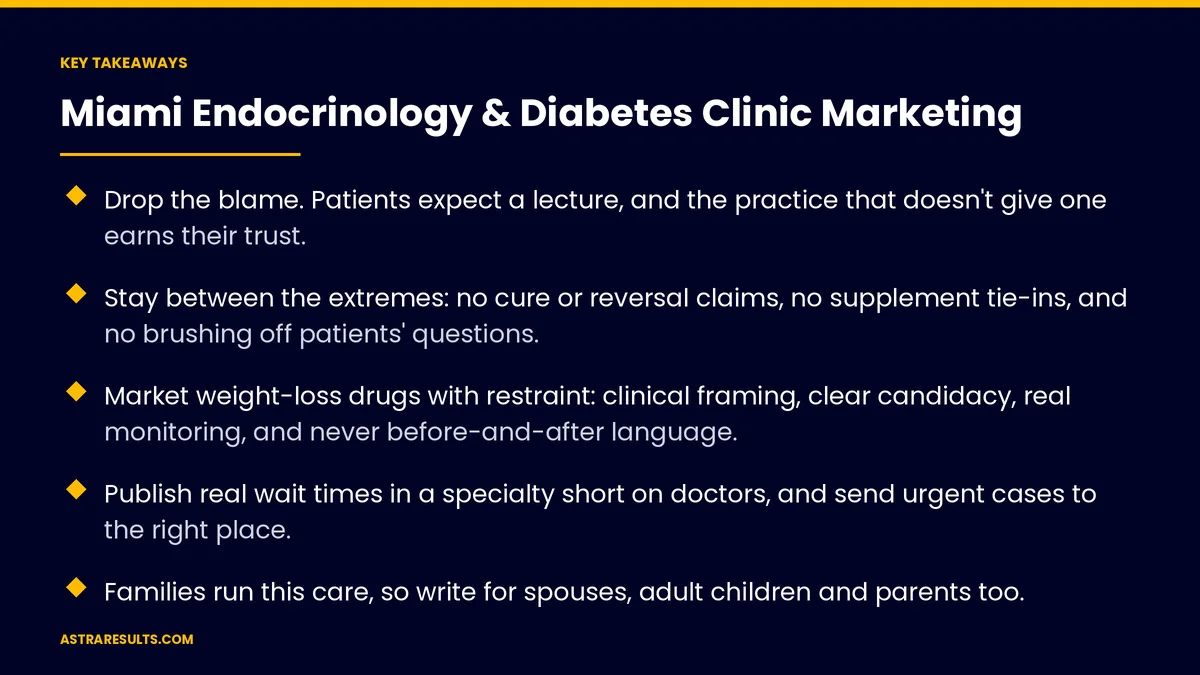
Key Takeaways
- Drop the blame. Patients expect a lecture, and the practice that doesn't give one earns their trust.
- Stay between the extremes: no cure or reversal claims, no supplement tie-ins, and no brushing off patients' questions.
- Market weight-loss drugs with restraint: clinical framing, clear candidacy, real monitoring, and never before-and-after language.
- Publish real wait times in a specialty short on doctors, and send urgent cases to the right place.
- Families run this care, so write for spouses, adult children and parents too.
- Measure follow-through and retention, and never turn clinical results into marketing claims.
Published: October 17, 2026 | Reading Time: ~10 minutes | Category: Medical · Endocrinology
The miracle market is loud. It runs on supplement claims, reversal promises and strict elimination diets. More and more, it includes clinics selling weight-loss drugs with language no doctor would write in a chart. The answer is simple to state and hard to do: the medicine, without judgment and without hype. In short: no blame, no miracles.
Two facts about this market shape everything below.
Access is the limit. There are not enough endocrinologists, and waits are long across the country. A practice that posts its real wait serves patients better than one that implies it can see them tomorrow.
Long-term care is the business. Thyroid disease, diabetes and most hormone conditions are managed for years or decades. So the value is in keeping patients well cared for over time, not in signing up new ones.
This guide is for licensed practices and is not medical advice. Diagnosis, medication choices, lab results and every clinical statement belong to your physicians and must follow current guidelines. Marketing that mentions medication has its own legal sensitivities, so have counsel review it. Every asset goes through compliance review before it is published.
In This Playbook
- The No-Blame Tone
- Plain Evidence Between Two Extremes
- Metabolic Medication, Handled With Restraint
- Access in a Specialty Short on Doctors
- Families, Caregivers, and Long-Term Care
- Referrals and Sub-Specialty Pages
- Which marketing channels work for a Miami endocrinology clinic?
- Measurement
- A 90-Day Build
The No-Blame Tone
This is the skill that unlocks the specialty.
What patients bring in. Many have been told their condition is their fault. They feel guilty about food and weight. They play down symptoms to avoid a lecture. Some have avoided care for years because every visit felt like a judgment.
What the tone does. It describes these as medical conditions with genetic, physical and environmental causes. It says plainly that the practice manages the condition and does not judge the person. It frames the first visit as an evaluation, not a reckoning.
What is off limits. Willpower language, "finally take control" lines, words that make food a moral issue, weight-shaming images, and any before-and-after that hints at a change in character. This is the same no-shame approach Astra uses in gastroenterology, applied where blame is strongest.
Why it matters for care. A patient who expects to be judged holds things back: what they eat, whether they take their medication, how they feel. So the tone is not only kindness. A patient who feels scolded stops telling the truth, and care gets worse from there.
Weight and body composition. This content sits close to eating-disorder territory. It needs a physician to oversee it and avoids numbers where it can. It never borrows the before-and-after style the rest of the market uses freely.
Plain Evidence Between Two Extremes
This is how a specialist stands apart.
Against the miracle market. No reversal claims. No cure language. No tie-ins with supplements or branded protocols. No hint that a program works the same for everyone. Some conditions improve a great deal, and others need care for life. Telling those apart is exactly what a specialist does and a marketer cannot.
Against brushing patients off. Patients bring questions from that market: glucose monitors bought online, elimination diets, thyroid claims, supplement routines. The practice that takes those questions seriously keeps the patient an eye-roll would lose. Astra follows the same rule in men's health marketing: engage, don't dismiss.
Say both things. Say where standard care helps. Say where the market's claims go beyond the evidence. Astra's dermatology guide uses the same two-way approach. To patients who have been sold to for years, it reads as credibility.
The technology, explained plainly. Continuous glucose monitors and insulin pumps changed diabetes care. Content that explains what each tool does, who it helps, what it asks of the patient and what it costs is a service. Selling them as a lifestyle upgrade is not.
Metabolic Medication, Handled With Restraint
This is the most hyped corner of the field, and it will shape practice reputations for years.
How to frame it. The newer weight-loss and metabolic drugs are real clinical tools. Whether a patient should take one, at what dose, with what monitoring and for how long are decisions for the physician.
Describe the drugs in general terms. Be clear about who is and isn't a candidate. Say that follow-up is part of safe care, and that these drugs are not handed out on request.
What stays out of the marketing. Transformation images, pounds-lost claims, before-and-after results, urgency or "limited supply" ads, and anything that presents the practice as a faster way to get a prescription.
Where a specialist wins. Storefront clinics and telehealth apps compete on speed and price. A specialist competes on a full evaluation: what else might explain the symptoms, which conditions come with them, what monitoring safe treatment needs, and what happens after the medication phase.
Cost and coverage. Insurance coverage for these drugs is complicated and keeps changing. Explain the general picture plainly and send patients to their own plan for specifics. That heads off the most common disappointment in the category.
Compounded versions and shortages. Patients run into compounded copies and shortage workarounds. A clear statement of what the practice does and does not do builds trust. Ask counsel to help word it.
Access in a Specialty Short on Doctors
This is the day-to-day reality of the field.
The situation. There are too few endocrinologists nationwide, and waits of several months are common. Many patients call a few offices, reach voicemail and give up.
What being clear looks like. Post your current wait for new patients. Say whether you are taking new patients and which conditions you see first. Astra built the same access standard for mental health practices, the other specialty where supply is tight.
Urgent cases. Some symptoms need a prompt evaluation. Content should say so and route those patients the right way, instead of leaving urgency to the scheduling queue. Astra applies the same routing rule in cardiology and across all health content.
Working with primary care. Much endocrine care is shared with the patient's primary care doctor. Publish how that works: what you take on, what you send back, and when you advise without taking over. It helps patients who are waiting, and it builds the referral network covered below.
Telehealth. It works well for follow-ups and for reviewing monitoring data. Be plain about what still needs an in-person visit, and state the limits of your state license.
Families, Caregivers, and Long-Term Care
Families are part of the care team, and long-term care is the business.
Who manages the condition. A spouse who now cooks differently. An adult child who tracks a parent's medications and appointments. A parent running a child's type 1 diabetes care. Write content for them directly. As Astra's cardiology work shows, caregiver content reaches decisions that patient-only content misses.
From pediatric to adult care. Young adults with type 1 diabetes often lose track of care when they leave their pediatric team. Few practices write about this. Practical guidance for the young adult, and for the parent stepping back, fills the gap.
The systems that keep patients in care. Reminders that bring patients back, lab and monitoring follow-up, refill messages, and education built to last rather than to overwhelm. This is clinical work. It is also what keeps patients with the practice.
Language. Diet advice, medication instructions, monitoring targets and symptom reports only work if the patient understands them. That makes native-language care a clinical need, not a marketing extra, as Astra's bilingual medical marketing method sets out.
Food and family sit at the center of this care, and both are cultural. That is why the region's Colombian, Venezuelan and Argentine communities matter here.
Referrals and Sub-Specialty Pages
Where referrals come from. Primary care comes first. Other sources include:
- Cardiology, since heart and metabolic disease overlap a lot
- OB-GYN, for pregnancy-related and reproductive hormone care
- Urology
- Kidney, eye and foot specialists who treat diabetes complications
- Bariatric surgery
- Orthopedics, for bone health
- Oncology, for thyroid nodules and thyroid cancer
What earns referrals. Tell referring doctors your real wait, because they need it to advise their patients. Send prompt, readable notes. Return patients to primary care rather than keeping them. Be clear about what you manage and what you only advise on. Where labs or other services are involved, take no fees for steering patients.
Sub-specialty pages. Give each condition its own single-topic page, written for the person who searches it:
- Thyroid disease and nodules, the biggest search category in this field
- The types of diabetes, explained plainly
- PCOS, a large group of patients who are often blamed and poorly served, where the no-blame tone matters most
- Osteoporosis and bone health
- Adrenal and pituitary conditions
- Where reproductive endocrinology starts and ends
Which marketing channels work for a Miami endocrinology clinic?
Search. Build a library of condition pages, each written under a named physician and held to the standards health content demands. Cover thyroid and nodules, the types of diabetes, PCOS in the no-blame tone, monitoring technology, and cost and coverage.
These pages earn the AI answers patients ask for, such as "what does a thyroid nodule mean," "type 1 versus type 2" or "¿qué significa mi A1C?" Our AI SEO service builds the entity work behind them.
Physician video. A doctor saying plainly that these are medical conditions, not character flaws, delivers the no-blame tone better than anything else. Astra's guide to video for medical and legal practices covers how to produce it.
Paid search. Run it behind a strong negative-keyword list that cuts the category's biggest waste: supplement, detox, reversal-program and diet-product searches, plus people shopping for prescriptions or compounded drugs. Never use transformation or urgency ads.
Reviews. Ask every patient, and never filter who gets asked. Take care with privacy, since many patients won't say publicly that they have these conditions.
Language and community. Spanish runs native throughout. Add Kreyòl and Portuguese where you can staff them properly. Community programs should serve rather than sell: real diabetes education in neighborhoods where diabetes is common.
Measurement
The dashboard follows Astra's case-study framework:
- Visit and monitoring follow-through, the main engagement numbers, since long-term care is the business
- Years retained, by patient group
- Time to first appointment against the wait you publish, with urgent cases tracked on their own
- The referral ledger by referring doctor, including how fast notes go back
- How caregiver content is used, and how many visits families start
- Medication consults alongside the share of patients told no, the sign of a responsible practice in a category built on saying yes
- A regular tone check, looking for blame language, transformation creep and any claim that goes beyond the evidence
- Follow-through by language
- Cost per retained patient, on the same cost-per-case ledger Astra uses for law firms
Clinical results are tracked inside the practice for care quality and never turned into marketing claims.
A 90-Day Build
Days 1–30: Tone and rules
Write down the no-blame tone, with a list of banned words: willpower, control, moral food language, transformation framing. Write the medication content rules with physician sign-off and counsel review. Publish real wait times and set up routing for urgent cases. Set up tracking for follow-through, retention and the tone check.
Days 31–60: The library goes live
Publish the thyroid, diabetes-type, PCOS and bone-health pages under physician bylines, in English and native Spanish. Launch the technology and cost-and-coverage pages. Publish the caregiver and pediatric-to-adult content. Start physician video on the medical-condition message, and publish the primary-care page.
Days 61–90: Referrals and first reads
- Reach out to referring doctors with your real wait, and track how fast notes go back
- Start community diabetes education, run as a service
- Rebuild paid search with the supplement and prescription-shopping exclusions checked
- Check AI answers for accuracy in both languages
- Run the first tone check
- Take the first reads on follow-through, retention, referrals and medication consults told no, then plan the next quarter around long-term care
How Astra Builds Endocrinology Practices
Astra Results Marketing builds endocrinology and diabetes marketing in the space between blame and hype. The no-blame tone keeps patients telling the truth. Plain evidence takes patients' questions seriously without endorsing the market they came from. Weight-loss drugs get clinical restraint, wait times are published, and long-term care is treated as the engine it is.
Results are measured on follow-through and retention, never on outcome claims. Engagements begin with a tone, access and referral review through our business consulting team.
Related reading
Frequently asked questions
Why does a no-blame tone matter for care, not just manners?
Because a patient who expects judgment holds back. They underreport food, missed doses, symptoms and side effects, and care built on missing information gets worse. Describe these as medical conditions with physical and genetic causes, frame the visit as an evaluation, and remove willpower language from every page. Patients then tell their doctor the truth. Here, kindness and good care are the same thing.
How do we compete with clinics that push weight-loss drugs?
Compete on a full evaluation, not on speed. Ask what else could explain the symptoms, which conditions come with them, what monitoring safe treatment needs, and what happens after the medication phase. Storefront and telehealth operators sell speed and price; a specialist offers the workup they can't. Keep transformation images, pounds-lost claims and urgency ads out entirely. Track how often you tell a patient they are not a candidate. In a category built on saying yes, that number is your credibility.
Should we engage patients' questions about supplements and diets?
Yes, and seriously. Dismissing them loses the patient, and endorsing them costs you credibility. Say what the evidence supports, what it doesn't, and what is still unknown, including where standard care has real limits. Most patients have been sold to, not taught. The specialist who finally explains the picture plainly becomes the one they trust.
Our wait is four months. What should the website say?
Four months. Publish your real wait, whether you are taking new patients, which conditions you see first, and where urgent cases should go. A patient who calls five offices and gets five voicemails may stop calling, and a referring doctor needs the wait to advise her patient. Promising speed you can't deliver produces complaints that outlast any campaign.
What content should address caregivers rather than patients?
Practical content for the people doing the work. That means spouses changing how a household eats, adult children tracking medications and appointments, and parents of children with type 1. It also means young adults taking over their own care as they leave pediatrics, a stage where care often breaks down. Make sure instructions are readable in the caregiver's language. A plan only gets followed if the person carrying it out can read it.
What should we measure in a chronic-care specialty?
Measure visit follow-through, monitoring follow-up and years retained. Long-term care is the business, so these matter more than new-patient counts. Add time to first appointment against your published wait, the referral ledger with note turnaround, and the share of medication consults told no. Track clinical results inside the practice for care quality, and never turn them into marketing claims.
Ready to Build the Practice Patients Tell the Truth To? Astra Results Marketing builds endocrinology and diabetes marketing on a no-blame tone, plain evidence, restraint on weight-loss drugs and real wait times, measured on follow-through and years retained. Start with a tone, access and referral review for your practice. ▸ CALL (786) 321-2866 · ▸ REQUEST YOUR CONSULTATION